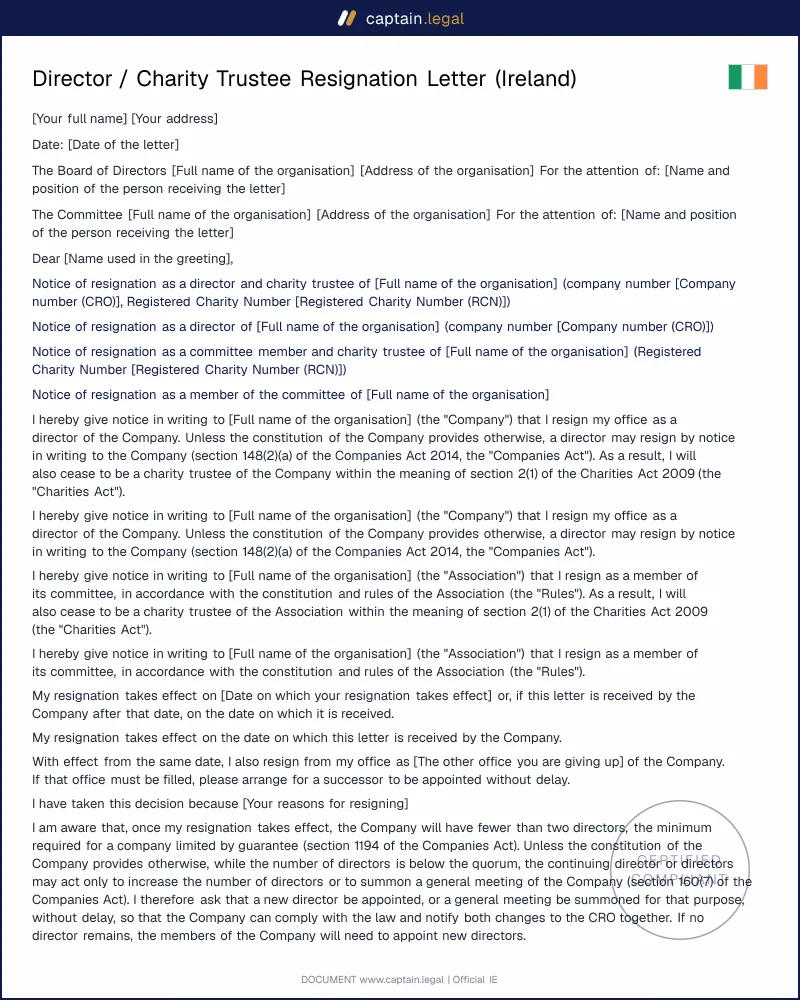
Section 148(2)(a) of the Companies Act 2014 holds the rule: save to the extent that the constitution provides otherwise, the office of director is vacated if the director resigns by notice in writing to the company. The Law Reform Commission's revised text of section 148 of the Companies Act 2014 shows the provision as currently in force. Part 18, which governs CLGs, leaves it unchanged.
Once the director has gone, the company must send the Registrar a notification of the change within 14 days under section 149(8), using Form B10. If it does not, section 152 gives the former director a remedy: serve a notice asking the company to file forthwith and, if it still has not complied within 21 days after service, forward a copy of the resignation notice to the Registrar and to the remaining officers, with the prescribed information. The CRO calls this filing Form B69. Without a dated, signed notice of resignation, that remedy is very hard to use.
A CLG must have at least two directors (section 1194). If the resignation takes the board below its quorum, section 160(7) allows the continuing directors, unless the constitution provides otherwise, to act only to appoint more directors or to call a general meeting. Where the CLG records its directors as senior managing officials in its beneficial ownership register, Regulation 23 of S.I. No. 110 of 2019 requires the change to be delivered to the Register of Beneficial Ownership within 14 days of the date on which the company must update its own register. For a registered charity, the register shows the names of the charity trustees, and section 39 of the Charities Act 2009 requires the charity trustees to inform the Charities Regulator "as soon as may be" when an entry ceases to be correct.