The governing statute is the Paternity Leave and Benefit Act 2016, as amended by the Family Leave and Miscellaneous Provisions Act 2021. Section 6 grants two weeks' leave to a relevant parent, taken as a single period. Only one relevant parent can take it for the same child, and a person who takes adoptive leave cannot also take paternity leave. Section 2(1) defines the relevant parent: for a birth, the father, the spouse, civil partner or cohabitant of the mother, or a parent of a donor-conceived child under section 5 of the Children and Family Relationships Act 2015; for an adoption, the spouse, civil partner or cohabitant of the qualifying adopter. The current wording is in the Law Reform Commission's revised text of the Paternity Leave and Benefit Act 2016.
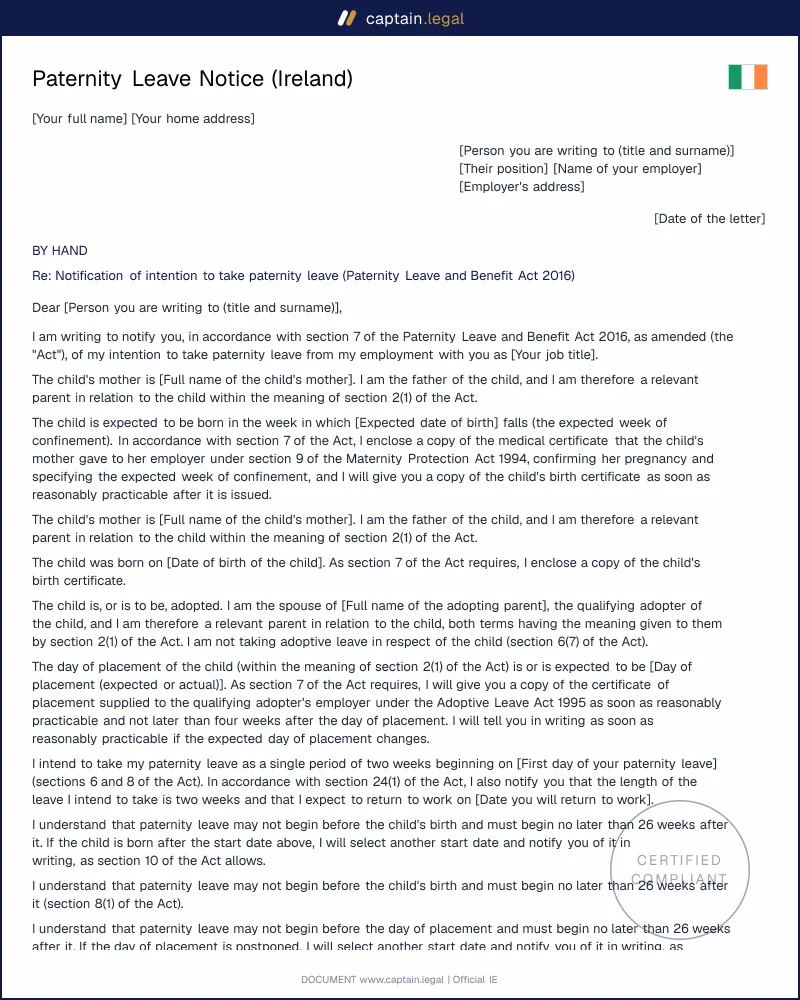
Timing sits in sections 7 and 8. Notice should be given as soon as reasonably practicable and not later than four weeks before the expected week of confinement, or four weeks before the expected day of placement. An employee who misses that point can still notify at least four weeks before the leave begins (section 7(5)), and where a baby arrives four weeks or more early, notice within seven days of the birth counts as compliant (section 9). The leave starts on the day the employee selects, never before the birth or placement and no later than 26 weeks after it. Section 7 also lists the documents: a copy of the certificate the mother gave her own employer, a doctor's statement where she is not an employee, the birth certificate, or the adoption paperwork.
During the leave the employee keeps every employment right except pay, subject to narrow exceptions such as a suspended probation (section 19). A dismissal or suspension during the leave is void (section 20), penalisation is prohibited (section 22) and the employee returns to the same job on the same terms (section 23). Disputes go to an adjudication officer of the Workplace Relations Commission, with an appeal to the Labour Court.