Personal

Will Template Ireland (Succession Act 1965)

Irish will drafted under the Succession Act 1965: executors, a guardian for children under 18, specific gifts, a residuary estate with back-up gift and the legal right share of a spouse or civil partner, with guidance notes for signing before two witnesses.
4.6/5— 25 reviews50 000+ downloadsInstant download
Share

A last will is the document that decides who inherits your home, savings and personal belongings, who looks after your estate, and who cares for your young children if you die. This will template is drafted for people whose permanent home is in Ireland and who want a clear, professionally structured will under the Succession Act 1965 without starting from a blank page. It suits married couples, civil partners, single parents and people without children, and it builds in the legal right share of a spouse, a back-up gift if your chosen beneficiaries die first, and guidance notes on signing correctly at home.

Compliant

2026 Legislation

50,000+ clients

trust us

Affordable

From €4.90 / doc

Secure payment

Instant download

Will Template Ireland (Succession Act 1965)

Secure payment

Fill in the template

What is a will template for Ireland?

A will is a written declaration of how your property is to pass on death, and it only takes effect when you die. In Irish practice the will appoints executors, who collect the assets, pay debts and funeral costs, apply for the grant of probate and distribute what is left. It can also appoint a testamentary guardian for children under 18, make specific gifts of money or items, and then leave the remainder, called the residuary estate, to the people or charities you choose.

The difference between a will template and a solicitor's will is the drafting process, not the legal effect. A properly prepared and signed will made from a template is just as valid as one drafted in an office, provided it meets the formal rules on writing, signature and witnesses. Homemade wills go wrong in predictable ways: a missing residuary clause sends part of the estate into intestacy, and a gift to a witness is simply lost. This will template is one of the personal and family documents for Ireland and covers the standard clauses a practitioner expects to see in a simple estate.

When do you need this document?

The most common trigger is a new family. Couples usually assume everything passes to the survivor anyway, but under the intestacy rules a surviving spouse with children takes two-thirds, not the whole estate, and the share of a child under 18 is held until that child comes of age. A will template that leaves everything to the spouse first, and to the children after that, avoids the split and lets you choose a guardian. Couples who own a home together should also check how the title is held. Property questions of that kind are covered by our Irish property and tenancy templates.

Single people without children need a will just as much. Without one, the estate goes to their parents, then brothers and sisters, and a long-term partner who is not a spouse or civil partner gets nothing automatically.

Edge cases matter too. Separated people who have not divorced remain spouses for succession purposes unless their rights were extinguished, so the legal right share may still apply. People who made a will abroad for a holiday home can keep it in force and use this will template for everything else. Anyone with a farm or a family company should treat this template as a starting point and talk to a solicitor, and keep the company's own papers in order with our company and partnership templates for Irish businesses.

Key clauses included in our template

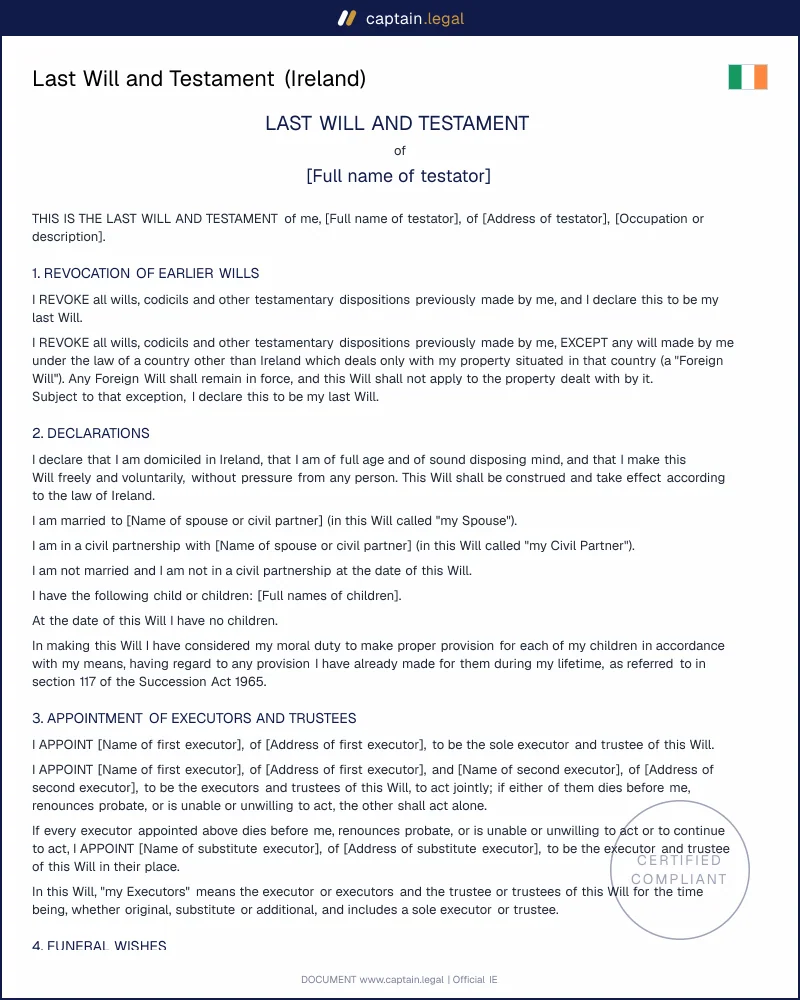
The opening part identifies you by name, address and occupation, revokes earlier wills (or keeps a foreign will for property abroad), declares your marital status and lists your children. A short declaration records that you considered your duty to each child under section 117. You then appoint one or two executors, with an optional substitute. Optional articles cover funeral wishes, a testamentary guardian and specific gifts of money or items, each with a 30-day survivorship condition.

At the core of the document sits the residuary clause. You can leave everything to your spouse or civil partner first, then to your children in equal shares at 18 or 21, with grandchildren taking the share of a child who dies before you. Alternatively, you can name people or charities in shares you set, with their shares growing if one of them dies first. A final back-up gift sends anything left over either to your relatives under the intestacy rules or to people you name, so nothing is left without an owner. If you are married or in a civil partnership, a separate article records the legal right share and the election your spouse or civil partner can make under section 115, as your executors must notify by law. Gifts to charities work best with the registered charity number from the register kept by the Charities Regulator; charities themselves will find their governing documents among our templates for Irish charities and community groups.

Your executors get practical powers in the closing articles, including holding the share of a minor on trust. The attestation clause tracks the wording of section 78, and a separate set of guidance notes on signing and storage is printed on a new page that you remove before signing.

How to fill out this will template

You answer a short questionnaire and the will template on the right updates as you go. The first steps ask for your name, address and occupation, then your marital status. If you are married or in a civil partnership, you give your spouse's or partner's name and decide whether they inherit the residuary estate first. Next you say whether you have children and list them, which is how the template knows whether to show the declaration under section 117.

The following steps deal with your executors (one or two, plus an optional substitute), a guardian for children under 18, and any specific gifts. You then choose who inherits the rest of your estate and at what age your children take their share outright, and you pick a back-up gift. The last questions cover funeral wishes and earlier wills. Use "Next" and "Back" to move between steps, then click "Finish" to generate the Word and PDF files. Print the will, date it, initial each page and sign it in front of both witnesses at the same sitting. Do not staple anything to the signed original. Our Irish legal document library has other documents you may want alongside it.

Common mistakes to avoid

The mistake we see most often is the casual witness. A daughter who stands in as witness for her mother loses her own gift under section 82, even though the rest of the will is valid. The same applies to the husband or wife of a beneficiary, and a solicitor executor who witnesses also loses the right to charge fees. Close behind is the staggered signing, where one witness arrives after the testator has signed and the other has already gone home. Both witnesses must be in the room when you sign or acknowledge your signature.

Handwritten changes after signing cause the next set of problems. Under section 86, a crossing out or an added name has no effect unless you and both witnesses sign beside it, and the Probate Office will query any unexplained alteration, staple mark or missing page. Others leave the residue to a single person with no back-up, or never review the will after marriage, which revokes it automatically, or after separation, which does not. Treat any change in your family as a reason to sign a new will, and keep the original somewhere your executors can find it.

Key takeaways

SA 1965 S.78

Two witnesses, present at the same time

An Irish will is valid only if you sign it at the foot or end, or acknowledge your signature, while both witnesses are in the room together, and each witness then signs in your presence (section 78 of the Succession Act 1965). Under section 82, a gift to a witness or to the spouse or civil partner of a witness is void, although the rest of the will stands. Choose two independent adults who receive nothing.

SA 1965 S.111

Your spouse keeps a legal right share

A will on its own cannot cut out a husband, wife or civil partner. Sections 111 and 111A give the survivor one-half of the estate if there are no children, or one-third if there are, with priority over every gift in the will. The template records this right in its own article, treats any gift to your spouse as given in satisfaction of it, and reminds your executors of the election under section 115.

SA 1965 S.85

Marriage revokes a will, divorce does not

Getting married or registering a civil partnership automatically revokes an earlier will, unless it was made in contemplation of that marriage or civil partnership (section 85(1)). Separation and divorce have no such effect, so a former spouse can still inherit under an old will. Children of any age may also ask the court for provision under section 117, within six months of the first grant. Review your will after every family change.

Frequently Asked Questions

A will made from this template is legally binding once it is signed in line with section 78 of the Succession Act 1965. That means it is in writing, you sign it at the end, both witnesses are present at the same time when you sign or acknowledge your signature, and each witness then signs in your presence. No solicitor, notary or registration is required for validity. What a template cannot do is override the legal right share of a spouse or civil partner, or stop a child applying to court under section 117.

Yes, once you click "Finish", your completed will is generated in Word and PDF. The PDF is ready to print and sign. The Word version is useful if you want to review the wording with your executors or a solicitor before the signing day, although any change should be made before you sign, never on the signed original. Print it on plain paper, single sided, and keep the pages together. The guidance notes come on a separate page so that you can remove them before signing without disturbing the will itself.

The main deadline is six months from the first grant of representation. A child who claims under section 117 must issue proceedings within that period, and the same six months apply to a qualified cohabitant under section 194 of the Civil Partnership and Certain Rights and Obligations of Cohabitants Act 2010, provided the relationship had not ended two years or more before the death. A spouse or civil partner who must choose between the gifts in the will and the legal right share has six months from being notified by the executors, or one year from the grant if later. A challenge to the validity of the will itself, for lack of capacity or undue influence, is not tied to the six-month limit, although delay can still defeat it.

You can write such a will, but it will not achieve that result. A surviving spouse is entitled to the legal right share under section 111, which is one-half of the estate where there are no children and one-third where there are children, and the same applies to a civil partner under section 111A. The right is lost only if it is renounced in writing, before or during the marriage, extinguished by a court order, or forfeited in limited cases such as desertion for two years or more. Our will template records the legal right in its own article so that your executors and your spouse know where they stand.

The safest witness is an independent adult who can see you sign and receives nothing under the will. A beneficiary who witnesses does not invalidate the will, but under section 82 he or she loses the gift. The same goes for the husband, wife or civil partner of a beneficiary. Avoid anyone likely to be hard to trace later, because the Probate Office sometimes asks a witness for an affidavit. If your pension or death benefit comes through work, check your nomination form too, because those benefits usually pass outside the will. Employers can find contracts and policies among our employment documents for Irish employers.

You do not need one for a straightforward estate: a house, savings, a pension and personal belongings passing to family or friends. A solicitor is worth the cost when you own a farm or agricultural land, a business, property outside Ireland, or assets likely to trigger significant Capital Acquisitions Tax. The same applies where a beneficiary has a disability, where you have children from more than one relationship, or where there is any doubt about your mental capacity. In those cases a professionally drafted will can save your family far more than it costs.

4.6/5

25 verified reviews · 50 000+ downloads

Will Template Ireland (Succession Act 1965)
  • Immediate access to the document
  • PDF + Word download
  • Compliant with 2026 legislation
  • Reviewed by lawyers
Fill in the template
Secure payment
Updated on November 3, 2026

You might also like

Cohabitation Agreement (Ireland)
Child Travel Consent Letter (Ireland)