Leave Request

Annual Leave Request Form Ireland (Organisation of Working Time Act 1997)

Request paid annual leave in writing and record the employer's decision: dates, working days, entitlement and balance, carried-over leave, cover, and approval, new dates or refusal, under the Organisation of Working Time Act 1997.
4.6/5— 13 reviews50 000+ downloadsInstant download
Share

An annual leave request is the written record of an employee asking to take paid holidays on specific dates, together with the employer's answer. In Ireland it sits on top of the Organisation of Working Time Act 1997, which sets a statutory entitlement of up to 4 working weeks a year and leaves the final say on timing to the employer. It suits staff who want their holiday request on paper, and managers who need a clean record of the request, the answer and the balance. A single form captures the dates, the working days, the entitlement figures, any carried-over leave and the decision, so nobody reconstructs a holiday dispute from text messages months later.

Compliant

2026 Legislation

50,000+ clients

trust us

Affordable

From €4.90 / doc

Secure payment

Instant download

Annual Leave Request Form Ireland (Organisation of Working Time Act 1997)

Secure payment

Fill in the template

What is an annual leave request form?

Legally, an annual leave request form is an internal workplace document rather than a contract. It does not create the right to holidays, because that right comes from statute and from the employee's contract of employment. What it does is fix the facts: who is asking, for which days, and how the request fits within the year's entitlement. The bottom half then records the employer's decision and who made it, with a date. When a disagreement reaches the Workplace Relations Commission, the first question is usually whether the leave was approved and when, and an email chain is a poor witness.

People often confuse the form with a holiday booking in a rostering app. An app shows blocked-out days, rarely the consultation, the reason for a refusal or the consent to carry days forward. It also differs from statutory notices such as a parent's leave notice, which carry their own notice periods under separate Acts. Annual leave has no employee notice period written into the 1997 Act. The timing is the employer's call, which is why a signed record of the request and the reply is worth keeping.

When do you need this document?

A staff member planning a summer fortnight who wants a written yes before booking flights is the everyday case. A form submitted in March for August dates gives the manager time to plan cover. Retail and hospitality employers use it before Christmas, when several people want the same week; the refusal section then records that the decision concerned timing only and that the employer will consult on alternative dates. New starters are a quieter use. Someone who joins in October accrues leave month by month, so the entitlement line should show the pro rata figure under section 19(1)(b) or (c), not a full 20 days. Charities and clubs that employ staff often use it as their leave register (see our nonprofit governance templates for Irish organisations).

Carry-over is the other trigger. An employee who could not use all their days before 31 March and wants to take them in May needs the consent recorded, since carried-over leave has to be taken within six months of the end of the year it relates to. Long periods of sick leave are the edge case that catches employers out: certified illness lets the leave roll forward for 15 months, and an untidy record makes it hard to show which year's days were used. For other absences, such as parent's leave, carer's leave or sick leave, the Irish leave request and notice templates cover the statutory notices that this form does not replace.

Key clauses included in our template

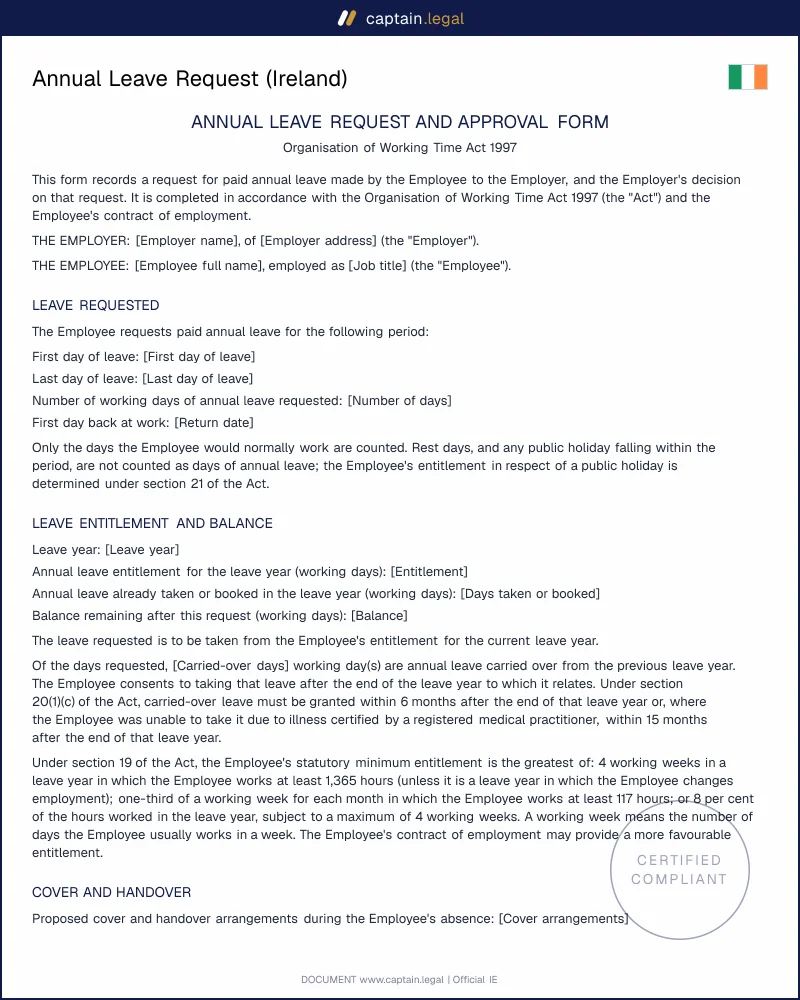
Our template opens by identifying the employer and the employee and defining "the Employer", "the Employee" and "the Act", so the rest of the page reads cleanly. The request section lists the first and last day of leave, the number of working days requested and the first day back. A short paragraph explains that rest days and public holidays in the period are not counted, which heads off the usual arithmetic dispute.

Entitlement comes next: the form records the leave year, the total entitlement, days already taken or booked and the balance remaining after the request. If the employee is using carried-over days, a separate clause states how many, confirms the employee's consent and sets out the six-month and 15-month limits from section 20(1)(c). The three statutory calculation methods from section 19 are restated too, so a part-time employee can check the figure against the law. A cover and handover section follows.

Before signing, the employee confirms a declaration that recites the section 20(1) consultation rule and the section 19(2) rule on illness during leave, with the date of the request. The decision section changes with the answer you select: a blank tick-box block for the employer to complete by hand, an approval, an approval for different dates with the employee's agreement, or a refusal with the reason and a commitment to consult the employee on alternative dates. Closing notes cover pay in advance, the unbroken two-week period under section 19(3), the three-year retention rule and data protection under the Data Protection Acts 1988 to 2018. Contracts and policies for small companies in Ireland sit in the same library.

How to fill out this annual leave request form

You start with the employer's name and address, then the employee's full name and job title. The next screen takes the leave dates, the number of working days and the return date; enter working days only, leaving out rest days and public holidays. The entitlement screen asks for the leave year as your employer runs it and the figures behind the balance. The following screen asks whether any of the days come from last year: answer yes and a field appears for the number of days, while the matching clause appears in the preview.

After the cover arrangements and the date of the request, you choose how the decision section should look. An employee submitting the form leaves it blank, and the document prints a tick-box block for the manager to sign. An employer recording an answer picks approval, approval for other dates or refusal, and the form asks only for what that answer needs, then for the person deciding. Each answer updates the document on the right, and Finish produces the final version. The same wizard runs every one of our Irish legal document templates.

Common mistakes to avoid

Counting calendar days is the error we see most. A two-week holiday for someone on a four-day week uses eight days of leave rather than ten, and a bank holiday Monday inside the period should not come off the balance at all. Next comes a balance figure that deducts carried-over days from the current year, which makes the employee look overdrawn. Refusing leave with no reason and no alternative dates is risky, because the employer still has to grant the entitlement within the leave year.

Silence is another problem. A manager who says nothing until the week before the holiday has missed the one-month consultation point, and a late refusal at that stage is hard to defend. Paying holiday money in the next payroll run, rather than in advance, breaches section 20(2). Some employers also offer cash in place of unused statutory leave. Statutory annual leave cannot be bought out while employment continues; payment in lieu applies only when the employment ends with leave outstanding, under section 23.

Key takeaways

TIMING

Your employer sets the dates, after consulting you

Under section 20(1) of the Organisation of Working Time Act 1997, the employer decides when annual leave is taken, having regard to work requirements. It must weigh the employee's family responsibilities and opportunities for rest, and consult the employee or their trade union no later than one month before the leave starts. A refusal concerns the dates only: the full statutory entitlement must still be granted.

SICK ON LEAVE

Sick on holiday: the day goes back into your balance

A day of annual leave on which the employee is ill is not treated as annual leave, provided the employer receives a certificate from a registered medical practitioner for that illness (section 19(2)). The day returns to the balance and is taken later. The form reminds the employee to report the illness promptly under the employer's sick leave procedure, because a late certificate is where disputes usually start.

CARRY-OVER

Carried-over leave: six months, or 15 if certified ill

Leave is normally granted within the leave year, which starts on 1 April under the Act. With the employee's consent it can be taken in the six months after that year ends, and certified illness extends the window to 15 months. The form records how many carried-over days the request uses and the employee's consent, so the balance for the current year stays accurate and nobody argues later about which days were used.

Frequently Asked Questions

The form records a request and a decision, and both parties sign it, so it is solid evidence of what was agreed. It does not create or remove statutory rights: the entitlement comes from section 19 of the Organisation of Working Time Act 1997 and from the contract of employment, and nothing on the form can reduce the statutory minimum. An approval is hard to walk back. Moving the dates means consulting the employee again under section 20(1)(b), and a WRC adjudication officer will look closely at leave withdrawn at short notice, especially once travel is booked.

Within limits, yes. Section 20(1) lets the employer set the timing of leave based on work requirements, but it must weigh your family responsibilities and your opportunities for rest, and it must consult you no later than one month before the leave starts. A refusal concerns the dates only. Your full statutory leave still has to be granted within the leave year or, with your consent, within six months after it ends. The refusal option on the form records the reason and the employer's commitment to consult you on alternative dates.

Employees face no minimum notice under the 1997 Act. The deadline it does set falls on the employer, which must consult you at least one month before the leave begins, so a request lodged more than a month ahead gives the employer room to comply. Many contracts and staff handbooks add their own notice rule for longer holidays, and that rule binds you if it is in your terms of employment. For summer and Christmas, asking two or three months ahead is common, and the date of request on the form proves when you asked.

Under section 19(2) of the Act, a day of annual leave on which you are ill does not count as annual leave, provided you give your employer a certificate from a registered medical practitioner for that illness. The day goes back into your balance and you take it later. Tell your employer as soon as you reasonably can, because a certificate handed in weeks afterwards invites argument. Pay for those days then follows your contract and statutory sick leave rules, and the sick leave notification and other Irish leave forms help you put the absence in writing.

Once you click Finish, the completed form is available as a Word document and as a PDF. The Word version suits HR teams that add a reference number or adapt the cover section to their own handover checklist; the PDF suits an employee emailing a fixed copy to a manager. Both versions keep the decision block, so a manager can tick and sign a printed copy when the employee leaves it blank. Print the PDF if your employer wants a handwritten signature, and keep a scan with your own records.

They do not. Public holidays are governed by section 21 of the Act, separately from annual leave. If a public holiday falls on a day you would normally work during your holiday, it is not deducted from your annual leave balance; your employer gives you one of the section 21 options instead, usually a paid day off on that day. Leave the public holiday out when you count the working days requested. Rest days work the same way, so a fortnight that includes a bank holiday Monday uses nine days of leave for someone on a five-day week.

4.6/5

13 verified reviews · 50 000+ downloads

Annual Leave Request Form Ireland (Organisation of Working Time Act 1997)
  • Immediate access to the document
  • PDF + Word download
  • Compliant with 2026 legislation
  • Reviewed by lawyers
Fill in the template
Secure payment
Updated on November 3, 2026

You might also like

Remote / Flexible Working Request (Ireland)
Parental Leave Notice (Ireland)