Leave Request

Remote and Flexible Working Request Ireland (Work Life Balance Act 2023)

Employee's signed request for remote working under section 20 of the Work Life Balance and Miscellaneous Provisions Act 2023, or for flexible working as a parent or carer under section 13B of the Parental Leave Act 1998, with a pre-filled draft agreement for the employer to sign on approval.
4.8/5— 16 reviews50 000+ downloadsInstant download
Share

A remote working request is the signed letter an employee in Ireland sends to their employer to ask for permission to do some or all of their work away from the employer's premises. Every employee can make one under the Work Life Balance and Miscellaneous Provisions Act 2023, and parents and carers can use a parallel route to ask for flexible working, such as reduced hours, flexitime or compressed hours. The letter must reach the employer at least eight weeks before the proposed start date and contain the details the Act lists. Our template produces the request and a draft agreement pre-filled with your arrangement, ready for both sides to sign if the answer is yes.

Compliant

2026 Legislation

50,000+ clients

trust us

Affordable

From €4.90 / doc

Secure payment

Instant download

Remote and Flexible Working Request Ireland (Work Life Balance Act 2023)

Secure payment

Fill in the template

What is a remote working request?

Irish law gives employees a right to ask, not a right to work from home. A remote working arrangement under section 16 of the 2023 Act means that work you ordinarily do at the employer's place of business is done somewhere else, with no change to your hours or duties. If you want fewer hours or a different pattern, that is a flexible working request, which is a separate right under Part IIA of the Parental Leave Act 1998 and open only to parents of young children and to carers. The two routes share a structure (written request, eight weeks' notice, four weeks for the reply, signed agreement on approval) but differ in who qualifies. Our template covers both and switches the statutory references to match the route you choose.

Because the Act requires specific content, an email saying "can I work from home on Fridays?" may not trigger the statutory timeline at all. Employees who need other letters for parental or carer's leave will find them among our leave request templates for Irish employees.

When do you need this document?

Most requests come from an office worker with a long commute who wants two or three days a week at home on a permanent basis. A second frequent case is the employee who is moving further away, for example to Wexford or Sligo, and wants to keep a Dublin role with occasional days on site. New starters can apply early; the arrangement starts once six months of service are complete.

Flexible working fits a different profile. A parent whose child finishes school at 2.40 p.m. may need reduced hours or a later start; an employee whose mother has had a stroke may need compressed hours for a year. Both qualify, provided the child is under 12 (16 with a disability or long-term illness) or the person cared for needs significant care for a serious medical reason. Where you qualify for both routes, flexible working offers stronger compensation but requires a fixed end date. Employers dealing with these requests alongside contracts and policies can browse our Irish employment contracts and HR letters.

Key clauses included in our template

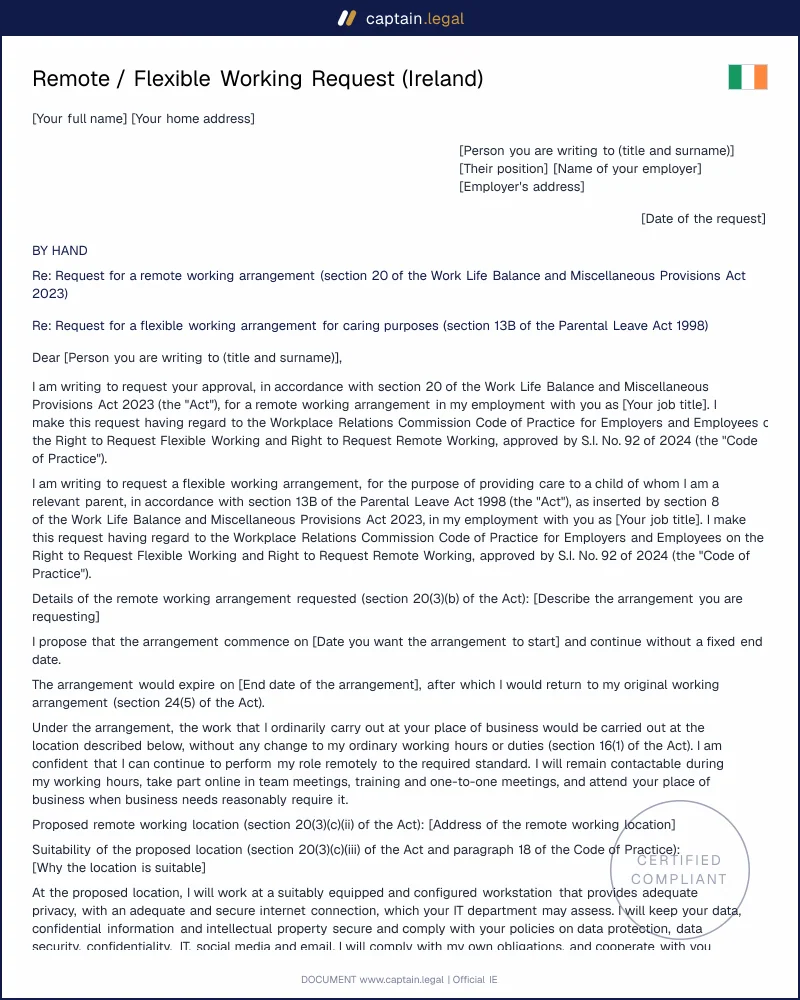
The letter opens with the statutory basis, your job title and the arrangement you want: which days, where, and from when. For remote working, it then sets out the location, why it is suitable and your reasons, which are the three items section 20(3)(c) requires. It adds the commitments the WRC code expects: a properly equipped workstation with privacy, a secure internet connection, compliance with data protection and IT policies, cooperation with a risk assessment under the Safety, Health and Welfare at Work Act 2005, and attendance on site when business needs require it. For flexible working, the letter identifies the child (date of birth and age limit) or the person cared for, the relationship and the care needed, and encloses or offers the medical certificate defined in section 13B(9).

Procedure fills the second part of the letter. It confirms the six months' service rule and the eight-week deadline, recalls the four-week reply period and the possible extension, offers a trial period if you choose one, and asks for an alternative arrangement if the request cannot be approved in full. It also reserves your protection against penalisation.

On a new page, the draft agreement sets out the arrangement, its start date, its end date or open-ended status, and the review or trial clause. It then lists the statutory grounds on which the employer can end it (substantial adverse effect on the business, or failure to use the arrangement as agreed, each with a 7-day window for representations), your right to request an early return, record keeping for three years, and WRC jurisdiction. Signing it gives the employer the written agreement section 21(1)(b)(i) requires; small firms will find their company paperwork among our business templates for Irish companies.

How to fill out this remote working request

You start on Captain.Legal with your name, home address, job title and the date your employment started, which the letter uses for the six-month rule. The next screen asks for your employer's legal name, address and the person you are writing to, usually your line manager or HR. You then choose the route, remote working or flexible working for caring purposes, and enter the date you want the arrangement to begin. The questionnaire adapts from there. Remote working asks for the pattern of days, an end date if you want one, the address of the remote location, a description of the workspace and your reasons. Flexible working asks who the arrangement is for, why you need it, the type of change, your new hours and the end date the law requires.

The last screens cover the optional trial period, a phone number or email address, how you will deliver the letter and its date. Move between screens with Next and Back; the preview on the right updates as you type, so you can reread the letter and the draft agreement before clicking Finish. Print and sign the request. If you also need documents for your household, such as a will or a power of attorney, our personal and family legal documents for Ireland are built the same way.

Common mistakes to avoid

Timing causes the most damage. Employees send the request three or four weeks before they want to start, and the employer is then entitled to say the request does not meet section 20(3)(d). Count eight full weeks back from the start date and add delivery time if you post it. The reply clock also runs from receipt, not from the date on the letter, so hand delivery with a signed acknowledgment saves arguments later.

Vague requests are the second problem: "hybrid working as needed" gives the employer nothing to assess. Name the days, the address and the equipment. Third, employees who want to cut their hours sometimes file a remote working request; under Part 3 your hours stay the same, so a reduction needs the flexible working route, and only parents and carers have it. Fourth, people forget that an open-ended arrangement can still end: the employer may terminate it for a substantial adverse effect on the business after giving you seven days to respond. Finally, never sign the employer's agreement without reading the termination clause, which should mirror the Act rather than allow termination at will.

Key takeaways

WLB ACT S.20

Eight weeks' notice and the content the Act lists

Any employee can ask to work remotely, but the arrangement cannot start before six months' continuous employment. The request must be in writing and signed, describe the arrangement, give the start date and any end date, and set out your reasons, the proposed location and why it is suitable. It must reach your employer not later than eight weeks before the start date, so count back from that date and allow for delivery.

S.21 AND S.13C

Four weeks to reply, extendable by eight more

Your employer must consider the request against its own needs and yours and reply within four weeks of receiving it: approval by an agreement signed by both of you, a written refusal with reasons, or a notice extending the period by up to eight weeks where viability is hard to assess. The WRC can enforce this procedure and award compensation, but it cannot overturn a refusal on its merits.

PLA 1998 S.13B

Changing your hours is reserved to parents and carers

A remote working arrangement keeps your hours and duties unchanged. To reduce hours, compress them or change your pattern, you need the flexible working route, open to parents of a child under 12 (16 with a disability or long-term illness) and to employees caring for a close relative or household member with a serious medical need. It requires a fixed end date and the WRC can award up to 20 weeks' pay for a breach of the procedure.

Frequently Asked Questions

The request does not oblige your employer to say yes, but it does oblige them to follow the procedure. Once a valid request arrives, the employer must consider it with regard to its needs, your needs and the WRC code of practice, then reply in writing with an approval, a reasoned refusal or an extension notice. If they ignore it or skip a step, an adjudication officer can order them to comply and award compensation. The signed agreement that follows approval binds both parties and is appended to your contract of employment.

Your employer must reply as soon as reasonably practicable and not later than four weeks after receiving the request. Where the employer has genuine difficulty assessing whether the arrangement can work, it may extend that period by up to eight more weeks, but only by written notice that states the length of the extension. Flexible working requests follow the same timetable under section 13C of the Parental Leave Act 1998.

Yes, and the reasons do not have to meet a strict legal test, but they must be given in writing and should be objective. The code of practice lists the questions an employer may ask: whether the duties must be done on site, need face-to-face contact or on-site equipment, and whether the employee is on an extended probation, under a performance plan or needs close supervision. An employer who refuses should explain why and may suggest an alternative arrangement. If you are refused, you can make a new request later, for instance after fixing the workspace issue or proposing fewer remote days.

You can bring a complaint to the Workplace Relations Commission, generally within six months of the date of the dispute, extendable to twelve months for reasonable cause. The adjudication officer will check the procedure (reply within the deadline, written reasons, consideration of your needs) but will not decide whether remote working suits your job. Compensation can reach four weeks' remuneration for a remote working request and twenty weeks' remuneration for a flexible working request. Penalising you for making the request is a separate breach that you can raise in the same complaint.

Flexible working under section 13B is open to a parent, adoptive parent or person acting in loco parentis of a child under 12, or under 16 if the child has a disability or long-term illness. A child adopted at 10 or 11 is covered for two years after the adoption order. Carers qualify too, where a child, spouse, civil partner, cohabitant, parent, grandparent, sibling or household member needs significant care for a serious medical reason. If you are planning time away rather than new hours, see our parental and carer's leave notices.

Once you click Finish, you can download the request and the draft agreement in Word or PDF. The Word file lets you add a sentence about a specific project or change a date before printing, while the PDF, with your signature scanned in, suits an email submission if your employer accepts requests by email. The request must be signed by you, so print it, sign it and keep a copy. Other Irish documents are listed in our full catalogue of Irish legal templates.

You can ask. After the agreement is signed, you can request in writing, with reasons and a proposed date, a return to your original arrangement before the agreed end date. The employer must reply within four weeks, may refuse with reasons and, if it agrees to the return but not to your date, must propose another one. When a fixed-term arrangement expires, you go back to the working pattern you had before it was approved. For a flexible arrangement linked to a child, the arrangement ends at the latest when the age limit is reached.

4.8/5

16 verified reviews · 50 000+ downloads

Remote and Flexible Working Request Ireland (Work Life Balance Act 2023)
  • Immediate access to the document
  • PDF + Word download
  • Compliant with 2026 legislation
  • Reviewed by lawyers
Fill in the template
Secure payment
Updated on November 3, 2026

You might also like

Statutory Sick Leave Notification (Ireland)
Annual Leave Request (Ireland)