Leave Request

Maternity Leave Notification Ireland (Maternity Protection Acts)

Employee's letter to her employer under the Maternity Protection Act 1994: first notice of maternity leave with medical certificate, additional maternity leave, change of dates (new start date, early birth, baby in hospital, cancelling additional leave) or return to work with breastfeeding breaks.
4.5/5— 17 reviews50 000+ downloadsInstant download
Share

A maternity leave notification is the written notice a pregnant employee in Ireland gives her employer to secure her statutory leave. It states that she is pregnant, when her leave will begin and whether she will take the extra unpaid weeks, and it goes with the medical certificate the law requires. The same letter is used later in the leave cycle to move the start date, report an early birth, ask for a postponement while a baby is in hospital, cancel additional maternity leave or confirm a return to work. It applies to full-time, part-time and casual employees alike, whatever their length of service.

Compliant

2026 Legislation

50,000+ clients

trust us

Affordable

From €4.90 / doc

Secure payment

Instant download

Maternity Leave Notification Ireland (Maternity Protection Acts)

Secure payment

Fill in the template

What is a maternity leave notification?

Under Irish law, maternity leave is a statutory right, but the right depends on notice. The Maternity Protection Act 1994 makes the minimum period of 26 weeks subject to the employee telling her employer in writing of her intention to take it and producing a medical or other appropriate certificate that confirms the pregnancy and the expected week of confinement. A chat with a line manager does not meet that test. The maternity leave notification does, and it is the document an adjudicator at the Workplace Relations Commission will ask for if the dates are ever disputed.

People often confuse it with the claim for Maternity Benefit. The two are separate. The notification goes to your employer and protects your job and your leave dates; the benefit claim goes to the Department of Social Protection and depends on your PRSI record, not on your contract. It also differs from a request for parental leave or parent's leave, which have their own rules and appear among our maternity, parental and other leave request letters.

When do you need this document?

The usual moment is four to six months into a pregnancy, once the due date is confirmed and a certificate is available. Send it well before the four-week deadline, because your employer also has to complete form MB2 for your Maternity Benefit claim, a claim you should lodge at least six weeks before your leave. Many employees give notice of additional maternity leave in the same letter, which removes a second deadline from the calendar.

Plans move, though. A doctor may advise an earlier start, or you may decide to work a week or two less. The Act lets you revoke the first notification and replace it, so a short follow-up letter giving the new date at least four weeks ahead is the clean way to do it. An early birth can trigger a deadline: if the baby arrives four weeks or more before the expected week and you have not yet given notice, write within 14 days. A birth more than two weeks early also adds extra leave, which payroll needs to know about.

Two rarer situations need care. One is a newborn kept in hospital, where some mothers go back to work for a few weeks and save the rest of their leave for when the baby comes home. The other is a change of heart about additional maternity leave: the earlier notice must be revoked in writing, and the same letter can also be the return to work notice. Employers will find the contracts these letters refer to among our employment contracts and HR letters for Irish employers.

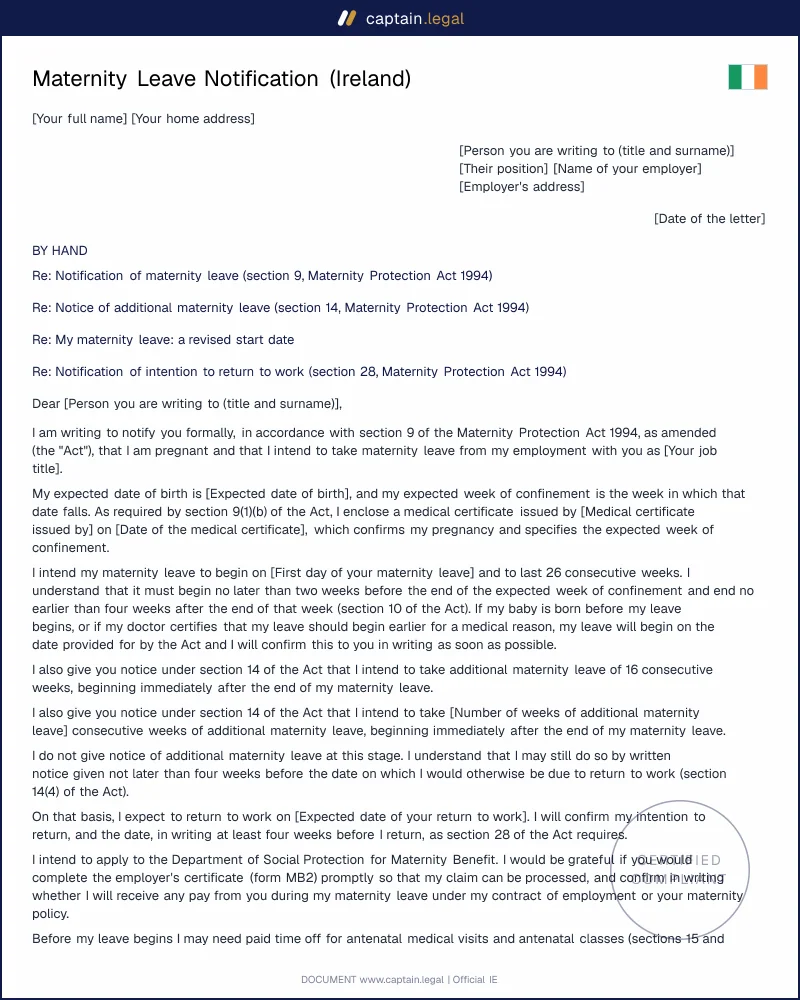
Key clauses included in our template

The letter opens with the sender and recipient blocks, the date and the delivery method, then a subject line that changes with the purpose you choose. Each version defines the Maternity Protection Act 1994 once as "the Act" and cites the section it relies on, so an HR manager can check it quickly.

  • For a first notice, the expected date of birth, the issuer and date of the medical certificate, the start date and the expected return date are set out, with a request that your employer complete form MB2 and say whether any contractual pay applies.
  • Additional maternity leave takes one of three forms: the full 16 weeks, a shorter block you choose, or no notice yet with a reminder of the section 14(4) deadline.
  • A request to postpone leave while your baby is in hospital follows section 14B closely, including the 14-week condition and the employer's duty to reply in writing.
  • If you are breastfeeding, the return letter claims one hour a day without loss of pay under section 15B and its regulations, until your baby is 104 weeks old.

The first notice also flags paid time off for antenatal visits and classes (sections 15 and 15A), asks for a review of the risk assessment and confirms that annual leave keeps accruing (section 22). The return letter claims your old job, or suitable alternative work under section 27. Every version closes with a contact line, a short reservation of rights and a request for written acknowledgement, plus a receipt block when the letter is handed over in person.

How to fill out this maternity leave notification

You start by choosing what the letter is for: a first notice, a separate notice of additional maternity leave, a change of dates, or a return to work. That answer shapes the rest of the questionnaire. Next come your name, address, job title and a personal phone number or email, then your employer's details and the person you are writing to. The preview on the right fills in as you type.

For a first notice, the form asks for the expected date of birth, the doctor, midwife or hospital on your certificate, its date and the first day of your leave, then whether you want additional maternity leave and when you expect to be back. Notes under the date fields explain the deadline that applies. You move through the steps with Next and Back, choose how the letter will be delivered, date it and click Finish. A new baby often prompts parents to make a will, one of our personal and family legal documents for Ireland.

Common mistakes to avoid

The mistake we see most is leaving it late. Employees wait for a good moment with a manager, and the deadline arrives first. The Act offers no general excuse for late notice, so send a dated maternity leave notification early and correct it later. A second error is forgetting the certificate, which the Act requires at the time of the notice: attach a copy and keep the original. A third is assuming a phone call to HR is enough. It is not, and a letter you cannot prove you sent is close to worthless in a dispute.

The return to work has its own traps. Some mothers return at the end of the 26 weeks after giving notice of additional maternity leave and never revoke it, so their employer plans for an absence that will not happen. Others skip the return notice because the date was in the first letter. Section 28 still requires it four weeks ahead, and a failure can count against you if your reinstatement goes wrong. Finally, do not ask for an extension just because your baby was late: the Act allows one only where your 26 weeks would otherwise end less than four weeks after the week of the birth, which is rare. Company templates for small employers sit among our business documents for Irish companies.

Key takeaways

MPA 1994 S.9

Written notice four weeks before your leave

Maternity leave lasts 26 consecutive weeks, but the right depends on notice. Section 9 requires you to tell your employer in writing, as soon as reasonably practicable and at least four weeks before the leave begins, and to give a medical or other appropriate certificate confirming the pregnancy and the expected week of confinement. At least two weeks must fall before the end of that week and four weeks after it.

MPA 1994 S.14

Up to 16 extra weeks, unpaid, on written notice

Additional maternity leave of up to 16 consecutive weeks follows immediately after the 26 weeks. Maternity Benefit does not cover it and your employer need not pay you unless your contract says so. Notice can go with the first letter or later, but no later than four weeks before the date you would otherwise return, and a notice you no longer want must be revoked in writing within the same time limit.

S.23, S.26 AND S.28

Return notice and protection from dismissal

You must confirm in writing at least four weeks before your return that you intend to come back and on what date (section 28). You return to the same job under the same contract, with any improvements made during your absence (section 26). A dismissal while you are on protective leave is void (section 23), and one connected with pregnancy, birth or breastfeeding is unfair under the Unfair Dismissals Act 1977.

Frequently Asked Questions

It is a statutory notice rather than a contract, and its force comes from the Maternity Protection Act 1994. Once your employer receives it in time with the medical certificate, your right to the minimum 26 weeks is secured and cannot be refused or traded away. Your employer does not need to sign or approve it. What the letter cannot do is create rights the Act does not give, such as paid additional leave where your contract is silent. Keep proof of delivery: a signed receipt or a registered post slip dates it, and so does a sent email if your employer accepts notices by email.

The Act sets a minimum of four weeks before your leave begins, in writing, and asks for notice as soon as reasonably practicable before that. Early notice gives your employer time to plan cover, complete form MB2 and review the risk assessment for your role. Notice of additional maternity leave can go in the same letter or follow later, but it must arrive at least four weeks before the date you would otherwise have returned.

Every letter comes in both formats: when you click Finish, it is generated in Word and PDF. The Word file lets you adjust a sentence or match your own letterhead. The PDF is the version to print, sign and hand over or attach to an email, because it keeps the layout exactly as it appears in the preview on the right. You can browse more Irish legal templates for employees and employers.

No law requires it. Irish employers do not have to pay salary during maternity leave unless the contract of employment or a company policy says so, although many larger employers top up pay. Most employees instead receive Maternity Benefit from the Department of Social Protection for 26 weeks, provided they have enough PRSI contributions. The benefit does not cover additional maternity leave, which is usually unpaid. Your notification asks your employer to confirm in writing whether any pay applies.

You can ask your employer to postpone part of your leave under section 14B, return to work while your baby is in hospital, and take the rest of your leave once your baby comes home. To postpone maternity leave, you must already have taken at least 14 weeks, four of them after the week of the birth, and the postponement cannot exceed six months. The resumed leave must start within seven days of discharge. Your employer is allowed to refuse, so the letter is framed as a request and asks for a written decision. You also need to tell the Department of Social Protection so that your benefit is paused.

Section 23 of the Act makes void any termination of your employment while you are absent on protective leave, and any notice of termination given during that absence and expiring after it. A dismissal connected with pregnancy, giving birth or breastfeeding, or with exercising maternity rights, is unfair under the Unfair Dismissals Act 1977 and can also be discrimination on the gender ground. Complaints go to the Workplace Relations Commission, normally within six months. Our leave letters for employees in Ireland include the other notices you may need around this time.

The Act allows a notification to be revoked by a further written notice, so changing your start date means sending a new maternity leave notification with the revised date. Cancelling additional maternity leave works the same way, but the revocation must reach your employer at least four weeks before the date you would otherwise return. If the change is for a medical reason and your doctor certifies an earlier start, attach that certificate: under section 11 it fixes the start date without the usual four weeks' notice.

4.5/5

17 verified reviews · 50 000+ downloads

Maternity Leave Notification Ireland (Maternity Protection Acts)
  • Immediate access to the document
  • PDF + Word download
  • Compliant with 2026 legislation
  • Reviewed by lawyers
Fill in the template
Secure payment
Updated on November 3, 2026

You might also like

Statutory Sick Leave Notification (Ireland)
Parent's Leave Notice (Ireland)