Personal

Statutory Declaration Ireland (Statutory Declarations Act 1938)

Prepare a general statutory declaration in the form set by the Statutory Declarations Act 1938: your facts, capacity, purpose and exhibits, with an attestation ready for a commissioner for oaths, practising solicitor, notary public or peace commissioner.
4.5/5— 17 reviews50 000+ downloadsInstant download
Share

A statutory declaration is a written statement of facts that you sign before an authorised witness, using the wording set by the Statutory Declarations Act 1938. Banks, insurers, conveyancing solicitors and county councils ask for one whenever they need a fact confirmed and no certificate exists to prove it: a lost document, a change of name, years of residence at an address, the ownership of a share certificate. Below you will find who can take it, what happens if it is false, and how to prepare a clean declaration ready to sign before a commissioner for oaths or practising solicitor.

Compliant

2026 Legislation

50,000+ clients

trust us

Affordable

From €4.90 / doc

Secure payment

Instant download

Statutory Declaration Ireland (Statutory Declarations Act 1938)

Secure payment

Fill in the template

What is a statutory declaration?

In Ireland, the expression has a fixed legal meaning. Section 1(2) of the 1938 Act provides that a statutory declaration, in every statute and statutory instrument, means a declaration made under that section, in the form set out in the Schedule to the Act. Two features follow. The declarant does not swear an oath: he or she "solemnly and sincerely" declares that the facts are true, and closes with the words "I make this solemn declaration conscientiously believing the same to be true and by virtue of the Statutory Declarations Act 1938". And the document only becomes a declaration once it is signed in front of an authorised person, who then completes and signs the attestation at the foot.

People often confuse it with an affidavit. Both are signed before a commissioner for oaths or a solicitor, and both carry criminal consequences if false, but an affidavit is sworn (or affirmed) and is the normal vehicle for evidence in court proceedings. The declaration is the instrument of everyday administration: the receiving body is a bank, a government department, a club committee or a company secretary, not a judge. Other everyday forms where a plain signature is enough are grouped in our personal legal documents for Ireland.

When do you need this document?

The most common request comes after a loss. A duplicate share certificate, a replacement life assurance policy document or a reissued title document is rarely granted on a phone call, so the issuing body asks you to declare when and how the original was lost and that it has not been pledged or transferred. Name changes are frequent too: a bank or pension provider wants confirmation that "Anna Nowak" and "Anna Kowalska" are the same person, with the marriage certificate exhibited. Proof of residence is another classic, where no utility bill covers the full period.

Company work generates its own share of declarations. Directors confirm facts about share registers or lost certificates, and the form then needs the capacity clause; our company and commercial documents for Ireland cover the resolutions and transfers that often travel with it. Property matters are just as frequent. Conveyancing solicitors use declarations to confirm undisturbed possession, the absence of rights of way, or the identity of a seller whose name differs between title documents, alongside the property and tenancy agreements that frame the sale or letting.

Key clauses included in our template

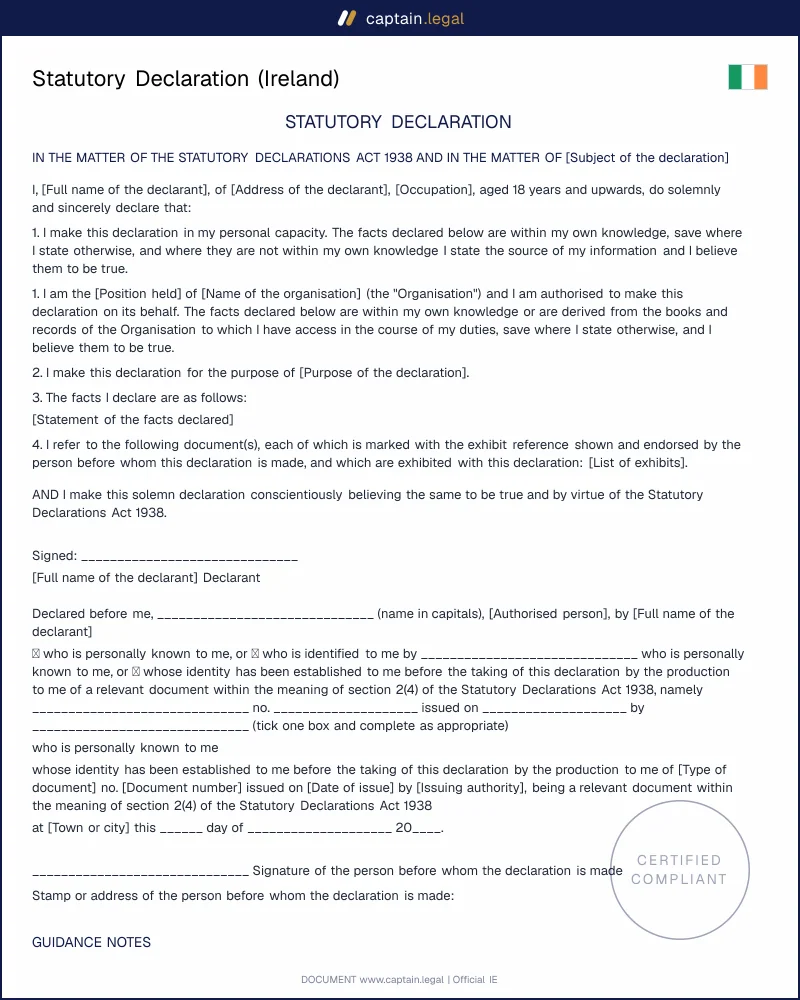
The form follows the order of the Schedule and adds only what makes the declaration more reliable in practice.

  • The heading cites the 1938 Act, and the "In the matter of" line names the subject in a few words, so a busy bank officer knows at a glance which file it belongs to.
  • For an officer of a company, charity or club, a capacity paragraph states the position held, the organisation's name and registered number, and that the facts come from personal knowledge or from the books and records of the body. The board resolution authorising that officer often sits with our nonprofit governance documents.
  • Your facts go in a numbered paragraph. In the personal version, paragraph 1 says that any fact outside your own knowledge names its source, the same discipline a court expects in an affidavit, and the purpose clause in paragraph 2 records who will receive the declaration.
  • Exhibits, when you attach them, are listed with references such as "SMK1" and described in one line each; the guidance page then adds the endorsement wording that the witness writes on each document.
  • At the foot, the attestation reproduces the 2008 Schedule: the witness's name in capitals, his or her capacity, the method of identification (or three tick boxes if you leave it open), the place, a blank date and the witness signature, followed by a detachable page of guidance notes.

How to fill out this statutory declaration form

You start with your name as it appears on your identity document, your address and your occupation. The next screen asks whether you are declaring in your personal capacity or on behalf of an organisation; choose the second option and the form asks for the body's name, registered number and your position, then adds the capacity paragraph to the text. You then give the subject of the declaration, which fills the "In the matter of" heading, and its purpose, which completes the sentence "I make this declaration for the purpose of...".

The facts screen is a single free text box. Write in the first person, with dates, places and figures, and leave out opinions. If you attach exhibits, you list them on the next screen with their references. The identification step lets you leave the choice to the witness, state that he or she knows you personally, or enter the particulars of your passport or identity card so that the attestation is already complete. Finally, you enter the town where you will sign and, if you know it, the capacity of the person taking the declaration.

Click Finish, complete your order, download the document in Word or PDF, print it, and bring it unsigned to the witness together with your identity document and any exhibits.

Common mistakes to avoid

The commonest error is signing at home, which means redoing the declaration, because the Act requires the signature to be made in the witness's presence; leave the signature and the date blank until you are in front of the witness. The second is choosing the wrong witness. A friend who is "a solicitor" but no longer holds a practising certificate cannot take it, and a practising solicitor may not exercise these powers in proceedings in which he or she acts for a party or has an interest.

Content causes the rest of the trouble. Declarants write what they hope is true rather than what they know. Because the offence turns on knowledge of falsity in a material respect, say plainly when a fact comes from someone else and who that person is. People also forget to bring the documents they refer to, or bring photocopies that nobody has marked, so the witness cannot endorse them. Others print a general form when the bank had its own prescribed wording (several statutes and public schemes do), which wastes a trip. Finally, check the spelling of your name against your passport: a mismatch between the declaration and the identity document is the quickest way to have the attestation refused.

Key takeaways

SDA 1938 S.1(1)

Who can take your declaration (not a Garda)

Section 1(1) of the Statutory Declarations Act 1938 lists a notary public, a commissioner for oaths, a peace commissioner, a person authorised by law and, since 2011, a judge of the District Court. A practising solicitor has the powers of a commissioner for oaths under section 72 of the Solicitors (Amendment) Act 1994, but not in proceedings where he or she acts for a party. A member of An Garda Síochána is not on the list.

SDA 1938 S.2

Sign only in front of the witness, with photo ID

The declaration must be signed in the presence of the person taking it, who then completes the attestation (section 2(1)). That person must know you, have you identified by someone he or she knows, or check a passport, an EU, EEA or Swiss identity card or another document listed in section 2(4) and write its particulars into the attestation. The form lets you leave this choice open or fill in your document details in advance.

PERJURY ACT 2021

A knowingly false declaration is a crime

Making a statutory declaration you know to be false in any material respect is an offence under section 6 of the 1938 Act, as replaced by the Criminal Justice (Perjury and Related Offences) Act 2021, and it can lead to up to 10 years' imprisonment on indictment. An honest mistake is not an offence. The template therefore asks you to state the source of any fact that is not within your own knowledge.

Frequently Asked Questions

It is a formal statement with statutory force rather than a contract, so "binding" means two things. The receiving body may rely on it as evidence of the facts declared, and you are criminally liable if you knowingly state something false in a material respect. That liability flows from section 6 of the Statutory Declarations Act 1938, as replaced by the Criminal Justice (Perjury and Related Offences) Act 2021, save where an older Act sets its own summary penalty (section 15 of the 2021 Act). The document only has that status once it is signed before an authorised person who completes the attestation. Until then it is an unsigned draft with no legal effect, however carefully you have prepared it.

The list in section 1(1) of the 1938 Act covers a notary public, a commissioner for oaths, a peace commissioner, a person authorised by law to take declarations and a judge of the District Court. A solicitor with a current practising certificate has the powers of a commissioner for oaths under section 72 of the Solicitors (Amendment) Act 1994, so a practising solicitor can take it, except in proceedings where he or she acts for a party. Peace commissioners are lay appointees in the local community, but a member of An Garda Síochána is not authorised by the Act to take a declaration. Commissioners and notaries may charge the same fee as for an affidavit under section 5.

Yes, both formats are available once your order is complete. The PDF is the safer choice if you only need to print and sign, because the layout of the attestation and the guidance page stays exactly as previewed. The Word file is useful when the bank or solicitor wants a small wording change, such as an extra exhibit or a different heading, before the appointment. The guidance notes sit on a separate page that you detach before handing the declaration over. You can also browse the full range of Irish legal templates if the receiving body asks for other documents at the same time.

Preparing the text online is a matter of minutes, longer if the facts involve several dates or exhibits. The appointment itself is short: the witness checks your identity, asks you to confirm that the contents are true, watches you sign, and completes the attestation. What takes time is the receiving body's own processing, which the declaration does not control. If you need it urgently, call ahead to confirm that a solicitor or commissioner for oaths will be available and bring your passport or national identity card.

Under section 3A of the 1938 Act, a declaration made outside the State is valid before a person authorised under section 1 or before a person authorised to administer oaths under local law, and Irish diplomatic and consular officers can also take one under the Diplomatic and Consular Officers (Provision of Services) Act 1993, which section 3A preserves. With a local official, the signature (and the seal, where local law requires it) must be authenticated, which in most Hague Convention countries means an apostille, although some EU states party to a 1987 EC Convention need none. Check with the receiving body before you book a local notary. Emigrants handling family matters at home can pair it with our Irish personal and family forms.

An honest mistake is not an offence, because the law punishes only a statement you know to be false in a material respect. That said, the receiving body can reject a declaration that turns out to be inaccurate, and you will usually have to make a fresh one. Do not amend the signed original by hand after the appointment, as the witness attested the text as it stood. If you spot an error before signing, correct it in the online form, download a new version and print it again. Small typing slips noticed at the appointment are usually struck through and initialled by you and the witness before signing.

4.5/5

17 verified reviews · 50 000+ downloads

Statutory Declaration Ireland (Statutory Declarations Act 1938)
  • Immediate access to the document
  • PDF + Word download
  • Compliant with 2026 legislation
  • Reviewed by lawyers
Fill in the template
Secure payment
Updated on November 3, 2026

You might also like

Child Travel Consent Letter (Ireland)
General Power of Attorney (Ireland)