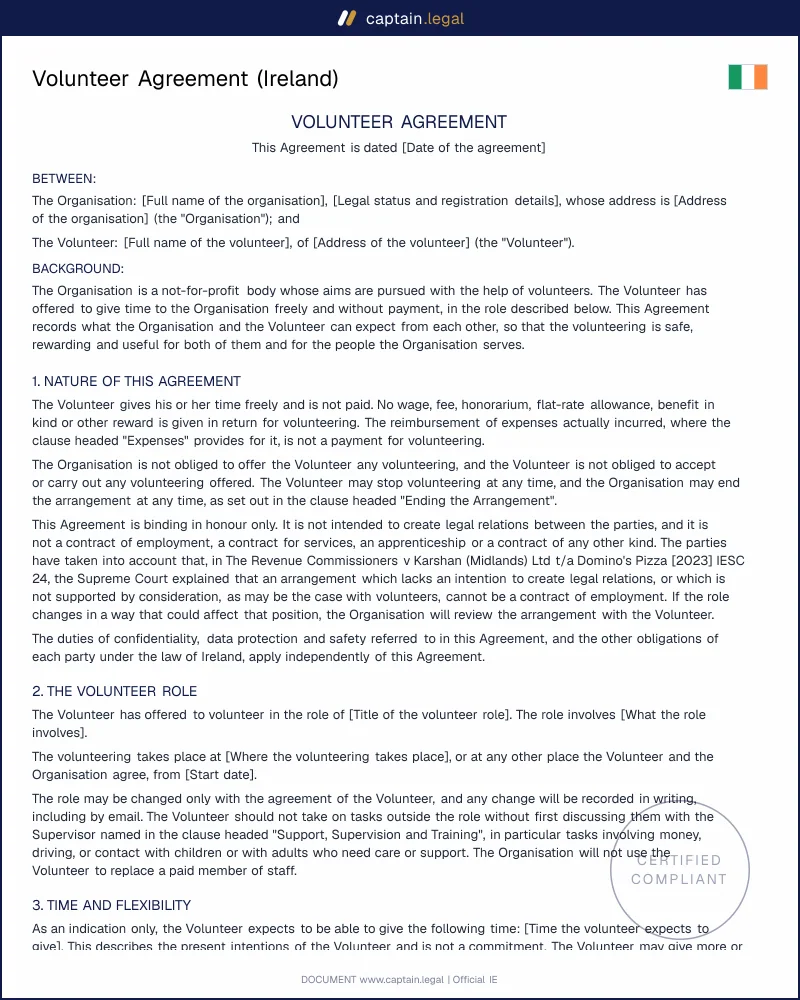
Ireland has no Volunteering Act, so the starting point is the general law on contracts and employment status. In The Revenue Commissioners v Karshan (Midlands) Ltd t/a Domino's Pizza [2023] IESC 24, the Supreme Court set out a five-step framework for deciding who is an employee, and the first question is whether there is a contract at all. Arrangements that lack an intention to create legal relations, or that are unsupported by consideration, "as may be the case with volunteers", are ruled out straight away. Revenue's Tax and Duty Manual Part 05-01-30 adds that repaying a volunteer's actual expenses, up to civil service rates, is not consideration where the organisation's aims are altruistic and non-commercial. A flat weekly allowance is a different matter, and it is the payment most likely to make a volunteer look like an employee. If the role is in fact paid, use one of the contracts of employment and contractor agreements for Ireland instead.
The law turns strict on vetting. Under section 12 of the National Vetting Bureau (Children and Vulnerable Persons) Act 2012, a relevant organisation must not permit anyone, paid or unpaid, to undertake relevant work or activities with children or vulnerable persons until it has received a vetting disclosure from the National Vetting Bureau, and a breach is an offence. Section 3(1)(c) exempts occasional help given for no commercial consideration at a school, sports or community event, unless it includes coaching, mentoring, counselling, teaching or training of children or vulnerable persons. The definitions and Schedule 1 (Parts 1 and 2), which lists relevant work, are in the revised National Vetting Bureau Act 2012 published by the Law Reform Commission. A provider of a relevant service to children must also have a child safeguarding statement under section 11 of the Children First Act 2015 and give a copy to its staff, volunteers included.
Section 3 of the Protected Disclosures Act 2014 treats a volunteer as a "worker", and section 23 makes void any provision of an agreement that restricts protected disclosures. The General Data Protection Regulation and the Data Protection Act 2018 govern the records you keep, and vetting information falls under the rules on criminal conviction data in section 55 of the 2018 Act.