Personal

IOU and Acknowledgement of Debt Ireland

Signed acknowledgement of an existing debt under Irish law: amount in figures and words, origin of the debt, optional repayment plan (set date, instalments or on demand), interest only if agreed, deed with witness or simple signature.
4.6/5— 18 reviews50 000+ downloadsInstant download
Share

An IOU or acknowledgement of debt is a short document in which a person who owes money confirms, in writing and over his or her signature, how much is owed, to whom and why. In Ireland it is used between relatives, friends and small traders when money has already changed hands. Memories fade fast. Signed by the debtor, it fixes the balance, can set out a repayment plan and, for a debt already payable, starts time running again under the Statute of Limitations 1957. Our template produces a one or two page document under Irish law, signed by the debtor alone.

Compliant

2026 Legislation

50,000+ clients

trust us

Affordable

From €4.90 / doc

Secure payment

Instant download

IOU and Acknowledgement of Debt Ireland

Secure payment

Fill in the template

What is an acknowledgement of debt in Ireland?

Under Irish law, an acknowledgement of debt is a unilateral written admission by the debtor that a specific sum is owed to a named creditor. It does not create the debt: the money was lent, the goods delivered or the bill paid on the debtor's behalf before anyone signs. What it adds is evidence and time. Once signed, it makes it very hard for the borrower to claim later that the money was a gift, and it gives the creditor a fresh limitation period for any sum already due.

People often confuse it with a loan agreement. A loan agreement is a contract signed by both parties when the money is advanced, and it governs the whole relationship from drawdown to default. An IOU comes afterwards and is signed by the debtor only. That makes it the right tool when the loan was informal, when a friend paid a bill and wants it recognised, or when a trader lets a customer pay off an overdue invoice. Families who prefer to set things up properly from the start will find other options among our personal and family legal documents for Ireland.

When do you need this document?

The most common situation is the family loan that was never written down. A parent advances money for a car or a deposit, the child repays part of it, and years later nobody agrees on the balance. A signed acknowledgement of debt settles the figure while relations are still good. The same applies between friends, and between former partners after a separation when one has paid shared bills for months.

Small traders use it too. A plumber whose customer cannot pay an invoice in full may accept monthly payments, provided the customer signs first. For the next job rather than the last one, our Irish business contracts and company documents cover terms of sale and service agreements. One caution: a business creditor dealing with a consumer should keep the plan interest free.

Timing is the other trigger. A creditor who realises the loan was made five years ago has every reason to obtain a signed acknowledgement now, since time runs again from the signature for a debt already payable. Debts linked to a tenancy are different: rent arrears and deposit disputes go to the Residential Tenancies Board, and our Irish residential tenancy documents handle them on their own terms.

Key clauses included in our template

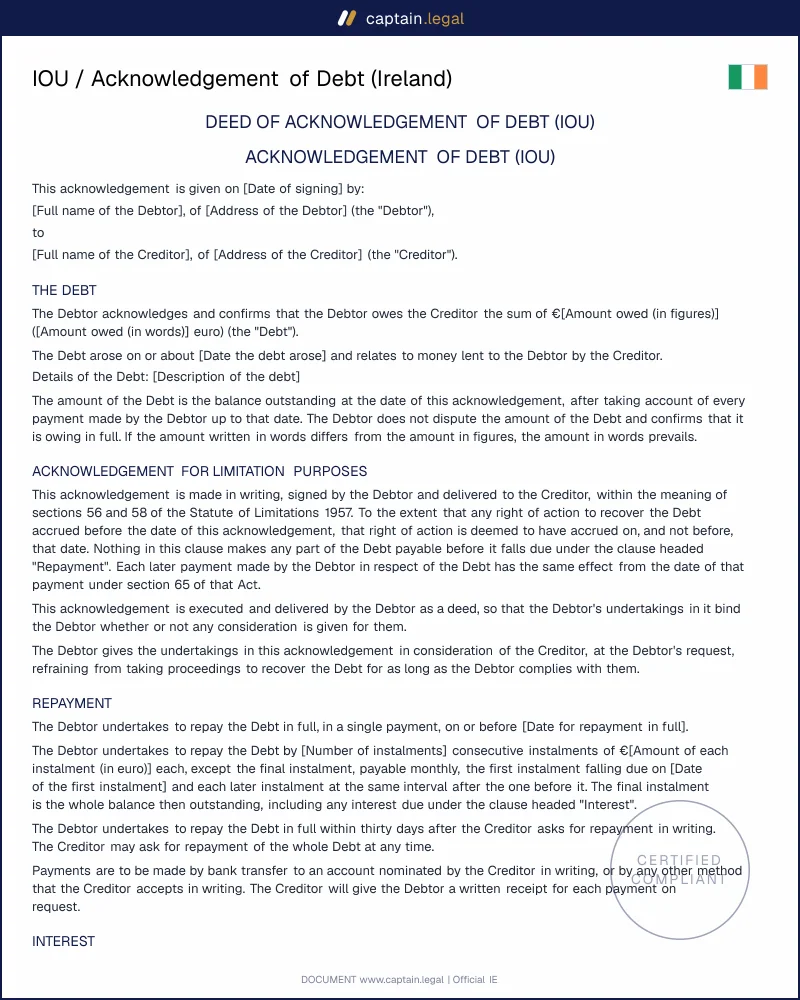
The opening identifies the Debtor and the Creditor by name and address and dates the document. The first clause records the amount in figures and in words, with the words prevailing if the two differ, then the origin of the debt (money lent, goods sold, services provided, money paid on the debtor's behalf or another obligation) and a short factual description. The debtor confirms that the figure is the balance after every payment already made and that it is not disputed. A clause on limitation cites sections 56, 58 and 65 of the 1957 Act without bringing forward any payment date.

Repayment takes one of three forms: a single payment by a set date, instalments (monthly, every two weeks or weekly, the last one clearing the balance), or payment within thirty days of a written request. Payment is by bank transfer to an account the creditor nominates, with a receipt on request. Interest appears only if chosen, as simple interest at an agreed annual rate that never increases on late payment.

The protective clauses are short. Early repayment carries no charge. With instalments, the creditor may call in the whole balance only after an instalment is fourteen days late and written notice has been given. No extra sum becomes payable because of a delay, indulgence is not a waiver, and the creditor's original rights survive. A deed binds without consideration; with a simple signature, the consideration is the creditor's agreement not to sue while the plan is kept. The closing clauses bind the debtor's personal representatives, set how notices are given and confirm that the debtor could take independent advice. Irish law governs, and the Irish courts decide any dispute.

How to fill out this acknowledgement of debt

You start with the Debtor's full name and address, then the Creditor's, using the names on official identification. The next screen asks for the amount still owed, in figures and in words: enter the balance after repayments, not the original loan. You then pick the origin of the debt in a short dropdown, give an approximate date and describe the transaction in a sentence or two.

The repayment screen offers three options. A set date opens a single date field. Instalments open a separate step for the number of payments, the amount of each, the frequency and the first due date. On demand needs nothing further. Interest is off by default, and the rate field appears only if you switch to an agreed rate.

Last comes the signing step: a deed signed in front of a witness or a simple signature, then the place and date. The preview on the right updates as you answer, and you move with Next and Back. Click Finish, download the document in Word or PDF, and keep a copy before handing the signed original to the Creditor. Other papers are listed in the full catalogue of Irish legal templates.

Common mistakes to avoid

The error we see most often is a document that never reaches the creditor. Because section 58 requires the acknowledgement to be made to the creditor, an IOU kept by the debtor proves little. A vague description comes close behind: "money owed" without a date or purpose invites the argument that the paper refers to another transaction, or that the payment was a gift. Writing down the original amount when part has been repaid is just as risky, since it gives the debtor an easy reason to dispute the whole document.

Creditors also like to add a flat late fee or a doubled rate, and Irish judges can refuse to enforce exactly that under the penalty rule. Keep one agreed rate and rely on calling in the balance instead. A deed signed without a witness is not a deed at all under section 64, and the deed version of the template relies on that form rather than on a consideration clause, so choose the simple signature if no witness is available. Pick an independent adult who adds a name, address and occupation. Parents planning a new advance rather than recording an old one should browse the wills, powers of attorney and other personal documents in Ireland.

Key takeaways

SOL 1957 SS.56, 58, 65

A signed acknowledgement restarts the clock

Under section 56 of the Statute of Limitations 1957, when the debtor acknowledges a debt that is already payable, the creditor's right of action is deemed to accrue again on the date of the acknowledgement, so the six year period for a simple contract starts afresh. Section 58 requires it to be in writing, signed by the debtor and made to the creditor, and each later payment has the same effect.

LCLRA 2009 S.64

Signing as a deed needs a witness, not a seal

An individual's deed no longer needs a seal: it must be described as a deed, signed in the presence of a witness who attests the signature and delivered as a deed. Signed this way, the repayment promises bind the debtor even though the creditor gives nothing in return, and an action on them can generally be brought within twelve years. An independent adult witness reduces the risk of later disputes.

PENALTY RULE

Interest only if agreed, never a late payment fee

No interest is due unless the debtor agrees to it, and an agreed rate should stay the same when a payment is late, because a fixed late fee or a higher default rate can be held unenforceable as a penalty. Calling in the whole balance after an unpaid instalment and written notice is the safer remedy. A business creditor who adds interest for a consumer debtor may fall within regulated consumer credit.

Frequently Asked Questions

It is. As evidence, a signed IOU is hard to dispute, and for limitation purposes section 58 of the Statute of Limitations 1957 adds that it must be in writing, signed by the debtor and made to the creditor. Time then runs again from its date for a debt already payable. The repayment promises bind too: as a deed they need no consideration, and with a simple signature the template records the creditor's agreement not to sue while the plan is respected. A court can still ask whether a term is a penalty, which is why the template avoids late fees.

A witness is not needed for the acknowledgement to work for limitation purposes, because a signed writing is enough. You need one if the debtor signs as a deed: section 64 of the Land and Conveyancing Law Reform Act 2009 requires an individual's deed to be signed in the presence of a witness who attests the signature. Choose an adult who is not the creditor and ideally not related to either party. The witness signs under the debtor's signature and writes a full name, address and occupation. No solicitor or notary is involved.

For a debt that is already payable, the six year period under section 11(1)(a) runs again from the date of signature. Sums that fall due later, such as a future repayment date or an instalment, start their own clock on their due date, and each payment opens a fresh period under section 65. Where the promise is made in a deed, an action on it can generally be brought within twelve years, because section 11(5)(a) covers instruments under seal and section 64(3) of the 2009 Act gives a deed that effect. Do not let a debt drift past six years without a fresh acknowledgement or payment.

Yes. Once you click Finish, the acknowledgement is generated in both formats. The PDF is the version to print and sign, because its layout stays fixed and the signature and witness lines land where they should. The Word file helps if you want to adjust the description of the debt or correct an address before printing. Print two copies: the creditor keeps the signed original, the debtor keeps a copy.

Interest is payable only if the debtor agrees to it, and the template leaves it out by default. With an agreed rate, it is simple interest from the date of the acknowledgement and stays the same when a payment is late. A separate late fee or a higher default rate is a classic target of the penalty rule and may be unenforceable. A business creditor should not charge interest to a consumer under this document, since the Consumer Credit Act 1995 can apply. Where the debtor is an employee, repayment by deduction from wages generally needs a contract term or the employee's prior written consent under the Payment of Wages Act 1991, and our employment documents for Irish employers help put the job terms in writing.

No. The Courts Service lists debt claims, including unpaid loans, among the claims the District Court small claims procedure does not accept, as it is reserved for certain consumer and business disputes. An unpaid acknowledgement of debt goes through the ordinary debt claim route: the District Court for smaller amounts, the Circuit Court above its limit and the High Court for the largest claims. Before issuing proceedings, a creditor normally sends a letter of demand that refers to the signed acknowledgement and gives a short final deadline, which is often enough to restart payments.

4.6/5

18 verified reviews · 50 000+ downloads

IOU and Acknowledgement of Debt Ireland
  • Immediate access to the document
  • PDF + Word download
  • Compliant with 2026 legislation
  • Reviewed by lawyers
Fill in the template
Secure payment
Updated on November 3, 2026

You might also like

Private Vehicle Sale Agreement (Ireland)
Child Travel Consent Letter (Ireland)