Leave Request

Carer's Leave Application Ireland (Carer's Leave Act 2001)

Employee's written notice of carer's leave under section 9 of the Carer's Leave Act 2001: person cared for, Department of Social Protection application (pending, decided or on appeal), Carer's Benefit, one or several periods, short-notice exception, plus the section 10 confirmation document.
4.8/5— 17 reviews50 000+ downloadsInstant download
Share

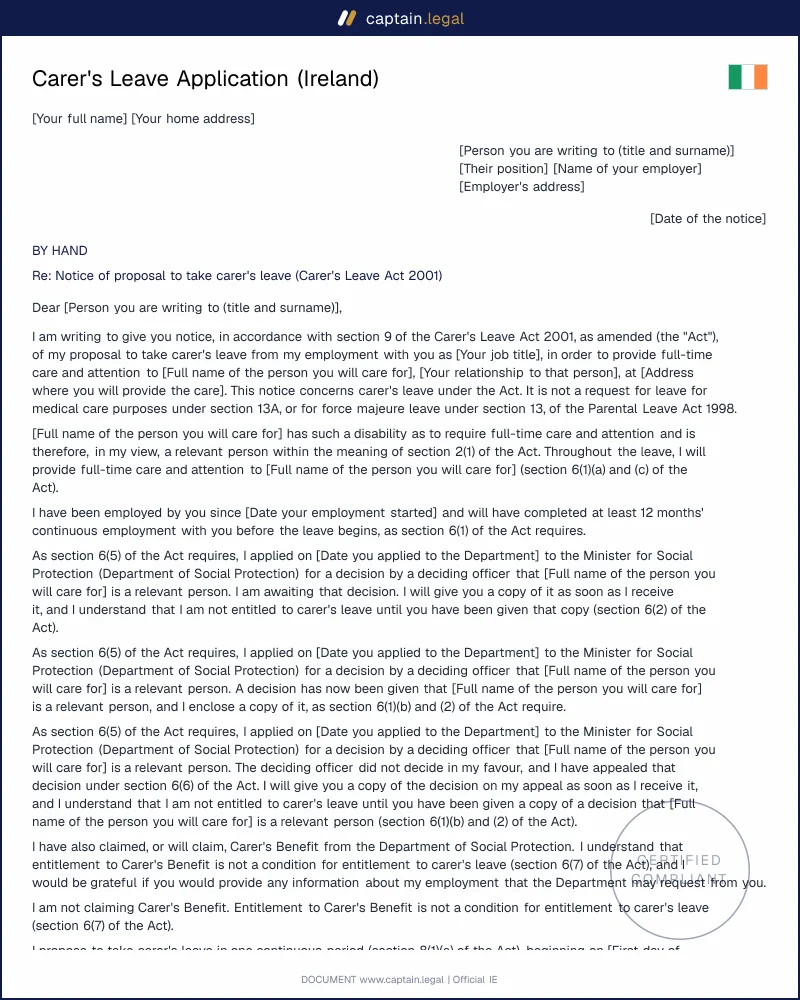
A carer's leave application is the written notice an employee in Ireland gives to their employer to take unpaid leave and provide full-time care to someone who needs it. Under the Carer's Leave Act 2001, the leave can last up to 104 weeks for each person cared for, with your job protected while you are away. The notice must reach the employer at least six weeks before the leave starts and confirm that you have applied to the Department of Social Protection for a decision on the person's care needs. Our template prepares that notice and the confirmation document both parties sign before the leave begins, so both written steps sit in one file.

Compliant

2026 Legislation

50,000+ clients

trust us

Affordable

From €4.90 / doc

Secure payment

Instant download

Carer's Leave Application Ireland (Carer's Leave Act 2001)

Secure payment

Fill in the template

What is a carer's leave application?

Carer's leave is a statutory right with a social welfare gatekeeper. The employee leaves work to care for a relevant person, meaning someone with such a disability that they need full-time care and attention. A deciding officer of the Department of Social Protection decides that question under section 6(5); the employer does not decide it, although it can report doubts to the Department under section 18. The carer's leave application is the employee's side of the process: it tells the employer that you propose to take the leave, that the application to the Department has been made, and when and in what form the leave will be taken, which are the three items section 9(1) requires. There is no relationship test: the person you care for can be your son, a neighbour or a parent, if the Department agrees they need that level of care.

Carer's leave is easily confused with other absences. It is long and unpaid; leave for medical care purposes gives up to five unpaid days in 12 months for a serious medical reason, and force majeure leave gives up to three paid days when an injury or illness makes your immediate presence indispensable. Both are confirmed on a prescribed form, while the leave request letters for Irish employees cover annual, maternity and parental leave. Carer's Benefit is a weekly payment, not a type of leave, and you do not need to qualify for it to take carer's leave.

When do you need this document?

The usual trigger is a sudden change in a parent's health. A stroke or a dementia diagnosis turns occasional help into round-the-clock supervision, and the adult child wants a long, protected absence rather than resigning. A carer's leave application is the formal route. Parents of a child with a severe disability use it the same way, often once parental leave has run out. Spouses and partners caring for each other through serious illness are another common case, as are people caring for a sibling who lives with them.

Timing shapes the rest. Many carers apply to the Department and send the notice in the same week, because the six-week clock and the decision run in parallel. Others already hold a favourable decision. Some need the leave in stages, for example 13 weeks while a sibling covers the next period, then a further block after the gap the Act requires. Wider contract questions belong with the Irish employment documents.

One edge case: where a second person needing full-time care lives with the person you already care for, section 7(2) allows leave for both, up to 104 weeks each and 208 in total.

Key clauses included in our template

The letter follows the order an employer's HR team will check it against the Act. It names the Carer's Leave Act 2001, separates the request from medical care leave and force majeure leave, and identifies the person you will care for and the address where you will provide that care. Several clauses carry the legal weight:

  • Your service is stated with its start date, confirming the 12 months' continuous employment that section 6(1) requires.
  • Depending on your file with the Department, one of three paragraphs appears (pending, decision enclosed, appeal lodged), each with the section 6(2) rule that the leave cannot start before the employer receives the decision.
  • Dates and form come next: one continuous period under section 8(1)(a), or several periods under section 8(1)(b) with the six-week gap.
  • Is your notice shorter than six weeks? A separate paragraph relies on the section 9(2) emergency exception instead of claiming compliance with the standard notice period.
  • A protective block records that annual leave keeps accruing for the first 13 weeks and that you return to the same job under sections 13 to 15.

On a separate page, the confirmation document repeats the start date, duration and form, lists the events that end the leave early under section 11 and leaves room for both signatures.

How to fill out this carer's leave application

You start with your own details, including the date your employment began, which the letter uses to show the 12 months of service. The next screen asks for your employer and the person you are writing to, usually the HR manager. You then name the person you will care for, describe the relationship in your own words ("my mother") and give the address where you will provide the care.

The most important question comes after that. You say whether your application to the Department of Social Protection is still pending, already decided in your favour, or under appeal, and give the date you applied. The letter and the enclosures adjust automatically: a pending application produces a draft confirmation document that should not be signed until the decision arrives, while a favourable decision is listed as an enclosure. You also say whether you are claiming Carer's Benefit.

Then you choose one continuous period or several periods, enter the first and last day, and confirm whether you are giving six weeks' notice. Your contact details, delivery method and the date of the letter close the questionnaire. Carers who take stock of family affairs at this point often make or update a will, and the personal legal documents for Ireland include one. The preview updates as you type, and Finish produces the final file.

Common mistakes to avoid

The most common error is sending the notice before applying to the Department. Section 9(1)(b) requires the notice to state that the application has already been made, so a letter promising to apply "soon" does not meet the Act, and the six weeks may have to start again. The second is counting six weeks from the date printed on the letter, when what matters is the day the employer receives it. Registered post or delivery by hand with a signed receipt removes the argument, while email works only if your employer accepts notices that way.

Employees also underestimate the 13-week line. Ask for eight weeks and the employer can say no, provided it gives reasonable grounds in writing; a period of 13 weeks or more cannot be refused on that basis. Some carers sign the confirmation document on the day they hand in the notice, before any decision exists. Signing before the decision falls outside section 10(1) and may cut short your right to revoke the notice under section 9(3), which runs only until the date of that document. The last mistake is taking on paid work during the leave beyond what the social welfare rules permit, which can end both Carer's Benefit and the leave itself. Employers covering the role often hire a consultant, and the templates for running an Irish business include that agreement.

Key takeaways

SECTIONS 6-10

Apply to the Department first, then give notice

Carer's leave depends on a Department of Social Protection decision that the person needs full-time care and attention. You must apply before giving notice, and the written notice must reach your employer at least six weeks before the leave, unless an emergency makes that impracticable. The leave cannot start until the employer has a copy of the decision, and both parties sign a confirmation document at least two weeks ahead.

SECTION 8

Up to 104 weeks, with a 13-week threshold

Each person you care for carries up to 104 weeks of leave, taken in one continuous period or in several periods not exceeding that total, with at least six weeks between periods. Your employer may refuse a period shorter than 13 weeks, but only on reasonable grounds stated in writing; a period of 13 weeks or more cannot be refused on that basis. You need 12 months' continuous service, and you normally care for one person at a time.

SECTIONS 13-16

Unpaid, but your job and rights are protected

Your employer does not have to pay you during carer's leave, and Carer's Benefit is a separate weekly payment with its own PRSI conditions, not a condition of the leave. Annual leave keeps accruing for the first 13 weeks and public holidays in that period still count. At the end you return to the same job on the same terms, or to suitable alternative work, and penalising you for taking the leave is unlawful.

Frequently Asked Questions

The Act creates the right; the notice is the formal step that triggers it. Once you meet the conditions in section 6(1) (12 months' service, a favourable decision from the Department, full-time care and no unauthorised work) and give the notice section 9 requires, the employer must allow the leave, subject to refusing periods under 13 weeks on reasonable grounds. A contract clause that reduces the entitlement is void under section 4, and disputes go to an adjudication officer of the Workplace Relations Commission.

At least six weeks before the leave starts, counted from the day your employer receives the notice. Where exceptional or emergency circumstances, such as a sudden deterioration after a hospital discharge, make that not reasonably practicable, section 9(2) allows notice as soon as reasonably practicable. The confirmation document must then be signed at least two weeks before the start date, and you cannot begin the leave until the employer has a copy of the Department's decision.

Not if you meet the statutory conditions. Leaving aside late notice (section 9(4) and (8)), the only refusal power concerns a period shorter than 13 weeks, and even then the employer needs reasonable grounds given in writing. If the employer doubts that the person needs full-time care, section 18 requires it to report that view to the Department, where a deciding officer rules on it. Dismissal or unfair treatment because you proposed to take carer's leave is penalisation under section 16, and a dismissal on that ground can be challenged as unfair.

Your employer has no obligation to pay you. Section 13(1) excludes remuneration and superannuation from the rights that continue during the leave, although some employers have policies that go further, which is why the letter asks the employer to confirm its position in writing. Income usually comes from Carer's Benefit, a weekly payment from the Department of Social Protection that depends on your PRSI contributions, but it is not a condition of the leave. You keep accruing annual leave during the first 13 weeks, and public holidays falling in that period still count.

Yes. When you click Finish, the notice and the confirmation document are generated together and can be downloaded in Word, if you want to adjust a sentence before signing, or in PDF, which is the safer format to print and hand over. The Captain.Legal Ireland homepage lists the other Irish categories if you need a related document. Keep a signed copy of both parts; the confirmation document must be kept for three years (sections 10(4) and 31(3)).

Scale and purpose. Carer's leave lasts up to 104 weeks, needs 12 months' service and a Department decision, and supports full-time care. Leave for medical care purposes, inserted into the Parental Leave Act 1998 by the Work Life Balance and Miscellaneous Provisions Act 2023, gives up to five unpaid days in any 12 consecutive months for a close relative or household member with a serious medical need, and has no service requirement. Planned absences such as annual or parental leave have their own notices among the Irish leave request templates.

No, you need the application, not the decision. The notice must confirm that you have applied to the Department of Social Protection for a decision that the person is a relevant person, and it can go to your employer while the Department is still assessing the case. What you cannot do is start the leave before your employer has a copy of a favourable decision. If the Department refuses and you appeal, the notice says so and the leave waits for the outcome.

4.8/5

17 verified reviews · 50 000+ downloads

Carer's Leave Application Ireland (Carer's Leave Act 2001)
  • Immediate access to the document
  • PDF + Word download
  • Compliant with 2026 legislation
  • Reviewed by lawyers
Fill in the template
Secure payment
Updated on November 3, 2026

You might also like

Parental Leave Notice (Ireland)
Annual Leave Request (Ireland)