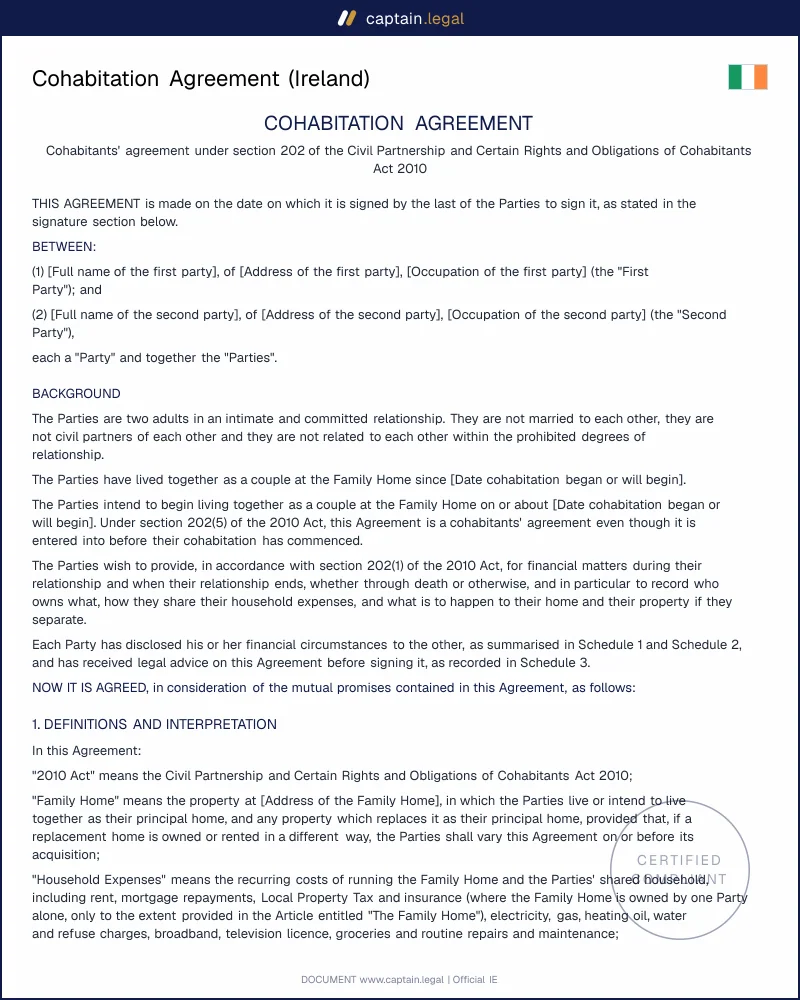
After the parties, recitals and definitions, the validity article mirrors section 202(2) and adapts to your answer: either each of you sees your own solicitor and Schedule 3 carries two certificates of independent legal advice, or you see one solicitor together and Schedule 3 carries a joint certificate plus the written waiver the Act requires. Schedules 1 and 2 hold each partner's financial disclosure, because an agreement signed on incomplete figures is the easiest one to attack.
The home article handles seven situations: owned by the first or the second partner alone, owned jointly as joint tenants or as tenants in common in stated shares, or rented in both names or in one. Where one partner owns the house, the other acquires no interest by paying towards running costs, and the mortgage, structural insurance and Local Property Tax stay with the owner unless you agree otherwise. Joint tenants sever by mutual agreement at the Separation Date, so survivorship stops after a break-up. Household expenses are split equally, in proportion to net income after tax, USC and PRSI, or as you describe, with or without a joint account; debts in each partner's own name and pensions stay personal, while joint debts follow the expenses split. Wills and powers of attorney sit alongside this agreement in our Irish personal legal documents.
On the way out, you can exclude both statutory claims, exclude redress only, or keep both and ask the court to give weight to what you signed. A buy-out procedure with a valuer from the Society of Chartered Surveyors Ireland deals with a jointly owned home, followed by an open-market sale if nobody buys. You also choose a period of one, three or six months, which sets the moving-out deadline or, for joint owners, the window for a buy-out notice, and an optional separation payment, while later articles cover death and tax, children, review triggers and family mediation, for example through the Legal Aid Board.