Non-Profit

Conflict of Interest Policy Ireland (Charities Governance Code)

Conflict of interest and loyalty policy for the board of an Irish charity or not-for-profit (CLG, association or trust), with the Companies Act 2014 and Charities Act 2009 rules, an annual declaration of interests form and a register of interests.
4.5/5— 13 reviews50 000+ downloadsInstant download
Share

A conflict of interest policy is the written rulebook a board adopts to decide what happens when one of its members stands to gain, or owes a loyalty elsewhere, on a decision the board is about to take. In Ireland the Charities Regulator expects every registered charity to decide how it handles conflicts, and many funders ask whether a written policy exists. This template is written for the board of an Irish charity or not-for-profit, whether it is a company limited by guarantee (CLG) or an unincorporated association or trust. It comes with an annual declaration of interests form and a register of interests.

Compliant

2026 Legislation

50,000+ clients

trust us

Affordable

From €4.90 / doc

Secure payment

Instant download

Conflict of Interest Policy Ireland (Charities Governance Code)

Secure payment

Fill in the template

What is a conflict of interest policy?

A conflict of interest arises when a board member's personal interests, or those of a close relative or business associate, could prevent them, or even appear to prevent them, from deciding only in the best interests of the organisation. The policy defines that situation, tells board members what to declare and when, and sets out how the rest of the board manages the matter: the conflicted member leaves the room, does not vote and is named in the minutes. A good policy also deals with the conflict of loyalty, which is subtler. A director nominated by a local authority, a funder or a parent body may gain nothing personally, yet still feel pulled towards the body that put them on the board. The template covers both, as the Charities Governance Code does.

The policy is different from the code of conduct a board signs, which covers behaviour in general (confidentiality, expenses, respect), and from the constitution, which the board cannot change on its own. The board adopts and reviews the conflicts policy itself, so it cannot authorise anything the constitution forbids, and it works alongside the charity and community group documents a board already relies on.

When do you need this document?

The obvious moment is registration. A new charity filling in its first Governance Code compliance record will find the integrity standards hard to meet without a written approach to conflicts. Funding is the second trigger. Many funders, public and philanthropic, ask whether a policy exists, and some ask to see the latest register of interests.

Then come the everyday cases. A charity needs a new roof and the treasurer's brother runs a building firm; the contract may still go to him if his quote is the best, provided the treasurer declares the link and takes no part in the decision. A board member's daughter applies for the coordinator post, which brings in the rules on hiring and managing staff as well as the conflict. A director sits on the board of another charity competing for the same grant. A sports club or residents' association that is not a charity faces the same questions on a smaller scale, which is why the template has a non-charity variant.

The edge case is the board where nearly everyone is conflicted, for example a family foundation deciding whether to buy property from one of its founders. Withdrawal fails when too few unconflicted board members remain for a quorum, so the policy has the board take legal advice and, where needed, refer the decision to the members in general meeting or, for an association or trust whose governing document does not allow that, to the court.

Key clauses included in our template

The policy opens with purpose, scope and definitions. "Conflict of Interest", "Conflict of Loyalty", "Connected Person" and "Benefit" are defined once and used consistently. The connected person definition is deliberately wide and covers cohabitants, step-relatives, business partners, an employer and controlled companies. The scope extends to committee members and senior staff who advise the board. The legal framework adapts to your answers: a CLG gets the directors' duties in section 228 and a separate section on company law requirements covering section 231 declarations, general notices, the three-day entry in the book, substantial property transactions under section 238 and the restrictions on loans, quasi-loans and guarantees for directors in section 239.

At its operational core, the policy covers declarations on appointment, every year and whenever something changes, the register kept by a named role, and the procedure at meetings. The conflicted member declares, answers questions, leaves, does not vote and, where the constitution allows, is not counted in the quorum. A further section covers decisions taken by email or written resolution, where undeclared conflicts often slip through. Conflicts of loyalty get their own section, with a variant for boards that include nominees from outside bodies.

Payments come last. Board members are paid under one of two variants: expenses only, or payments expressly permitted by the constitution, subject to six conditions including a written agreement, a fair price and a minority of paid members. Gifts above a threshold you set must be declared, data protection is handled under the GDPR and the Data Protection Act 2018, and directors' insurance is expressly carved out so the board can renew it without a conflict.

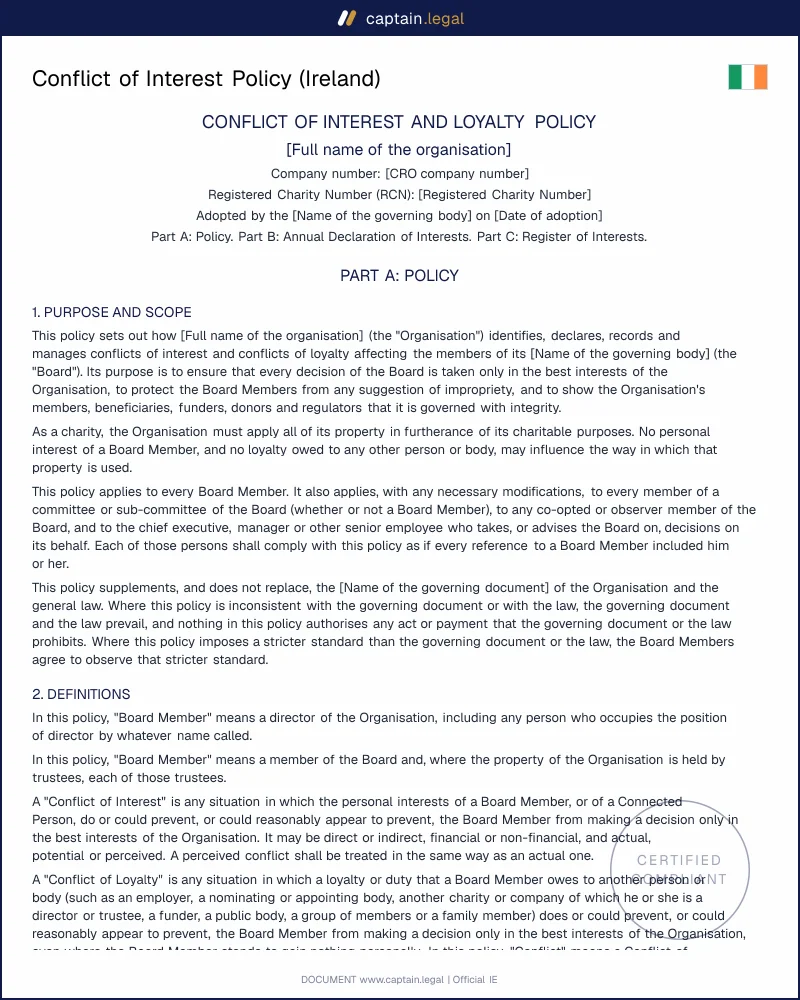
How to fill out this conflict of interest policy

You start with the organisation's name and its legal form. Choosing a company adds the CRO number and the Companies Act sections; choosing an unincorporated association or trust swaps in the fiduciary rules instead. The next screen asks whether the organisation is registered, or applying to register, with the Charities Regulator; if so, the Registered Charity Number appears under the title and the Charities Act and Governance Code clauses are added.

The form then asks for the name of the governing body (Board of Directors, Board of Trustees, Management Committee), the name of the governing document and the role that keeps the register. Two questions follow on payments and nominees, and each answer swaps in the matching clause. You then set the gift and hospitality threshold, the number of years entries are kept after someone leaves, and how often the board will review the policy. The adoption date and the chairperson's name come next, and a final screen asks you to check the preview on the right before you click Finish. Other legal templates for Ireland work the same way.

Common mistakes to avoid

The most common failure is a conflict of interest policy that exists only on paper. Boards adopt it, file it and never put declarations of interest on the agenda, so when a funder or the Regulator asks for evidence there is nothing in the minutes. A close second is the register that was filled in once at registration and never updated. Declarations must be renewed every year, and a director who changes job or joins another board must tell the register keeper in writing straight away, not at the next annual round.

Meetings are the next weak point. The conflicted member stays in the room "to answer questions" and ends up steering the discussion, or abstains from the vote but is still counted in a quorum that would otherwise fail. In a CLG, people forget that the section 231 book has a three-day deadline. Treasurers often overlook lease arrangements: a charity renting a hall or office from a director, or from the director's company, is a classic related party transaction, and the board should compare the rent with the market before signing, as it would for any of its leases and property agreements. Loans are similar. A director or relative who lends money to the organisation has an interest in the terms, which belong in writing, as with the private loans covered by personal and family legal documents. Finally, boards sometimes treat the policy as permission to pay a director whenever the board agrees, when in fact the policy cannot authorise any payment the constitution does not allow.

Key takeaways

CA 2014 S.231

Declare at the board meeting, record within 3 days

A director of an Irish company who is in any way interested in a contract or proposed contract with it must declare the nature of that interest at a board meeting: when the contract is first considered, or at the next meeting after the interest arises. A copy of each declaration goes into a book within 3 days, open to directors, the secretary, the auditor and members. The policy lets the board keep its register as that book.

CHARITIES ACT S.89

Paying a charity trustee: no statutory scheme yet

Section 89 of the Charities Act 2009, on paying charity trustees for services, was never commenced, and Part 6A, inserted by the Charities (Amendment) Act 2024 to replace it, is not in force either. Until then, a trustee may not profit from the role unless the governing document or the law allows it. The policy offers an expenses-only variant and a strict variant requiring a written agreement, a fair price and a minority of paid members.

CA 2014 S.1173

A conflicted CLG director cannot rely on s.161(7)

Section 161(7) of the Companies Act 2014, which lets an interested director vote and count in the quorum unless the constitution says otherwise, is disapplied for a CLG by section 1173. Whether a conflicted CLG director may vote therefore depends on the constitution. The policy asks the member to declare, leave the room and abstain, and lets the board refer the matter to the members if too few unconflicted directors remain.

Frequently Asked Questions

Adopted by a board resolution, the policy binds every board member as an internal rule, and each member confirms it by signing the annual declaration in Part B. The duties behind it come from the law: sections 228 and 231 of the Companies Act 2014 for directors, fiduciary duties for trustees. The Charities Governance Code is not a statute; it works on a comply or explain basis, and a written policy is the usual way to show how a charity deals with conflicts. A breach can lead to removal from the board or the repayment of a benefit, and section 232 makes a director account for any gain.

Both. Once you click Finish, you can download the policy as an editable Word file or as a PDF ready to print and sign. The Word version lets the board adapt a definition or add its logo, and the PDF suits board papers. Part B, the annual declaration form, and Part C, the register, are included in the same file and can be printed separately so that each member completes and signs a copy at the first meeting of the financial year.

For a company, section 231 sets the timing: a proposed contract must be declared at the board meeting where it is first considered, and an interest that arises later must be declared at the next meeting after the director becomes interested. The template goes further and asks board members to notify the register keeper in writing as soon as they become aware of a new interest, then to declare it again at the start of the relevant meeting. Entries go into the register within three days, matching the statutory deadline for the company's book.

Charity trustees in Ireland are usually unpaid, and the constitution decides whether any payment is possible. Revenue's conditions for a charitable tax exemption also limit payments to directors, and no statutory scheme for paying trustees is in force yet. Where the constitution does permit a payment for services, the template requires a written agreement, a reasonable price, a decision taken without the conflicted member and a minority of paid board members. Reasonable expenses can still be reimbursed on receipts, under an expenses procedure the board approves.

No statute requires one, and the Governance Code applies only to registered charities, but a written policy saves arguments when the committee awards a contract or hires someone known to a member. Choosing "not a charity" in the form removes the Charities Act 2009 and Governance Code clauses while keeping the declaration, register and meeting procedure. A group that later applies for charitable status reviews the policy before the application goes in.

The template lets you choose every year, every two years or every three years, and requires an earlier review whenever the law, the constitution or the organisation's activities change. In practice, the review should also follow the commencement of the Charities (Amendment) Act 2024 provisions on trustee duties and remuneration, which the charity version flags. Whatever cycle you pick, declarations are renewed every year, and the board signs off the register annually.

4.5/5

13 verified reviews · 50 000+ downloads

Conflict of Interest Policy Ireland (Charities Governance Code)
  • Immediate access to the document
  • PDF + Word download
  • Compliant with 2026 legislation
  • Reviewed by lawyers
Fill in the template
Secure payment
Updated on November 3, 2026

You might also like

Director / Charity Trustee Resignation Letter (Ireland)
Director / Charity Trustee Appointment Letter (Ireland)