Non-Profit

Club Constitution Ireland (Unincorporated Association)

Constitution (rules) for an Irish club, association, society or community group run as an unincorporated association: membership, subscriptions, committee, officers, meetings, finances, discipline, amendment and dissolution, with optional charity and child safeguarding clauses.
4.8/5— 21 reviews50 000+ downloadsInstant download
Share

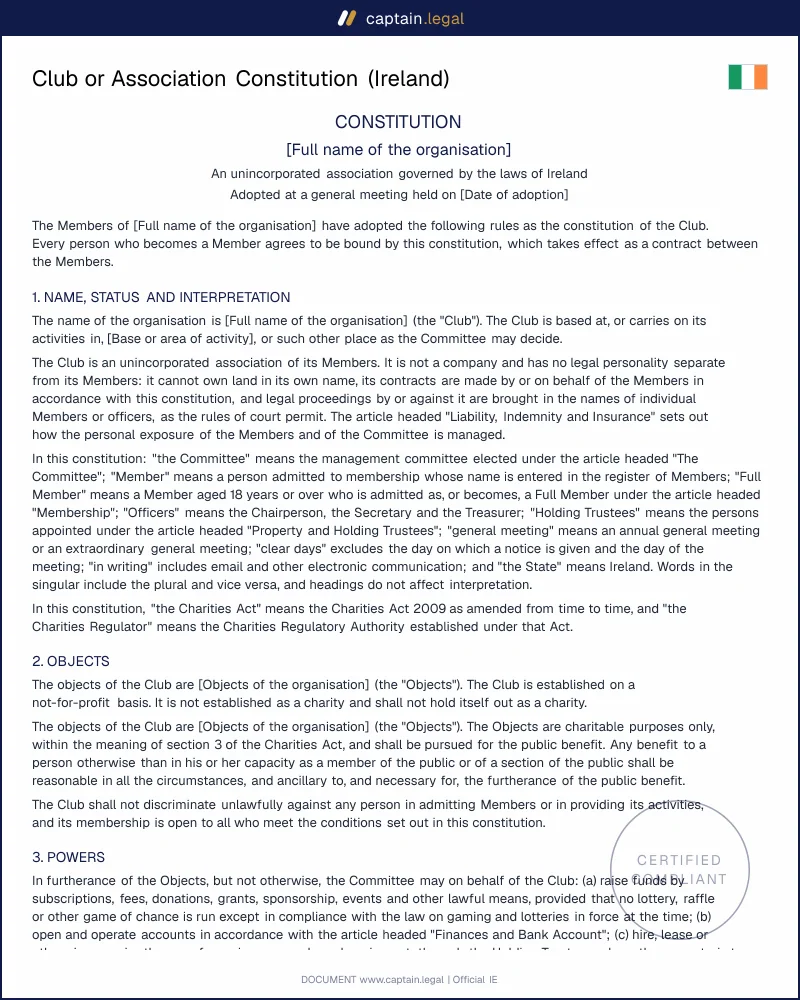
A club constitution is the written set of rules that a sports club, residents' association, hobby society or community group adopts to govern itself: who can join, how the committee is elected, how money is handled and what happens if the group winds up. This template is drafted for Ireland and for the most common structure on the ground, the unincorporated association, which needs no registration with the Companies Registration Office. It covers membership, subscriptions, the committee and officers, general meetings, the bank account, discipline, amendments and dissolution, and it adds clauses for charitable groups and for clubs that involve children when you need them.

Compliant

2026 Legislation

50,000+ clients

trust us

Affordable

From €4.90 / doc

Secure payment

Instant download

Club Constitution Ireland (Unincorporated Association)

Secure payment

Fill in the template

What is a club constitution?

In Irish law, a club that has not formed a company is an unincorporated association: people bound together by a shared purpose and by rules they have agreed. The club constitution is those rules. It takes effect as a contract between the members, which is why a court asked to settle a row about an expulsion or a disputed election starts by reading it. The club itself has no separate legal personality. It cannot own land in its own name, and when the club takes a lease or hires a coach, an officer or trustee signs on behalf of the members. That is the main difference from a company limited by guarantee (CLG), a legal person registered with the CRO whose members' liability is capped by the guarantee.

Most voluntary groups in Ireland start out unincorporated because it costs nothing and needs no annual return. Banks and funders still expect a written constitution before they deal with you, and governing bodies usually ask for one on affiliation. If your group sits closer to the charity world, the templates for Irish charities and community groups cover the governance paperwork that tends to follow.

When do you need a club constitution?

Money is the usual trigger. Irish banks generally ask for a constitution and minutes naming the officers before they open an account in the club's name, and grant schemes run by local authorities and sports partnerships usually ask for a copy with the application. A dispute is the second. Committees that ran for years on goodwill discover the gap the first time two members want the same office, or when someone has to be suspended and nobody knows who decides. A residents' association negotiating with a council needs one too, because the other side will ask who speaks for the group.

New groups also benefit from writing the rules before any money arrives. Setting the subscription, the quorum and the dissolution rule at the founding meeting avoids arguments later, especially about who owns equipment bought with fundraising money. A youth club or juvenile section brings child safeguarding duties that the committee must plan for from the start, including who will apply for vetting. A group renting a hall or a pitch on a long agreement should check the Irish lease and property templates before signing, because the signatories carry that commitment personally.

Key clauses included in our template

The opening articles fix the name, the short name the document uses (Club, Association, Society or Group), the base or area of activity and the objects, which limit what the funds can be spent on. Membership is open to anyone who supports the objects, with a written application, a register kept by the secretary and optional junior membership for under-18s, who take part but cannot vote or hold office. Subscriptions can be set each year by the AGM, fixed in the constitution or left out.

The committee has a minimum and maximum size you choose, three officers (chairperson, secretary and treasurer), annual elections with nominations 21 days ahead, co-option capped at one-third and a clear list of the ways a committee member leaves office. Conflicts of interest must be declared and minuted. General meetings run on 14 clear days' notice, a quorum you set, one vote per full member and no proxies, and an inquorate adjourned meeting can never amend the constitution, incorporate or dissolve the club.

The protective clauses are where a home-made constitution usually falls short. Every payment needs two unrelated signatories, long commitments need a general meeting's approval, and the accounts go to an independent examiner. Property is held by two to four holding trustees, committee members acting in good faith are indemnified out of club funds, and public liability insurance is compulsory. The closing articles cover data protection, alcohol licensing, incorporation, disputes, amendments by a two-thirds majority and dissolution, with surplus assets going to a registered charity for a charitable group and, otherwise, to a similar body or, if the members choose, to the full members in equal shares.

How to fill out this club constitution

You start with the organisation: its full name, the base or area it serves, its objects written as "to ..." and the short name the document will use. The second step asks whether the group's purposes are exclusively charitable. Answering yes adds the charity trustee rules, the annual report duty and the registration article, and sends surplus assets to another registered charity; answering no lets you choose between a similar body and the members.

On the membership step you say whether people under 18 will be involved, which switches on junior membership and the child safeguarding article, and you choose how subscriptions work. The committee step asks for its minimum and maximum size and its quorum. You then set the quorum for general meetings and the end of the financial year, before entering the date of the adoption meeting and the names of the chairperson and secretary who sign. The preview updates as you answer, and the articles renumber themselves. Click Finish, put the text to the members and keep the signed copy with the club's records; the other templates in the Captain.Legal Ireland document library work the same way.

Common mistakes to avoid

The most expensive mistake is assuming that a constitution limits the committee's liability. It does not protect anyone against a supplier, a landlord or an injured visitor: the person who signs a contract for an unincorporated club can be pursued personally. Another frequent error is a dissolution clause that hands everything to the members after the club has taken grants; grant conditions often require unspent money to be repaid, and Revenue's standard clauses for exempt bodies send the assets to a similar body. Charitable groups also advertise, collect from the public or accept donations before they are registered, which section 41 makes an offence, with each charity trustee personally liable to prosecution.

Quorums cause quieter damage. Set at 30 in a club where 15 people come to the AGM, the quorum is never met: every meeting goes to an adjournment, and an amendment or a dissolution, which an inquorate adjourned meeting cannot pass under the template, never passes. A quorum of three lets a handful of members rewrite the rules. Committees forget that a constitution amended informally is not amended at all. If the subscription is written into the constitution, a new rate needs a two-thirds resolution with the full text circulated in advance; if the AGM sets it each year, it still needs a vote at the AGM, not a committee email. Clubs with juniors often leave Garda vetting to the coaches, yet the duty sits with the club, and the employment contracts and letters for Irish employers are worth a look the day a paid coach joins.

Key takeaways

CHARITIES ACT S.41

No public fundraising before charity registration

A group that promotes charitable purposes only and applies its property to them is a charitable organisation under the Charities Act 2009 and must apply to the Charities Regulator for registration. Until it is registered, section 41 makes it an offence to advertise for it, invite the public to give it money or accept a gift on its behalf. A sports body approved by Revenue under section 235 of the Taxes Consolidation Act 1997 is an excluded body.

NO LEGAL PERSONALITY

Whoever signs for the club can be liable personally

An unincorporated club is not a legal person. Its constitution limits each member's share of the debts as between the members, but a supplier, landlord or injured visitor is not bound by that rule and can pursue the person who signed or authorised the commitment. The template therefore requires insurance, two signatories and general meeting approval for long commitments, and sets out a route to a company limited by guarantee.

CHILDREN FIRST ACT

Activities for children bring safeguarding duties

A club providing recreational, social or physical activities to children provides a relevant service under the Children First Act 2015. Within 3 months it must assess the risk of harm, prepare and display a child safeguarding statement and appoint a relevant person, then review it every 24 months. The club must receive a vetting disclosure from the National Vetting Bureau before anyone, volunteers included, does relevant work with children.

Frequently Asked Questions

Once the members adopt it at a general meeting, the club constitution takes effect as a contract between them, and Irish courts will enforce it, for example by setting aside an expulsion that ignored the procedure it lays down. It binds members, not outsiders: a creditor is not bound by your internal liability rule. No witness, notary or public registration is required for an unincorporated association. If the group is charitable, the Charities Regulator still examines the constitution on registration, and Revenue may ask for its own standard clauses before granting a charitable tax exemption.

Both formats come with the finished document. The PDF is the version to sign at the adoption meeting and to send to the bank or a funder, since its layout cannot shift. The Word file is useful when the members later pass an amendment and the secretary has to keep an up-to-date copy, as the template requires. You can also return to the online form, change your answers and download a fresh version whenever the club's details change.

The form is short: a group that has already agreed the objects, the committee size and the quorums can complete it in one sitting. The constitution takes effect when the members approve it at a general meeting, so the timetable depends on the notice you give. An existing club changing its rules follows its current amendment procedure; under this template that means at least 14 clear days' written notice with the full text circulated. A new group adopts it at a founding meeting, which also elects the first committee. Charity registration comes afterwards, on the Charities Regulator's own timescale.

An ordinary unincorporated club does not register with the CRO or any other public body, which is one of its attractions. Registration only arises from what the club does. A group with exclusively charitable purposes must apply to the Charities Regulator, a club wishing to supply alcohol to its members needs a certificate of registration from the courts, and a club providing activities to children must have a child safeguarding statement and obtain vetting disclosures, either through its governing body or by registering with the National Vetting Bureau.

They can be. As between the members, the template limits each member's share of the club's debts to what he or she owes in subscriptions, but third parties are not bound by that rule. Whoever signs a contract or authorises a debt may be personally liable, and the indemnity from club funds is only as good as the funds. Members are sometimes asked to guarantee a club loan personally. That guarantee follows them, not the club, so take advice before signing and keep it with your own personal legal documents for Ireland.

Not if Revenue has approved it under section 235 of the Taxes Consolidation Act 1997, the exemption designed for bodies promoting athletic or amateur games or sports: the Charities Act 2009 lists such approved bodies as excluded bodies that cannot be charitable organisations. A club without that approval would still have to show a charitable purpose under section 3, such as the promotion of health or community development, because sport for its own sake is not among the purposes the Act lists. Groups with mixed purposes should look at their main objects carefully before choosing the charitable option.

4.8/5

21 verified reviews · 50 000+ downloads

Club Constitution Ireland (Unincorporated Association)
  • Immediate access to the document
  • PDF + Word download
  • Compliant with 2026 legislation
  • Reviewed by lawyers
Fill in the template
Secure payment
Updated on November 3, 2026

You might also like

Constitution of a Company Limited by Guarantee (CLG, Ireland)
Director / Charity Trustee Resignation Letter (Ireland)