Employment

Dismissal Letter Ireland (Unfair Dismissals Acts)

Employer's letter confirming a dismissal in Ireland after a fair procedure, for capability, competence, conduct after warnings or gross misconduct, with statutory notice, final pay and the right of appeal.
4.5/5— 13 reviews50 000+ downloadsInstant download
Share

A dismissal letter confirms in writing that an employer in Ireland has decided to end an employee's contract, why it has done so and what happens next. Irish employers send it at the very end of a disciplinary or capability process, once the employee has been heard and a decision has been taken. The letter records the ground for dismissal under the Unfair Dismissals Act 1977, the notice or summary termination, final pay, the return of company property and the right of appeal. It suits companies, sole traders and partnerships that want a record able to stand up before the Workplace Relations Commission.

Compliant

2026 Legislation

50,000+ clients

trust us

Affordable

From €4.90 / doc

Secure payment

Instant download

Dismissal Letter Ireland (Unfair Dismissals Acts)

Secure payment

Fill in the template

What is a dismissal letter in Ireland?

In Irish employment law, a dismissal letter is the written record of the employer's decision to terminate a contract of employment. No statute prescribes its form, and a dismissal can technically be communicated orally. The letter still matters because of section 6(6) of the Unfair Dismissals Act 1977: when a dismissal is challenged, the burden is on the employer to show that it resulted wholly or mainly from a fair ground. An adjudication officer will usually start with the dismissal letter, and a vague one ("your services are no longer required") invites the conclusion that the real reason was something else.

The document differs from a disciplinary warning letter, which imposes a sanction short of dismissal, and from a redundancy letter, which deals with the disappearance of the job and carries its own consultation and payment rules. Our template covers the four situations that come up most often in Irish workplaces: capability (usually long-term illness or absence), competence (performance that has not improved despite support), conduct after previous warnings, and gross misconduct leading to dismissal without notice.

When do you need this document?

The most frequent case is conduct after warnings. An employee who keeps arriving late or ignores safety rules has usually received a written warning and then a final written warning; when the conduct recurs and a disciplinary meeting confirms it, the letter closes the process and states that the final warning was still live. The second classic scenario is gross misconduct such as theft, fraud or violence, found after an investigation and often preceded by suspension on full pay. There, the letter ends the employment with immediate effect.

Capability cases are more delicate. The typical file involves months of sickness absence, an occupational health report saying a return is not foreseeable, and an employer who looked at adjusted duties and found none that would work. Competence cases arise when an employee cannot reach the required standard despite an improvement plan, training and review meetings. Employers often misjudge the position of an employee with less than a year's service: the exceptions to the one-year rule are wide, and equality claims are open from the first day, so a short tenure is never a free pass. Charities and sports clubs that employ staff follow exactly the same rules, and their governance documents sit in our nonprofit and club templates for Ireland. If you are handling a request for time off rather than a dismissal, see our leave request letters for employees in Ireland.

Key clauses included in our template

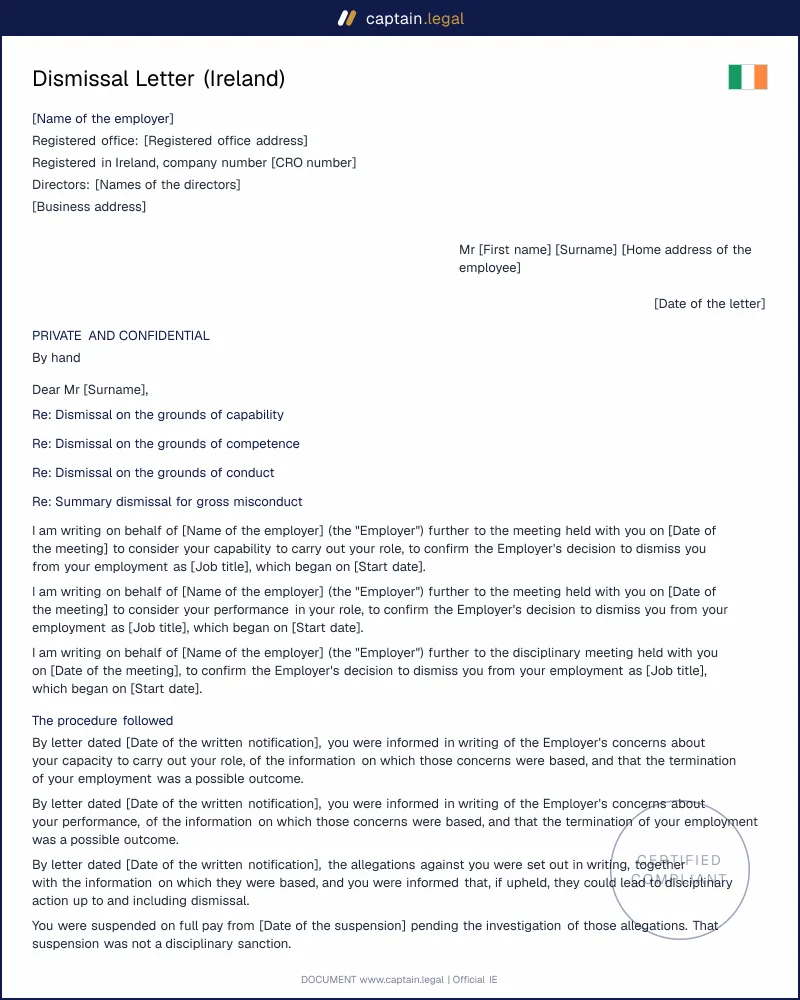
The dismissal letter opens with the employer's identity and, for a company, the particulars that section 151 of the Companies Act 2014 requires on business letters: registered office, registration number and directors. The subject line names the ground, and the procedural section records the written notification, any suspension on full pay, the meeting and whether the employee was accompanied.

  • Each of the four grounds has its own reasons paragraph, ending with the matching limb of section 6(4).
  • A capability letter records the medical evidence considered and that reasonable accommodation was examined.
  • Notice is the longer of the contractual and statutory periods. It runs, is paid in lieu, or, for gross misconduct, gives way to summary termination on the date the decision takes effect.
  • Final pay covers wages, untaken annual leave and public holiday compensation, reported to Revenue through payroll.
  • An impartial appeal officer, a deadline in working days and the right to be accompanied and represented complete the appeal clause.

A short clause asks for laptops, keys and access cards back by a set date and keeps confidentiality obligations alive. When the letter is handed over in person, an acknowledgement of receipt is added, worded so that signing confirms receipt only. Owners who need other company paperwork can browse our templates for Irish companies and business owners.

How to fill out this dismissal letter

You start by choosing the ground for dismissal, because the subject line, the procedure, the reasons and the notice clause all switch to match it. The form then asks whether the employer is a company registered with the CRO, adds the CRO number and directors only where needed, and moves on to the signatory, the employee's name and address, the job title and the start date.

Most of the work happens in the ground-specific step. For conduct, you describe the facts found and the warnings still in effect; for gross misconduct, the facts, any suspension and the date the dismissal takes effect. Capability asks for the medical evidence, competence for the support given. You then enter the date of the letter setting out the allegations, the meeting date and whether the employee was accompanied, followed by notice, company property, the appeal officer and the delivery method. Click Finish to generate the dismissal letter in Word and PDF. The full library of legal templates for Ireland holds the rest of the catalogue.

Common mistakes to avoid

In practice, the most common mistake is a dismissal letter that does not match what happened. An employer writes that the employee could be accompanied when the meeting was a ten-minute chat in a corridor, and a letter that overstates the procedure damages the employer's credibility on every other point. A close second is relying on an expired or first written warning to justify dismissal for ordinary misconduct: the Code of Practice expects progressive sanctions, and dismissal normally follows a final written warning still in effect.

Notice causes its own problems. Employers give the contractual notice when the statutory minimum is longer, impose payment in lieu without a contractual clause, or date a summary dismissal on the day the letter is written although it arrives days later by post. Naming as appeal officer the manager who took the decision is another frequent weakness; in a small firm, an external HR adviser can hear the appeal instead. Finally, many forget that an employee can ask for written reasons under section 14(4). Keep the signed letter, proof of delivery and meeting notes in one file, and answer any request for reasons promptly.

Key takeaways

UDA 1977 S.6

The employer must prove a fair ground for dismissal

Every dismissal is presumed unfair unless the employer shows that it resulted wholly or mainly from a fair ground, such as the employee's capability, competence or conduct, or from other substantial grounds. The adjudication officer can also weigh how reasonably the employer acted and whether the disciplinary procedure and the Code of Practice were followed, so the letter states the ground and the steps of the procedure.

MINIMUM NOTICE

Statutory notice depends on length of service

After 13 weeks of continuous service, the minimum notice runs from one week (under two years) to eight weeks (fifteen years or more), and longer contractual notice prevails. Payment in lieu needs a contractual clause or the employee's agreement. Gross misconduct allows termination without notice, but wages up to the last day and compensation for untaken annual leave remain payable in every case.

S.14(4) AND WRC

Written reasons within 14 days, claims in six months

If the employee asks for the grounds of dismissal, the employer must give written particulars of the principal grounds within 14 days of the request. A claim for unfair dismissal goes to the Workplace Relations Commission within six months of the date of dismissal, extendable to twelve months for reasonable cause. Employees with under a year's service are generally excluded, with important exceptions.

Frequently Asked Questions

The letter is a valid written notice of termination once it is signed by someone with authority to dismiss and delivered to the employee. No witness or solicitor is required. What it cannot do is make an unfair decision fair: if the procedure was flawed or the ground was not genuine, the Workplace Relations Commission can still award reinstatement, re-engagement or compensation under section 7 of the Unfair Dismissals Act 1977. Treat the template as the last step of a fair process and check that every fact it records is accurate.

Both formats are generated when you click Finish. The Word version lets you add your letterhead or a reference number before printing, while the PDF is ready to sign and hand over, or to attach to an email sent alongside registered post. Most employers keep the Word file on the personnel record. If a detail changes before delivery, such as the meeting date or the appeal officer, return to the form and regenerate both versions.

A claim must reach the Workplace Relations Commission within six months of the date of dismissal, extendable to twelve months where the employee shows reasonable cause for the delay. The date of dismissal is the date notice expires; where notice was paid in lieu or was too short, it is the date proper notice would have expired. That rule also matters for the one-year service threshold, because the statutory or contractual notice period counts towards the year even when it is not worked.

Reasons are not optional in practice. Under section 14(4) of the Unfair Dismissals Act 1977, the employer must give written particulars of the principal grounds within 14 days of the employee's request, and the burden of proving a fair ground sits with the employer from the start. A letter that states the ground and the facts behind it answers that request in advance. It is far harder to argue a different reason later when the letter says something else.

The statutory minimum is one week for 13 weeks to two years of service, two weeks for two to five years, four weeks for five to ten years, six weeks for ten to fifteen years and eight weeks beyond that. Longer notice in the contract prevails, so the contract itself should state the period, as the employment contract templates in our Irish catalogue do, and shorter contractual notice is replaced by the statutory scale. For gross misconduct, section 8 of the Minimum Notice and Terms of Employment Act 1973 allows termination without notice, though holiday pay owed is always payable.

Most employees with under a year's service cannot claim under the Unfair Dismissals Act 1977, but the exceptions are important. Where the dismissal is linked to trade union membership, pregnancy, maternity, parental, carer's or other family leave, or a protected disclosure, no service is required, and equality claims on grounds such as disability or age remain open. Follow a fair process anyway, and record it in writing. Adjudication officers look closely at timing when a dismissal follows soon after the employee announced a pregnancy or asked for leave.

The Code of Practice defines the representative as a colleague of the employee's choice or a registered trade union, excluding anyone unconnected with the enterprise. Since Iarnród Éireann v McKelvey, Irish courts treat legal representation at an internal meeting as the exception, kept for cases raising points that the employee and a colleague or union official could not reasonably handle; the seriousness of the allegation is not enough on its own. Most employers decline a solicitor and offer a colleague or union representative instead. Our template records whether the employee came accompanied or alone after being told of that right.

4.5/5

13 verified reviews · 50 000+ downloads

Dismissal Letter Ireland (Unfair Dismissals Acts)
  • Immediate access to the document
  • PDF + Word download
  • Compliant with 2026 legislation
  • Reviewed by lawyers
Fill in the template
Secure payment
Updated on November 3, 2026

You might also like

Independent Contractor Agreement (Ireland)
Redundancy Notice Letter (Ireland)