Business

Constitution of a Private Company Limited by Shares (LTD) Ireland

Ready-to-sign constitution for an Irish private company limited by shares under Part 2 of the Companies Act 2014: Schedule 1 paragraphs, share capital, pre-emption, transfer rules, directors and meetings, with up to four subscribers.
4.7/5— 13 reviews50 000+ downloadsInstant download
Share

A company constitution is the single document that, once registered, brings an Irish private company limited by shares into existence and sets the rules it runs on. Founders, accountants and company secretaries preparing a new LTD use it to state the company's name, its share capital and the internal rules on shares, meetings and directors, before filing it with the Companies Registration Office alongside Form A1. Our template follows the form set out in Schedule 1 to the Companies Act 2014 and adds supplemental regulations that write out the defaults that matter and leave the key choices to you.

Compliant

2026 Legislation

50,000+ clients

trust us

Affordable

From €4.90 / doc

Secure payment

Instant download

Constitution of a Private Company Limited by Shares (LTD) Ireland

Secure payment

Fill in the template

What is a company constitution for an Irish LTD?

Under Part 2 of the Companies Act 2014, the LTD is the default Irish company type, and its company constitution is a one-document constitution. There is no separate memorandum and articles of association, the format still used by a DAC, a CLG or a PLC. Section 19 lists what the document must state: the name, the fact that the company is a private company limited by shares registered under Part 2, limited liability, the share capital position, the number of shares (at least one) taken by each subscriber and any supplemental regulations. The LTD has no objects clause, because section 38 gives it full and unlimited capacity to carry on any lawful business.

The constitution is not a shareholders' agreement. It is a public document: the CRO registers it, anyone can obtain a copy, and section 31 makes it binding on the company and every member as if each had signed a covenant to observe it. A shareholders' agreement stays private and binds only its signatories. Many owners use both, with share transfer rules in the company constitution, where they bind future members automatically. Our business templates for Irish companies cover the documents that usually follow incorporation.

When do you need this document?

Every new LTD needs a company constitution, so the real question is which version suits your situation. The most frequent case is the single-member company: one founder, one director, a separate secretary, and a constitution that must still deal with a second shareholder arriving later. Two founders who split a business 50/50 face a different problem: the casting vote. If one founder chairs board meetings, the statutory casting vote hands that person the final word on every deadlock, which is rarely what the other founder agreed to.

Families usually want shares to stay among themselves. Parents bringing children in as subscribers, or siblings running a farm or a shop through a company, get that result from a right of first refusal on transfers, and a will from our personal legal documents for Irish families makes clear who inherits the shares. A business planning to hire quickly will also need employment contracts for your first staff.

One edge case deserves a word. If your project is a charity, a sports club or a community group, the LTD is usually the wrong vehicle and a company limited by guarantee fits better, which is what our nonprofit and CLG documents are built for.

Key clauses included in our template

The opening paragraphs reproduce Schedule 1 almost word for word: the name with its "Limited" or "Teoranta" ending, registration under Part 2, limited liability and the share capital. You choose between the two forms allowed by section 19(1)(d), either an authorised share capital divided into a stated number of shares, or no ceiling at all with shares of a fixed nominal value. The supplemental regulations then cover interpretation, the directors' authority to allot shares under section 69(1), calls, lien and forfeiture, transmission on death or bankruptcy, dividends under sections 117 and 124, accounts, notices by post and email under section 218, officers' indemnity within the limits of section 235, and winding up.

Shares get the most attention, because that is where small companies fall out. You decide whether existing members keep the statutory right of pre-emption on new shares or whether the directors may issue shares to anyone. You also decide whether to add a right of first refusal on transfers: a selling member must offer the shares to the other members first, at an agreed price or at fair value certified by an independent chartered accountant, with transfers to a spouse, civil partner, children or family trust left outside the procedure. The template disapplies the two-month limit in section 95(1)(b) for transfers that skip that procedure. Arrangements that go beyond these rules, such as vesting or non-compete terms, belong in a separate agreement drawn from our company and commercial documents for Ireland.

Governance closes the document. The directors' clauses set a minimum of one or two directors, restate the EEA residency rule, keep directors appointed by the board in office beyond the next AGM, and let you keep or remove the casting vote. General meetings, electronic participation under section 176A, written resolutions under sections 193 and 194, the single-member procedure in section 196 and the subscribers' declaration with witness or electronic authentication complete the text.

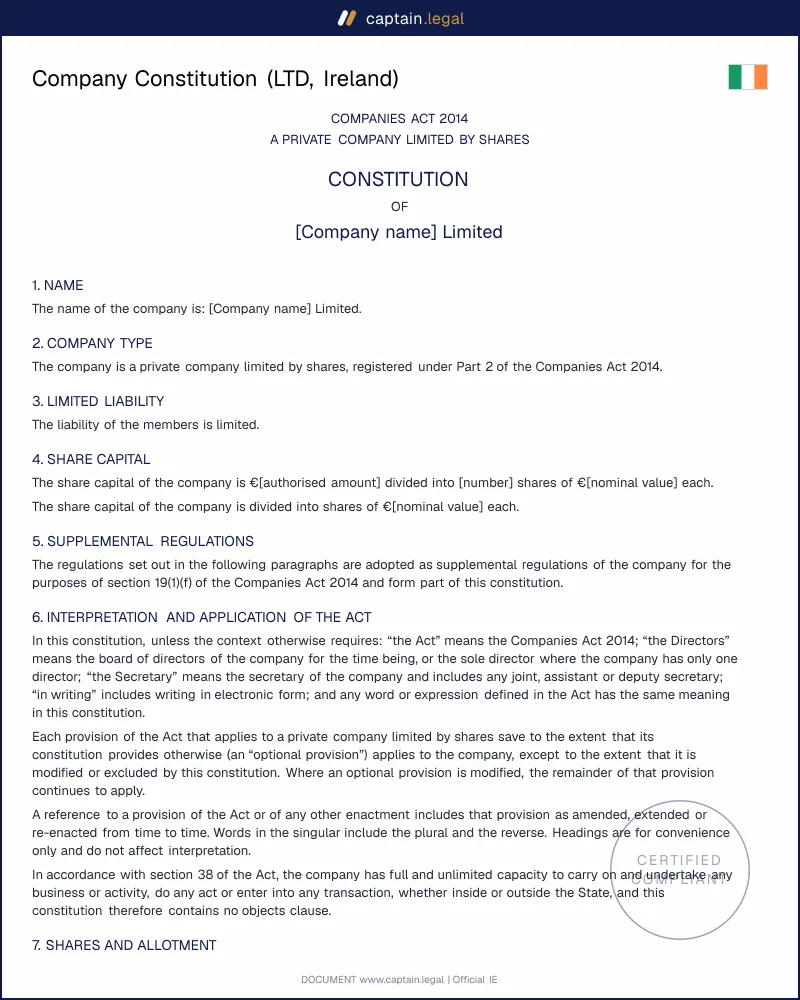
How to fill out this company constitution

You start with the company name, entered exactly as it will appear on Form A1, then pick the "Limited" or "Teoranta" ending. The next screens ask for the nominal value of each share and whether you want an authorised share capital; if you do, you add the total amount and the number of shares, and the preview rewrites paragraph 4 as you type. From there, the questionnaire turns to the board. You choose a minimum of one or two directors and decide whether the chairperson keeps a casting vote, and the quorum and voting clauses adjust to match.

Two questions then cover share issues and share transfers, each with a short note on what the option changes. After that you state how many subscribers will sign, up to four, and give each one's name, address, description and number of shares, along with the total where there is more than one. The final step asks for the signing date and whether the subscribers will sign on paper before a witness or authenticate electronically through the CRO's online system. Clicking Finish produces the constitution in Word and PDF, ready to sign and file with Form A1. The Irish legal document library lists everything else available for Ireland.

Common mistakes to avoid

The CRO's checks start with the name, and a name mismatch is a classic ground for a returned application. The name in the constitution must match the name on Form A1 exactly, including the ending and any punctuation, and a reserved name only holds for a limited period. Arithmetic causes the next problem: an authorised share capital of one amount divided into a number of shares that does not multiply back to it. The CRO examiner will spot it. Paper filings add a trap of their own: relying on the typed figure alone. CRO guidance asks each subscriber to write the number of shares taken in his or her own hand, which is why the template leaves a line for it beside each signature.

Governance mistakes surface later and cost more. Founders with a 50/50 split who leave the casting vote in place create a company where whoever chairs the meeting wins every tie. Appointing a sole director who also acts as secretary breaches section 129(6) and is a common reason for a returned application. Many people also assume the constitution appoints the directors. It does not. The first officers come from the Form A1 statement, and later changes go to the CRO on Form B10 within 14 days.

Key takeaways

CA 2014 S.19

Schedule 1 form, witnessed or authenticated

An LTD constitution must state the name ending in Limited or Teoranta, registration under Part 2, limited liability, the share capital and the shares taken by each subscriber. It follows the Schedule 1 form, is divided into paragraphs numbered consecutively, and is either signed by each subscriber before a witness who attests the signature or authenticated electronically under section 888.

OPTIONAL PROVISIONS

Statutory defaults apply unless you exclude them

Many rules of the Companies Act 2014 apply save to the extent that the constitution provides otherwise: the directors' discretion to refuse a transfer, the chairperson's casting vote, the board quorum of two, pre-emption on new shares. A constitution that says nothing accepts them all, which matters in a company owned 50/50 or when a family wants shares to stay among existing members.

S.129 AND S.137

One director is enough, but not as secretary

An LTD may have a single director, but that person cannot also be the company secretary, so a second individual or a corporate secretary is needed. At least one director must be resident in an EEA state unless the company holds a bond or a certificate of real and continuous link. The first directors are those named in the Form A1 statement, and naming someone only in the constitution has no effect.

Frequently Asked Questions

Registration is what gives it force. Once the CRO registers it and issues the certificate of incorporation, section 31 of the Companies Act 2014 binds the company and every member, present and future, as if each had signed it. A member who later disagrees with a clause cannot ignore it; the route is a special resolution under section 32, passed by at least 75% of the votes cast. The template follows the Schedule 1 form and meets the formal requirements of section 19, but the commercial choices are worth a check with your accountant or solicitor.

Both formats are available as soon as you click Finish. Most people print the PDF for wet-ink signing; for a paper filing, the CRO expects clear black print on durable paper. The Word file helps when an adviser wants to add a bespoke regulation. Any edit should keep the paragraphs numbered consecutively, as section 19(2)(b) requires, and leave paragraphs 1 to 4 in line with Schedule 1. Keep a signed copy with the statutory registers, because members can ask for one at any time.

No statutory deadline applies. The CRO publishes its current processing targets and the dates of the applications it is working on, and an online application through CORE, especially one lodged under the Fé Phráinn scheme used by formation agents, moves fastest when the documents are complete and the name is accepted. A returned application restarts the clock, so check names, share figures and officer details before you submit. Under section 28 you can reserve a name for up to 28 days while you prepare. The company only exists from the date on the certificate.

The company must take one of two routes. The first is a bond in the prescribed form, for the amount fixed by section 137(2), delivered with the Form A1 statement, which covers certain company law fines and tax penalties if the company fails to pay them. The second is a certificate under section 140 confirming a real and continuous link with an economic activity in the State, for example because the company trades here. A written statement from Revenue supports that application. Without either, the company and its officers in default commit an offence under section 137(6).

Not as a rule. Section 196 lets the sole member exercise every power of the general meeting without holding one, provided each decision is kept as a written record and given to the company. The annual general meeting can also be dispensed with by a written resolution that meets section 175(3). One exception survives: removing a statutory auditor still requires an actual meeting. The template sets the quorum at one member for a single-member company, so nothing needs amending if a second shareholder joins later.

Any part of it can be amended by special resolution, passed at a general meeting called on 21 days' notice, by a written resolution signed by all members, or by the 75% majority procedure in section 194. The amended text then goes to the CRO with the resolution, within the time set by the Act. A change of name also needs CRO approval under section 30. An amendment cannot force an existing member to take more shares or increase their liability without written consent, a protection found in section 32(4).

4.7/5

13 verified reviews · 50 000+ downloads

Constitution of a Private Company Limited by Shares (LTD) Ireland
  • Immediate access to the document
  • PDF + Word download
  • Compliant with 2026 legislation
  • Reviewed by lawyers
Fill in the template
Secure payment
Updated on November 3, 2026

You might also like

Terms and Conditions of Sale (Ireland)
Shareholders' Agreement (Ireland)