Employment

Fixed-Term Employment Contract Ireland (Fixed-Term Work Act 2003)

Fixed-term or specified-purpose contract of employment under Irish law: end date, project or cover, written statements of the objective condition and renewal grounds, four-year rule, unfair dismissals exclusion on expiry, probation, pay, leave, sick pay, pension and early termination options.
4.5/5— 14 reviews50 000+ downloadsInstant download
Share

A fixed-term contract is the written agreement an Irish employer uses to hire someone for a limited period: until a set date, until a project is finished, or until an absent colleague comes back. It carries the same core terms as any other contract of employment (pay, hours, leave, sick pay, pension) but adds the protections and formalities of the Protection of Employees (Fixed-Term Work) Act 2003. Get those formalities right and the employment can end cleanly when the term expires. Get them wrong and the employer may face an unfair dismissal claim, or find that a series of short contracts has quietly become a permanent job. Our template is written for Irish employers of every size.

Compliant

2026 Legislation

50,000+ clients

trust us

Affordable

From €4.90 / doc

Secure payment

Instant download

Fixed-Term Employment Contract Ireland (Fixed-Term Work Act 2003)

Secure payment

Fill in the template

What is a fixed-term contract in Ireland?

The 2003 Act defines a fixed-term employee as someone whose contract ends on an objective condition: arriving at a specific date, completing a specific task, or the occurrence of a specific event. The first is the classic fixed term; the other two are usually called specified-purpose contracts, because nobody can say in advance when the work will finish. A data migration or maternity cover both fall into this category, and the Act treats them exactly like a fixed term. In practice, the real question is often whether the stated end point was genuine or merely a label for a role that was always going to continue.

A permanent contract has no end date and continues until one side gives notice. A temporary agency worker has a contract with the agency rather than with the business where the work is done, and falls under different rules. Apprentices and people on publicly supported training, integration or vocational retraining programmes are excluded from the 2003 Act altogether. If the job has no genuine end point, a permanent contract is the honest choice, and you will find one alongside our other employment contracts and HR letters for Irish employers.

When do you need this document?

Seasonal peaks are the most common reason. Hotels, retailers before Christmas and farms at harvest all need extra staff for a few months, and a set end date fits that pattern. Project work comes next: an IT migration or a research grant gives the employer a natural end point, and a specified-purpose clause ties the employment to it rather than to a guessed calendar date. Cover for an absent employee is the third big category. Maternity, adoptive, parent's or carer's leave, a career break or a secondment all leave a post that must be filled without being vacant.

Renewals deserve their own mention. Employers often keep someone on through a second or third contract, and each renewal needs a written statement of the objective grounds for not offering a permanent post. Funding cycles are a frequent edge case: when a programme is extended year by year, the employee can drift past three or four years of service without anyone noticing. Charities that depend on annual grants meet this problem constantly, and the governance documents for Irish nonprofits sit naturally beside this contract. A second edge case arises when the absent colleague resigns instead of returning, which ends the cover purpose and may also open a permanent vacancy that the fixed-term employee should hear about. When the cover is triggered by a staff member's leave, the templates for leave requests and notifications help document the absence itself.

Key clauses included in our template

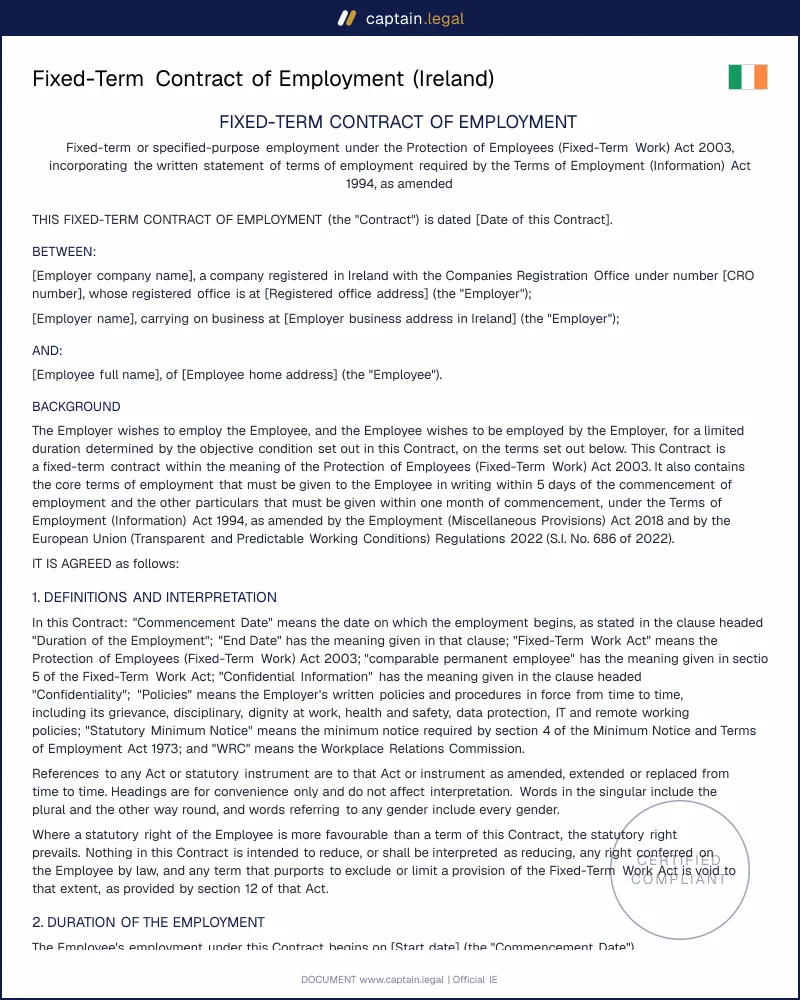
The contract opens with the parties, a definitions clause and a duration clause that adapts to your answer: a set end date with the reason for it, a task or event with its expected duration, or cover for a named post with the reason for the absence. A separate clause gives the section 8(1) statement of the objective condition in matching words, and, where the contract renews an earlier one, sets out the section 8(2) grounds and the start date of the first contract. It also states the limits of section 9.

Above both signatures sits the exclusion clause under section 2(2)(b) of the Unfair Dismissals Act 1977, drafted in the form the statute requires. Probation follows, from two weeks to six months, with a statement that the period is proportionate and that no new probation applies on a renewal for the same functions and tasks. The working terms mirror a permanent contract: place of work (on site, hybrid or remote), hours, overtime, pay and pay reference period, tips policy where relevant, annual leave reduced in proportion for part of a year, statutory sick leave or company sick pay, and MyFutureFund or the employer's pension scheme. An equal treatment clause covers section 6, information on permanent vacancies and access to training.

On early termination you get a real choice: statutory notice, a longer contractual notice, or no break clause at all. The template also covers payment in lieu, garden leave, lay-off, optional non-solicitation restrictions, redundancy rights on expiry and the return of property. Businesses that hire contractors rather than employees should look at the commercial agreements for Irish businesses instead.

How to fill out this fixed-term contract

You begin with the employer, either a company registered with the CRO or an individual or partnership, and then the employee and the right to work in Ireland. The questionnaire then asks how the contract will end, and follows up with the end date and its reason, the task or event and its expected duration, or the post being covered and the reason for the absence. Identifying the absent colleague by job title is enough and avoids sharing personal details.

Next comes the question that matters most for compliance: whether this contract renews or follows an earlier one. If it does, the form asks for the start date of the first contract and the objective grounds for renewing instead of offering a permanent job. Probation, place of work, hours, overtime, pay, leave, sick pay and pension follow, then the early termination options, optional restrictions and any collective agreement or sectoral order. The preview updates as you answer. Every answer can be revised before you download, and the same approach runs through our catalogue of Irish legal documents.

Common mistakes to avoid

The most expensive mistake is letting the paperwork lag behind the work. If the employee starts before the contract is signed, or signs only weeks later, the section 2(2)(b) exclusion may not hold, and an employee with a year of service could bring an unfair dismissal claim when the term ends. A close second is the specified-purpose contract with a vague purpose, such as "to assist with the workload", which gives no objective condition at all. Describe the task, event or absence so precisely that both parties will know when it has happened.

Rolling renewals are behind many of the fixed-term disputes that reach the WRC. Employers renew year after year without a written statement of objective grounds, then discover that the four-year limit has passed and the contract is deemed to be of indefinite duration. Paying a fixed-term employee less than permanent colleagues, or excluding them from sick pay or pension, also needs a real justification. Omitting a break clause is another trap: without one, ending the contract early can expose either side to a claim for the pay due until the end date. Finally, do not let a contract run past its end date by default, since continued work without a written renewal undermines the exclusion clause.

Key takeaways

UDA 1977 S.2(2)(B)

Expiry claims are excluded only by a signed clause

The expiry of a fixed term without renewal is a dismissal under the Unfair Dismissals Act 1977. Section 2(2)(b) takes it outside the Act only if the contract is in writing, signed by or on behalf of the employer and by the employee, and states that the Act will not apply to a dismissal consisting only of the expiry or the end of the purpose. The template contains that clause, above both signatures, and should be signed before work starts.

FTWA 2003 S.9

Successive contracts are capped at four years

Under section 9 of the Protection of Employees (Fixed-Term Work) Act 2003, once an employee has completed three years of continuous employment a fixed-term contract can be renewed only once, for at most one year, and continuous fixed-term contracts may not exceed four years in total. A term that breaches these limits has no effect and the contract becomes one of indefinite duration, unless the renewal is justified on objective grounds.

FTWA 2003 S.6

Fixed-term staff get the same terms as permanent

Section 6 of the 2003 Act forbids treating fixed-term employees less favourably than comparable permanent employees on pay, sick pay, leave or any other condition of employment, unless the difference is justified on objective grounds. Service qualifications must be the same, and the rule does not cover pension schemes for an employee working under 20 per cent of the comparator's hours. Section 10 adds a duty to tell them of vacancies.

Frequently Asked Questions

It is binding from the moment both sides agree to it, since a contract of employment needs no particular form in Irish law. The signatures matter for something else: a fixed-term contract only gives the employer the protection of section 2(2)(b) of the Unfair Dismissals Act 1977 if it is in writing, signed by or on behalf of the employer and by the employee, and contains the exclusion clause. Our template includes that clause and signature blocks for both parties, together with the particulars the Terms of Employment (Information) Act 1994 requires. Statutory rights still apply in full: no clause can reduce the protections of the 2003 Act, and any term that tries to do so is void.

Section 9 of the 2003 Act sets two limits. Once an employee has completed three years of continuous employment, a fixed-term contract may be renewed only once, and only for up to one year. Separately, two or more continuous fixed-term contracts may not exceed four years in total. A contract that breaches either limit is treated as a contract of indefinite duration. Both limits fall away only where the renewal is justified on objective grounds, and the employer must be able to prove those grounds. A single contract for five years is lawful; five consecutive one-year contracts generally are not.

Both formats are available as soon as you finish the questionnaire. The PDF is ready to print and sign, while the Word version lets you add details specific to your workplace, before anyone signs. Edit with care: changing the exclusion clause, the end date or the statement of objective grounds can weaken the protection the contract gives you. Employers drafting other workplace paperwork can find related documents in the Irish employment law templates section.

Under section 3(1A) of the Terms of Employment (Information) Act 1994, the employer must give the core terms in writing within 5 days of the start, and for a fixed-term contract those terms include the end date or, for a specified-purpose contract, the expected duration. The remaining particulars must follow within one month. Signing this contract before the first day covers both deadlines at once, and also makes the unfair dismissals exclusion far safer. Failing to provide the core statement within one month, without reasonable cause, is an offence.

Expiry of a fixed term, or the end of a specified purpose, without renewal counts as a dismissal under the Redundancy Payments Act 1967, so an employee with at least 104 weeks of continuous service may be entitled to a statutory redundancy payment if the dismissal is by reason of redundancy. Continuous service can include earlier fixed-term contracts, for example where an employee whose contract ended by redundancy returns within 26 weeks. No payment arises if the contract is renewed, and the right is lost if the employee unreasonably refuses a suitable offer of renewal.

Only if the contract allows it, or in limited cases such as gross misconduct. That is why the template asks you to choose: early termination with the statutory minimum notice, with a longer contractual notice, or no break clause at all. Statutory notice rises from one week to eight weeks with service, under the Minimum Notice and Terms of Employment Act 1973. Without a break clause, an employer who dismisses early for a reason other than misconduct may owe damages up to the pay due for the rest of the term. Note that the unfair dismissals exclusion covers only expiry, never an early dismissal.

4.5/5

14 verified reviews · 50 000+ downloads

Fixed-Term Employment Contract Ireland (Fixed-Term Work Act 2003)
  • Immediate access to the document
  • PDF + Word download
  • Compliant with 2026 legislation
  • Reviewed by lawyers
Fill in the template
Secure payment
Updated on November 3, 2026

You might also like

Job Offer Letter (Ireland)
Disciplinary Warning Letter (Ireland)