Business

Board Minutes and Directors' Written Resolution Ireland

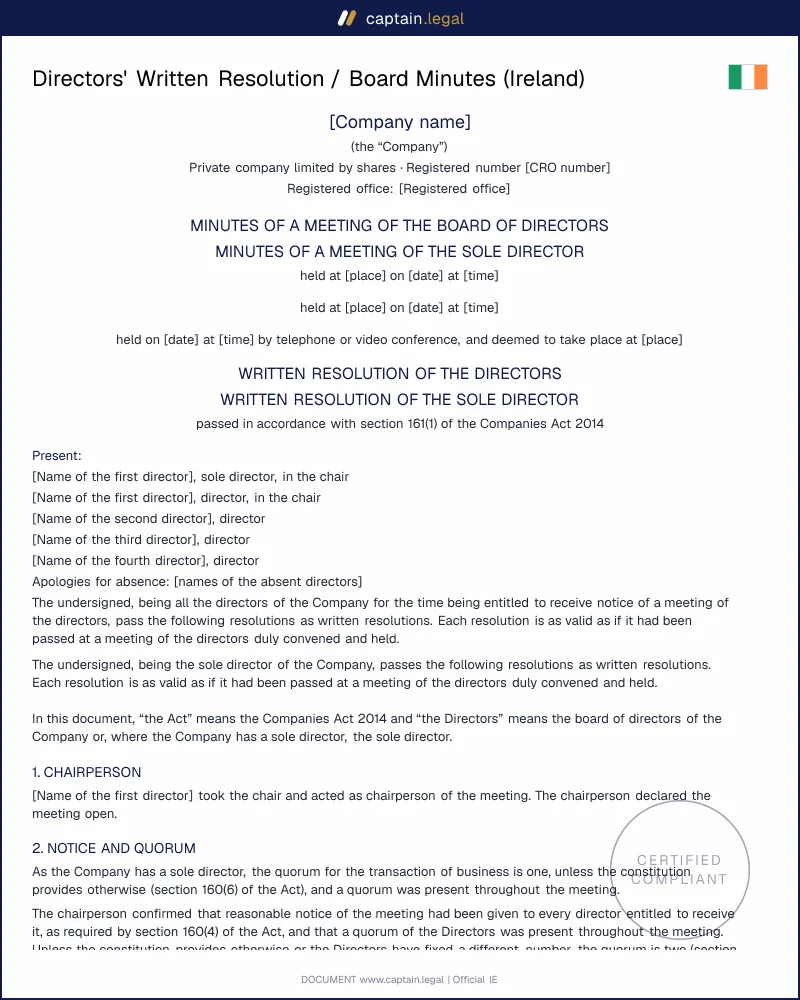
Minutes of a board meeting or a written resolution of the directors of an Irish private company limited by shares, under the Companies Act 2014: quorum, declarations of interest, bank account, share allotment, registered office and secretary, with CRO filing deadlines.
4.5/5— 17 reviews50 000+ downloadsInstant download
Share

Board minutes are the written record of what the directors of an Irish company decided and how they decided it. This template produces either the minutes of a board meeting or a directors' written resolution signed without a meeting, for a private company limited by shares (LTD) under the Companies Act 2014. It covers the decisions small companies take most often: opening a bank account, allotting new shares, changing the registered office, appointing a company secretary, plus one resolution in your own words. Founders, sole directors, accountants and company secretaries use it when a bank, an auditor or an investor's solicitor asks to see the board's decision in writing.

Compliant

2026 Legislation

50,000+ clients

trust us

Affordable

From €4.90 / doc

Secure payment

Instant download

Board Minutes and Directors' Written Resolution Ireland

Secure payment

Fill in the template

What are board minutes and a directors' written resolution?

Directors of an Irish company can decide things in two ways. They can meet, in a room or by video, discuss the business and vote, and the company then records the outcome in board minutes signed by the chairperson. Or they can skip the meeting and all sign one document setting out the decision, which is a written resolution of the directors. A written resolution signed by every director entitled to notice of a board meeting is as valid as a resolution passed at a meeting duly convened and held, which is why many owner-managed LTDs rarely hold formal board meetings at all.

Neither document is a member resolution, and the two sets of records live in different books. Shareholders decide some questions themselves (changing the constitution, changing the company name, approving a loan to a director under the Summary Approval Procedure), and the minutes of their general meetings are kept under section 199. Directors decide the day-to-day matters that the Act and the constitution leave to the board, and their minutes are kept under section 166. For the member-level paperwork, the Irish company and business templates cover the constitution and shareholders' agreements.

When do you need board minutes or a written resolution?

The commonest trigger is the bank. Irish banks routinely ask a new company for a certified copy of the board resolution approving its account mandate and naming who can sign, and they ask again when signatories change. Share issues come next. When an investor, a partner or an employee takes shares, the directors use their authority to allot under section 69, and the board minutes should record that the authority existed and how pre-emption rights were dealt with.

Changing the registered office is another routine case. The office must always be in the State, and the decision should exist in writing before Form B2 is filed. Replacing the company secretary works the same way under section 129. Companies that take on staff often pair these minutes with employment contracts for staff the board hires, because appointing a senior employee is itself a board decision worth recording.

A company with a sole director still needs records: the quorum is one, and a sole director who is also the sole member must record certain contracts with the company under section 255. That founder should also think about succession, since shares pass under a will and the personal legal documents for Ireland include one. Where a director is interested in the matter (a lease of premises the director owns is the usual example), the declaration belongs in the board minutes before the vote, not in an email afterwards.

Key clauses included in our template

The heading identifies the company by its registered name, CRO number and registered office, then states whether the document is minutes of a meeting or a written resolution of the directors or of the sole director. For a board of two or more, the minutes record who chaired, that reasonable notice was given, that a quorum was present and how the resolutions were carried: unanimously, by a majority or on the chairperson's casting vote. Declarations of interest come next, before any resolution is considered, and each resolution then has its own numbered section, renumbered to match the ones you choose:

  • Banks reject a resolution that contradicts their own mandate form, so the bank resolution adopts that form, sets the signing rule for cheques and online payments and authorises a director or the secretary to deal with the bank.
  • New shares are allotted only on receipt of the subscription price in cleared funds, with the directors' authority, the pre-emption position, the share premium rule and the Form B5 deadline written out.
  • For a move of the registered office, the template gives the new address and effective date.
  • Who signs Form B10? The secretary resolution records the consent to act, the board's view of the person's skills under section 129(4) and any outgoing secretary's resignation.
  • Your own resolution is printed after "RESOLVED that".

The closing sections give any director or the secretary authority to file forms and update the registers, then set out the signature block: the chairperson for minutes, every director with a date line for a written resolution. Related templates sit in the Irish legal document library.

How to fill out these board minutes

You start on Captain.Legal by entering the company's registered name, CRO number and current registered office, exactly as they appear on the CRO register. The next question decides the shape of the document: minutes of a meeting, or a written resolution signed without a meeting. You then say how many directors are concerned (one to four) and type their names; at a meeting, the first director named chairs and signs.

For minutes, the form asks for the date, time and place. Where two or more directors attended, it also asks whether they met in person or by video, whether anyone was absent and how the resolutions were passed; a sole director skips those questions. Two screens follow where you answer Yes or No for each resolution, and only the screens for the ones you keep appear afterwards; if you answer No to all of them, the form asks you to write the resolution to be passed. Click Next to move forward and Back to correct an answer; the preview on the right updates as you type and renumbers the sections. On the last screen, click Finish to generate the document, then sign it and file the original in the minute book.

Common mistakes to avoid

The most frequent mistake in practice is a written resolution that one director never signed. As a default rule, section 161(1) needs the signature of every director entitled to notice of board meetings, so a resolution signed by two of three directors does not work. The only statutory exception covers a minority of directors who could not vote on the matter, and then the resolution must name each of them and give the reason (section 161(2) and (3)). Close behind is the share allotment recorded with no thought for pre-emption. Unless the constitution, a special resolution or the terms of issue exclude it, new shares issued for cash must first be offered to existing holders of the class, with the offer open for at least 14 days unless every holder accepts or declines sooner (section 69(6)), and skipping this exposes the directors to a compensation claim under section 70(10).

Directors sometimes approve a loan to one of themselves by board resolution, but a loan to a director is prohibited by section 239 unless an exception applies, and buying a non-cash asset from a director, or selling one to a director, above the section 238 value thresholds needs the members' prior approval. Sole directors occasionally appoint themselves secretary, which section 129(6) forbids. Keep the signed minutes at the registered office with the book of interests, and if the decision is a lease of premises, check the lease against the commercial lease and property templates for Ireland before the board signs off.

Key takeaways

CA 2014 S.161

A written resolution needs every director

By default, a written resolution must be signed by every director entitled to notice of board meetings, in one copy or several identical copies, and it takes effect when the last director signs. The only statutory exception covers a minority of directors who could not vote on the matter, who must then be named with the reason. Keep the signed resolution in the same book as the minutes required by section 166.

CA 2014 S.160

Quorum of two, or one with a sole director

Unless the constitution or the directors fix another number, two directors form a quorum at an Irish board meeting, and one where the company has a sole director. Questions are decided by a majority, and the chairperson has a casting vote on a tie unless the constitution removes it. Directors may meet by telephone or video if each can hear and be heard, and they then count in the quorum.

CA 2014 S.231

Declare an interest before the board decides

A director interested in a contract with the company, for example as landlord, supplier or allottee of new shares, must declare the nature of the interest at a board meeting, and the company copies it into a dedicated book within 3 days. Some deals are outside the board's power: a loan to a director is prohibited unless an exception applies, and a large asset deal with a director needs the members' approval.

Frequently Asked Questions

Minutes record decisions; the decision binds because the board took it validly. What the minutes add is proof. Under section 166(3) of the Companies Act 2014, minutes signed by the chairperson of the meeting, or of the next meeting, are evidence of the proceedings, and section 166(4) presumes the meeting was duly held until the contrary is proved. A written resolution signed by all the directors entitled to notice is as valid as a resolution passed at a properly held meeting. Neither needs a witness, a seal or registration with the CRO, although the filings that follow from the decision do.

A company with one director passes a written resolution when that director signs it, and it takes effect on signature under section 161(5). The template switches to "written resolution of the sole director" and adjusts the wording and the signature block. The sole director cannot also be the company secretary, so a secretary appointment must name someone else. Where the sole director is also the sole member and contracts with the company outside the ordinary course of business, section 255 requires the terms to be written down or minuted at the next board meeting.

Form B2, which notifies a change of registered office, must reach the CRO within 14 days after the date of the change. A return of allotments on Form B5 is due within 30 days after the allotment. A new secretary is notified on Form B10 within 14 days, with the secretary's signed consent to act. The board minutes themselves are never filed with the CRO; they stay in the company's books. Late filing is an offence for the company and its officers, so many companies sign the minutes and submit the form on CORE the same week.

Both formats are available once the document is generated. The PDF is the version to print and sign, or to send to a bank that wants a certified copy. The Word file suits an accountant or company secretary who wants to add a resolution or adapt the wording to the company's constitution. Whichever format you use, keep the signed original with the statutory registers, because the company must be able to produce its minute books if the Corporate Enforcement Authority asks to inspect them (section 166(5)).

Minutes of a meeting are signed by the chairperson of that meeting, or by the chairperson of the next meeting when they are approved there, and either signature makes them evidence of the proceedings (section 166(3)). The company must enter them in the minute book as soon as may be after the meeting. A written resolution is different: each director signs, on one copy or on separate identical copies, and the date of the last signature is the date it takes effect.

Much the same procedure applies to a company limited by guarantee (CLG), which Part 18 of the Companies Act 2014 governs and under which most of the LTD rules on board meetings and written resolutions also apply. This template is drafted for an LTD, with share allotments and pre-emption that a CLG does not have. For a charity board, start with the nonprofit and charity documents for Ireland and record declarations of interest and minutes in the same way.

4.5/5

17 verified reviews · 50 000+ downloads

Board Minutes and Directors' Written Resolution Ireland
  • Immediate access to the document
  • PDF + Word download
  • Compliant with 2026 legislation
  • Reviewed by lawyers
Fill in the template
Secure payment
Updated on November 3, 2026

You might also like

Company Constitution (LTD, Ireland)
Non-Disclosure Agreement (Ireland)