Employment

Disciplinary Warning Letter Ireland (S.I. 146/2000 Code of Practice)

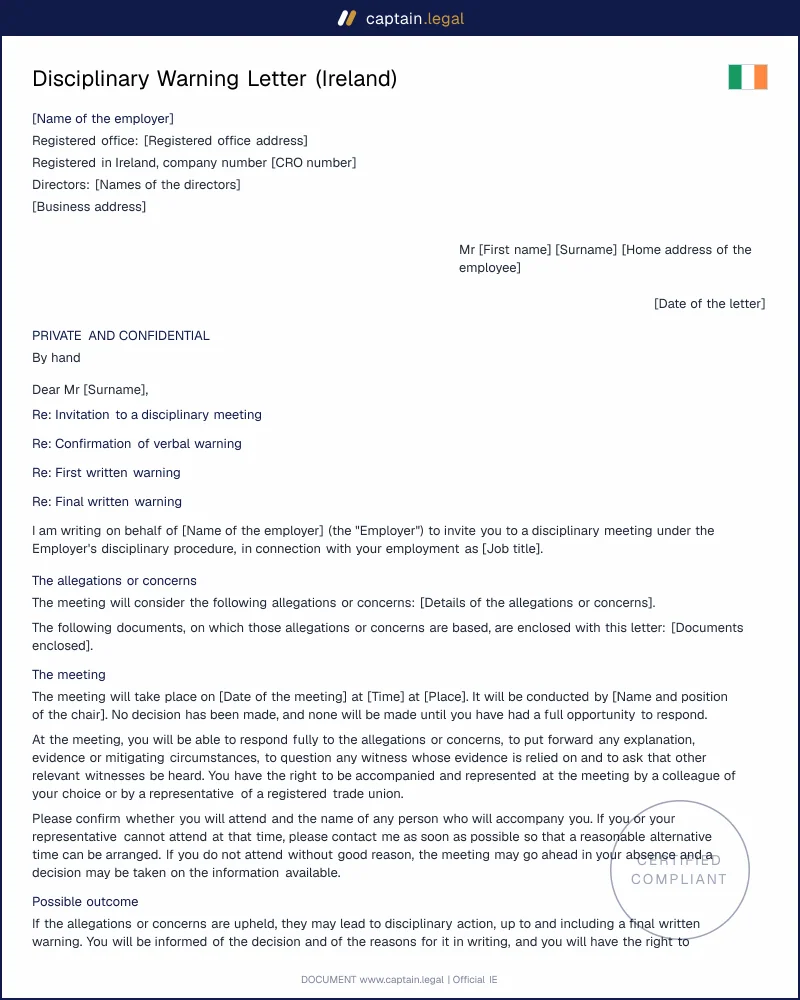
Employer's letter for Ireland confirming a verbal, first written or final written warning after a disciplinary meeting, or inviting the employee to that meeting, with findings, improvement required, duration on file and the right of appeal.
4.5/5— 12 reviews50 000+ downloadsInstant download
Share

A disciplinary warning letter is the written record of a sanction short of dismissal that an employer in Ireland imposes after a disciplinary meeting: a verbal warning confirmed in writing, a first written warning or a final written warning. It sets out what was alleged, what the employer found, the improvement expected, how long the warning stays on file and how to appeal. The same template also produces the invitation to a disciplinary meeting that should come first. It is written for employers and HR staff, from sole traders to companies and charities, who want each step of the procedure documented in a form an adjudication officer will recognise.

Compliant

2026 Legislation

50,000+ clients

trust us

Affordable

From €4.90 / doc

Secure payment

Instant download

Disciplinary Warning Letter Ireland (S.I. 146/2000 Code of Practice)

Secure payment

Fill in the template

What is a disciplinary warning letter in Ireland?

Irish law does not prescribe a form for a warning, and a manager can give one orally. The written letter matters because a warning is only as strong as the procedure behind it. If the employee later disputes the sanction, or if a dismissal follows and relies on earlier warnings, the employer has to show that each warning was fairly given and still in effect. A clear letter dated after the meeting, naming the allegations and the findings, is the best evidence of that. A vague note that "your performance is unacceptable" proves very little.

Between an informal conversation, which leaves no formal record, and a dismissal letter, which ends the employment, sits the disciplinary warning letter. In practice, most Irish procedures run in the order described by the Code of Practice on Grievance and Disciplinary Procedures: an oral or verbal warning, a written warning, a final written warning and only then dismissal. Our template covers the first three stages and the invitation letter. Its wording works for a conduct issue as well as a performance concern handled under the disciplinary procedure.

When do you need this document?

Most files start with a conduct issue that an informal word has not solved: repeated lateness, leaving a workstation without permission, ignoring a safety instruction or a rude exchange with a customer. Once an investigation shows a case to answer, the employer sends the invitation letter, holds the meeting and, if the allegation is upheld, confirms a verbal or first written warning. Performance problems follow a similar route once support and an improvement plan have failed to close the gap.

A final written warning is used when an employee already has a live written warning and the problem recurs, or when a single incident is serious but falls short of gross misconduct. Small employers often forget that the procedure applies to them too. A café owner with four staff is held to the same basic standard of fair procedure as a multinational. Charities and clubs that employ staff are no exception, and their governance paperwork sits in our templates for Irish charities, clubs and nonprofits. One edge case deserves care. When the employee is on sick leave or has just handed in one of the leave request letters used by employees in Ireland, a disciplinary process launched at that moment will be examined closely for any link with the absence.

Key clauses included in our template

The letter opens with the employer's details and, for a company, the particulars that section 151 of the Companies Act 2014 requires on all its business letters: registered office, CRO number and directors. Company owners will find their other records in our templates for Irish companies and business owners. The invitation variant sets out the allegations or concerns, lists the documents enclosed, gives the date, time and place of the meeting and names the person conducting it.

  • Before any finding, the invitation states that no decision has been made, offers the chance to question witnesses and confirms the right to be accompanied and represented.
  • If dismissal could follow, you say so in the invitation; a later dismissal will rarely survive scrutiny when the employee was never told what was at stake.
  • An optional paragraph suspends the employee on full pay. It states that the suspension is not a sanction and will be kept under review.
  • Warning letters record the invitation date, the meeting, whether the employee was accompanied, the findings and the decision.
  • Duration is written in months, after which the warning is removed and the employee is told.

Each warning ends with an appeal clause naming an appeal officer with no previous involvement, a deadline in working days and the right to representation at any appeal meeting. The consequence clause escalates with the stage. A verbal warning points to a written warning, and a first written warning to a final warning or, in a serious case, dismissal. A final written warning states plainly that any further problem while it is in effect may lead to dismissal.

How to fill out this disciplinary warning letter

You start by choosing the letter you need: the invitation, the verbal warning confirmation, the first written warning or the final written warning. Everything that follows adapts to that choice. The form then asks whether the employer is a company registered with the CRO, and adds the CRO number and directors only where they are required. After the employee's name, home address and job title, you describe the allegations or concerns exactly as they were, or will be, put to the employee.

For an invitation, the next screens cover the meeting date, time, place and chair, the documents enclosed, the most serious possible outcome and any suspension. A warning asks instead for the date of the invitation letter, the date of the meeting, whether the employee was accompanied, your findings, the improvement required, the number of months the warning stays on file and the appeal details. The signatory and the delivery method come last; choosing hand delivery adds an acknowledgement of receipt. Click Finish to generate the disciplinary warning letter in Word and PDF. The full catalogue of legal documents for Ireland covers the rest of the employment relationship.

Common mistakes to avoid

The mistake we see most often is a warning issued without a meeting. A manager sends a "final warning" by email after a heated morning, and the employee has never seen the allegation in writing or had a chance to answer it. A warning given without a fair hearing carries little weight when an employer later relies on it. A close second is the warning that never expires. Without a period stated in the letter, the employer cannot show that the warning was removed, as paragraph 4.14 of the Code expects, and an adjudication officer may discount it.

Other errors are quieter. Findings that simply repeat the allegations suggest that the employee's answers were never weighed. Sometimes the manager who investigated also chairs the meeting and then hears the appeal, which leaves no one impartial at any stage. Employers jump to a final written warning for a minor first offence, or describe an ordinary performance gap as "misconduct" when the employee has done nothing deliberate. Clear duties in the job offer and contract, both among our HR letters for Irish workplaces, make the improvement required easier to define. Many also forget to diarise the expiry date. Keep the signed letter, proof of delivery and meeting notes together on the personnel file, and write to the employee when the warning lapses.

Key takeaways

S.I. 146/2000

Allegations in writing, a hearing, then a decision

Under the Code of Practice on Grievance and Disciplinary Procedures, a warning follows a fair procedure: the details of the allegations are put to the employee, who can respond fully, be represented by a colleague or a registered trade union and receive an impartial decision. The Code is admissible in evidence before the Workplace Relations Commission and the Labour Court, so a warning given without a hearing carries little weight.

CODE PARA. 4.14

Every warning needs an expiry date on the record

Warnings should be removed from the employee's record after a specified period and the employee advised accordingly. The letter therefore states the number of months the warning remains in effect. A warning that never expires is out of line with the Code, and an adjudication officer may give it little weight when a later dismissal relies on it. Diarise the removal date and confirm it to the employee in writing.

FINAL WARNING

A final written warning should warn of dismissal

Warnings are usually progressive: verbal, written, final written, then dismissal, although a serious matter can justify a final written warning at an earlier stage. Dismissal for conduct short of gross misconduct normally relies on a final written warning still in effect, which told the employee that any further problem could lead to dismissal. If dismissal is a possible outcome of a meeting, the invitation should say so beforehand.

Frequently Asked Questions

The letter is a valid written sanction once it is signed by a manager with authority under your disciplinary procedure and delivered to the employee. No witness or solicitor is needed, and the employee does not have to agree with it. What the letter cannot do is cure a flawed process. If the allegations were never put to the employee, or the decision was taken before the meeting, the warning can be challenged and may count for little if a dismissal later relies on it. Treat the template as the record of a fair procedure, not a substitute for one.

Both formats are generated when you click Finish. The Word file is the one to adapt: you can add your letterhead or a file reference before printing. The PDF is ready to sign and hand over, or to attach to an email sent alongside registered post. Either way, the signed copy is what goes on the personnel file. If a detail changes before the letter goes out, such as the meeting date or the appeal officer, go back to the form and generate both versions again.

No fixed period appears in the Code of Practice, but it does expect warnings to be removed after a specified period and the employee to be told. Your own disciplinary procedure should set the durations, and the letter must state the one you apply. Many procedures give a verbal warning a shorter life than a final written warning. What matters is that the period is fixed in advance, written into the letter and respected. Once it ends, remove the warning from the active record and confirm that in writing to the employee.

A signature is not needed for the warning to take effect, and a refusal to sign does not cancel it. When the letter is handed over in person, our template adds an acknowledgement of receipt stating that the signature confirms receipt only and does not mean the employee agrees with the contents. That wording removes the usual reason for refusing. If the employee still declines, note the date and time of delivery, ideally with a colleague present, or send a copy by registered post so that receipt can be proved later.

Yes, if the matter is serious enough. Paragraph 4.11 of the Code describes progressive steps but accepts that more serious action can be warranted at an earlier stage, provided the fair procedure in paragraph 4.6 is followed. A serious safety breach or an abusive outburst may justify a final written warning as a first sanction. A first instance of lateness will not. Explain in the findings why the matter was serious, because an adjudication officer will ask whether the sanction was proportionate to what actually happened.

A representative, for the purposes of the Code, is a colleague of the employee's choice or a registered trade union, not anyone unconnected with the enterprise. In Iarnród Éireann v McKelvey [2019] IESC 79, the Supreme Court confirmed that legal representation at an internal disciplinary meeting is the exception, kept for cases with points that the employee and a colleague or union official could not reasonably handle. For an ordinary warning, refusing a solicitor while offering a colleague or union representative is the normal position. The template records which option the employee chose.

An internal appeal comes first, heard by someone with no previous involvement, as set out in the letter. Beyond that, an employee can refer a dispute about a disciplinary sanction to the Workplace Relations Commission under section 13 of the Industrial Relations Act 1969. Unless the employer objects, an adjudication officer investigates and issues a recommendation, which is not binding but can be appealed to the Labour Court, whose decision binds both sides.

4.5/5

12 verified reviews · 50 000+ downloads

Disciplinary Warning Letter Ireland (S.I. 146/2000 Code of Practice)
  • Immediate access to the document
  • PDF + Word download
  • Compliant with 2026 legislation
  • Reviewed by lawyers
Fill in the template
Secure payment
Updated on November 3, 2026

You might also like

Redundancy Notice Letter (Ireland)
Contract of Employment (Ireland)