Business

Non-Disclosure Agreement (NDA) Ireland: Mutual or One-Way

Mutual or one-way non-disclosure agreement governed by Irish law: confidential information, exclusions, disclosure to advisers, trade secrets under S.I. 188/2018, the protected disclosures carve-out, return of documents, injunctions, GDPR and an optional non-solicitation clause.
4.7/5— 32 reviews50 000+ downloadsInstant download
Share

A non-disclosure agreement is the contract two parties sign before one of them opens its books, its code or its customer list to the other. In Ireland it comes up before investment talks, supplier tenders, joint ventures, the sale of a business and the hiring of consultants. This template is drafted under Irish law and works in two modes: mutual, where both sides share information, or one-way, where only the First Party discloses. It covers the definition of confidential information, exclusions, permitted disclosures, trade secrets, return and destruction, injunctions and GDPR, with the whistleblowing carve-out that Irish law imposes anyway.

Compliant

2026 Legislation

50,000+ clients

trust us

Affordable

From €4.90 / doc

Secure payment

Instant download

Non-Disclosure Agreement (NDA) Ireland: Mutual or One-Way

Secure payment

Fill in the template

What is a non-disclosure agreement under Irish law?

Even without a contract, the equitable action for breach of confidence applies where information has the necessary quality of confidence and was passed on in circumstances that imposed a duty to keep it secret. The trouble is proof. Without a signed document, the discloser has to persuade a court that the other side knew the information was confidential, what it covered and what it could be used for. A non-disclosure agreement settles those three points in advance: it defines the Confidential Information, fixes the Purpose for which it may be used and says who inside the receiving business may see it.

"NDA" and "confidentiality agreement" mean the same thing, and both are ordinary contracts. Nothing is filed with the Companies Registration Office or any other register. What separates a usable NDA from a weak one is detail: a precise purpose, exclusions the receiving party has to prove, a fixed duration and a clear route to an injunction. A mutual NDA suits two companies exploring a deal on equal terms; a one-way NDA fits the inventor showing a prototype to a manufacturer. Both versions sit with the other contracts for Irish companies and sole traders.

When do you need this document?

The classic trigger is a first serious meeting. A software company demoing its product to a bank or two engineering firms preparing a joint tender will each disclose prices, margins or technical detail a competitor would pay for. Sign before the meeting, not after. The template covers earlier disclosures too, but signing first removes the argument.

Due diligence raises the stakes. A buyer looking at a pub or a consultancy sees the accounts and staff costs, and where premises change hands the deal also needs the property templates for Irish landlords and tenants. Many early stage investors refuse NDAs at the pitch, so founders keep the deck general and use the NDA at due diligence.

An outside consultant or developer usually signs the one-way version, often with the optional non-solicitation clause. If the person will become an employee, the confidentiality terms belong in the contract of employment, alongside the other employment documents for Irish employers. One warning: an employer's NDA covering an allegation of discrimination, victimisation or harassment is void under section 14B of the Employment Equality Act 1998, unless the employee asked for it after written independent legal advice and it meets the formal conditions of that section, or it records a resolution reached through WRC mediation.

Key clauses included in our template

Clause 1 defines Confidential Information broadly: oral and visual disclosures whether marked or not, notes and analyses that reflect it, and the existence of the talks themselves. In the mutual version each party can be Disclosing Party and Receiving Party; in the one-way version, anything the Second Party hands over is expressly unprotected unless agreed in writing. Clause 2 sets the core undertakings (secrecy, use for the Purpose only, no copying beyond need, a reasonable standard of care, no reverse engineering of samples or software), and clause 3 lets the Receiving Party brief its Representatives on a need-to-know basis while making it liable for their breaches.

Mark-ups usually target the limits. Clause 4 lists five exclusions (public domain, prior possession, a third party free to disclose, independent development and written consent) and puts the burden of proof on the Receiving Party. Clause 5 handles court orders and regulators, clause 6 protects protected disclosures and reports to An Garda Síochána or other authorities, clause 7 links the agreement to the trade secrets regulations and clause 8 confirms that no licence passes and that privilege is not waived.

In a dispute, the exit clauses carry most of the value. Clause 9 requires return or destruction within 10 Business Days of a request, and written confirmation on request. Clause 10 lets either side end the agreement on 30 days' notice while the duty of confidence runs on for the years you choose, or without time limit, and trade secrets stay protected for as long as they remain secret. Clause 11 preserves injunctions and an account of profits, clause 12 adapts to whether personal data is shared and clause 18 gives the courts of Ireland exclusive jurisdiction while allowing urgent relief abroad. Once the talks succeed, the commercial agreements for Irish businesses take over from the NDA.

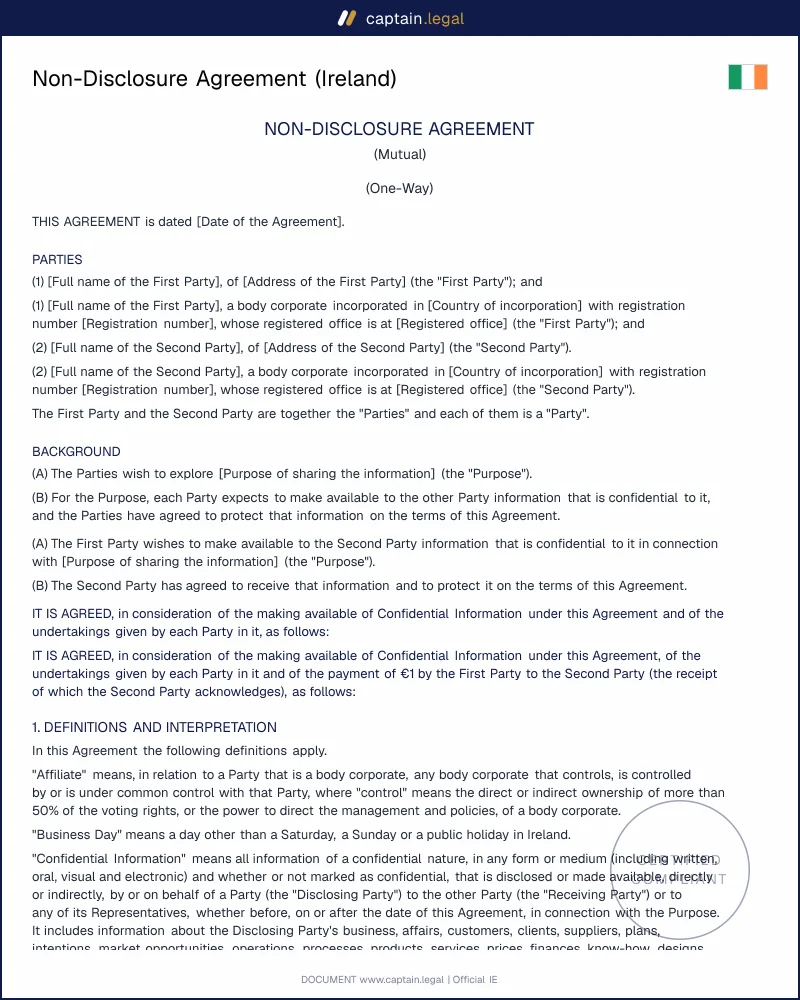
How to fill out this non-disclosure agreement

You start by choosing between a mutual and a one-way NDA; for one-way, enter the party who will disclose as the First Party. Each party then gets its own screen with full name, address and whether it is an individual or a company. For a company, a second screen asks for the country of incorporation, the registration number (the CRO number for an Irish company) and the name and position of the signatory, usually a director.

The Purpose deserves the most care. Write it as a noun phrase, for example "a possible joint venture for the development of a mobile payments application", and keep it narrow, because the Receiving Party may use the information for nothing else. The next screens cover the date, the duration of confidentiality, whether personal data will be shared and whether you want the non-solicitation clause. Use Next and Back to move between screens, then click Finish to generate the agreement in Word and PDF.

Common mistakes to avoid

The most frequent mistake is signing too late. Founders send a deck, have a promising call and only then think of an NDA, once the sensitive material has gone. The second is a Purpose so vague it permits almost any use: "business discussions" protects very little, while a named project gives the Disclosing Party a clear breach to point to. The third is an unlimited duration for information that will be stale within a year. A fixed period of two to five years after the agreement ends is easier to defend, and the template keeps trade secrets protected beyond it anyway.

Over-reaching is the other family of errors. A non-solicitation period of three or four years attached to a short negotiation invites the argument that the clause is an unreasonable restraint of trade, and Irish courts tend to strike out an unreasonable restriction rather than rewrite it. Some parties add wording that forbids any contact with regulators or the Gardaí. That wording is void under the 2014 Act so far as it covers protected disclosures and makes the drafter look careless in front of a judge. Finally, check the parties: a non-disclosure agreement signed in a trading name instead of the company that owns the information, or by someone without authority, is a gift to the other side's solicitor.

Key takeaways

PDA 2014 S.23

No NDA can block a protected disclosure

Section 23 of the Protected Disclosures Act 2014 voids any term of an agreement that prohibits or restricts protected disclosures. Since 1 January 2023, the Act also covers individuals who learn of wrongdoing during pre-contractual negotiations, a setting many NDAs share. Clause 6 of the template says so and preserves reports to An Garda Síochána and regulators. A leak to a competitor stays a breach, as does a press leak outside section 10.

S.I. 188/2018

A signed NDA backs up a trade secret claim

Under Regulation 5(2)(b) of the European Union (Protection of Trade Secrets) Regulations 2018, using or disclosing a trade secret in breach of a confidentiality agreement is unlawful. The holder can then seek provisional measures, injunctions, destruction of documents and damages, within six years. Information only qualifies if reasonable steps kept it secret, and the template records the NDA as one of those steps.

CONSIDERATION

A one-way NDA still needs consideration

An NDA signed under hand is a simple contract, and Irish law enforces it only if each side gives something in return. In a one-way NDA the discloser makes few promises, so the template recites the exchange of information and undertakings and adds a nominal payment by the First Party. No witness or registration is needed, and electronic signature is valid where both parties consent, as clause 17 records.

Frequently Asked Questions

Irish courts enforce it once the usual contract conditions are met: clear terms, an intention to create legal relations and consideration. The template records the consideration expressly, plus a nominal payment in the one-way version. No witness, notary or registration is needed. Each party signs under hand, and electronic signatures are valid under the Electronic Commerce Act 2000 where both sides consent, which clause 17 records. A court will still refuse to enforce a term that silences a protected disclosure, so the template excludes those from the outset.

Yes. Once you click Finish, the agreement is generated in both Word and PDF. The Word file helps when the other side's solicitor wants to mark up changes, such as a different duration. The PDF suits a signature on paper or through an electronic signature platform. Keep the signed version with a record of what you disclosed and when, because that record proves the scope of the Confidential Information if a dispute arises. The wider set of Irish legal document templates works the same way.

No statute fixes a duration, so the agreement sets it, and this template separates two periods. The agreement itself runs until either party ends it on 30 days' written notice, or until a definitive contract replaces it. The duty of confidentiality then continues for the number of years you choose, or without time limit. Trade secrets remain protected for as long as they stay secret, and personal data for as long as it is held. A claim for breach of contract, or under the European Union (Protection of Trade Secrets) Regulations 2018, must generally be brought within six years of the breach under the Statute of Limitations 1957.

Pick mutual whenever both sides will share anything sensitive, even if one side shares much more. A mutual agreement is often quicker to sign, as neither side feels short-changed. One-way works for an inventor approaching a manufacturer or a company briefing a consultant. Charities sending donor records to a fundraising agency use it as well, alongside the governance documents for Irish charities and clubs. In the one-way version, anything the Second Party discloses is expressly outside the agreement, so switch to a mutual NDA before that party starts sharing its own material.

No. Section 23 of the Protected Disclosures Act 2014 makes void any term that prohibits or restricts protected disclosures, and the 2022 amendments extended the Act to people who learn of wrongdoing during pre-contractual negotiations. Clause 6 of the template says so openly and also preserves reports to An Garda Síochána, cooperation with regulators such as the Data Protection Commission, legal advice and evidence given in court. Those disclosures are not a breach, and no advance notice is required where giving it would be unlawful. The rest of the agreement still binds: a leak to a competitor is a breach, as is a press leak outside the narrow cases in section 10 of the Act.

Move quickly. The usual first step is a solicitor's letter demanding that the misuse stop and that copies be returned under clause 9. If that fails, the Disclosing Party can apply to the Circuit Court or the High Court, depending on the value of the claim, for an interim or interlocutory injunction; clause 11 records that damages alone may not be adequate, although the court applies its own tests. The trade secrets regulations add orders against infringing goods and damages based on lost profits or unfair gains. Keep evidence of what was disclosed, to whom and when, because an injunction application turns on that proof.

4.7/5

32 verified reviews · 50 000+ downloads

Non-Disclosure Agreement (NDA) Ireland: Mutual or One-Way
  • Immediate access to the document
  • PDF + Word download
  • Compliant with 2026 legislation
  • Reviewed by lawyers
Fill in the template
Secure payment
Updated on November 3, 2026

You might also like

Shareholders' Agreement (Ireland)
Partnership Agreement (Ireland)