Real Estate

Tenant Notice of Termination Ireland (Residential Tenancies Act)

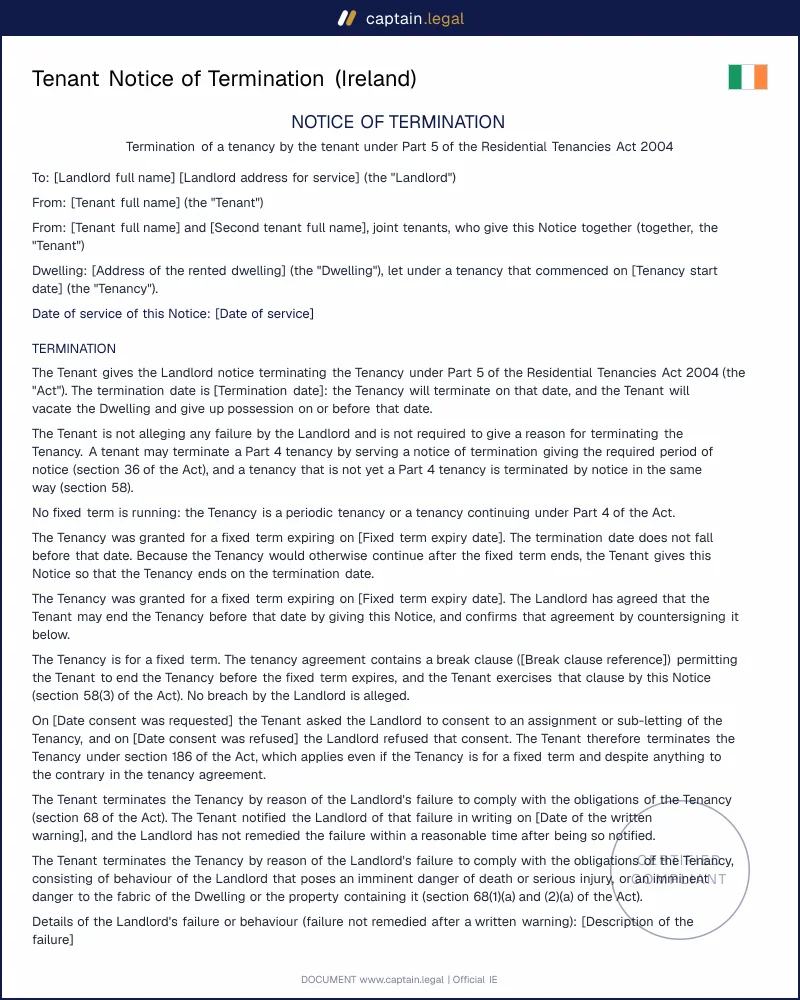
End your Irish tenancy with a valid written notice: termination date, Table 2 notice period or the shorter breach route, the RTB dispute statement, deposit refund request and joint inspection, for one or two tenants, fixed-term or periodic lettings and student accommodation.
4.5/5— 21 reviews50 000+ downloadsInstant download
Share

A tenant notice of termination is the written notice a tenant serves on a landlord to end a residential tenancy in Ireland. It is the only lawful way to end a private tenancy from the tenant's side, and the Residential Tenancies Act 2004 sets out exactly what it must contain. This template is built for tenants renting from private landlords, joint tenants leaving together, and students in purpose-built accommodation. It fixes the termination date, the correct notice period, the statement about the Residential Tenancies Board that the Act requires, and a request for the return of the deposit, so the landlord receives one signed letter instead of a text message that would never meet section 62.

Compliant

2026 Legislation

50,000+ clients

trust us

Affordable

From €4.90 / doc

Secure payment

Instant download

Tenant Notice of Termination Ireland (Residential Tenancies Act)

Secure payment

Fill in the template

What is a tenant notice of termination in Ireland?

Under Part 5 of the Act, a tenancy of a dwelling can only be ended by a notice of termination that complies with the statute. Section 58 rules out every other route: a tenant cannot end the tenancy by handing back the keys, by a phone call or a text, or by simply leaving. A notice that misses one of the formal requirements is invalid, and an invalid notice leaves the tenancy, and the rent, running. In practice this is how tenants end up paying an extra month for a flat they no longer live in.

The document is different from an informal arrangement to leave early, which still has to be put in a written notice (a shorter period can be agreed under section 69, but only after the tenant has said they intend to leave), and from the landlord's own notice, which carries far heavier rules (reasons, statutory declarations, a copy to the Board). A tenant does not have to give a reason when no breach is alleged. The reason only matters when the tenant relies on a shorter or earlier exit, for example because the landlord ignored a written warning about repairs or because the landlord's conduct puts the occupants in danger. For most renters, though, the tenant notice of termination is a short formal letter whose value lies in getting the dates right.

When do you need this document?

Most tenants serve this notice for a simple move. A tenant of three years who has found a new home must give 56 days' notice, counted from the day after service, and the date on the letter decides when rent stops. Job changes come next: a transfer to Cork or an offer abroad often arrives with little slack, and the notice period should be set against the start date in the new employment contracts and workplace letters in Ireland before either is signed.

Couples and housemates who rent together are the second big group. When joint tenants split up and both intend to leave, the notice should name both and be signed by both; a notice signed by one alone invites an argument that the tenancy continues for the other. Separating partners often pair it with cohabitation and personal agreements for Irish households. Parents moving house around a new baby usually have maternity, paternity and parental leave notices to serve on an employer in the same weeks.

Then come the cases where something has gone wrong. Heating that has not worked since the autumn, a leak the landlord keeps promising to fix, or an assignment refused without explanation all open a shorter or earlier exit. A landlord who leaves live wiring exposed after an electrician's warning is the kind of behaviour posing an imminent danger that justifies 7 days. A student whose college year ends in May can use the seasonal right in section 58(4), even mid-contract.

Key clauses included in our template

The opening block identifies the landlord at the address for service, names one or two tenants, describes the dwelling and the start date of the tenancy, and states the date of service. The operative paragraph gives the termination date. Behind it sits the clause explaining the basis for leaving: an ordinary notice with no breach alleged (with variants for a fixed term that is ending, or one ended early with the landlord's countersignature), a break clause identified by its reference, a refusal of consent under section 186, a breach under section 68 with the date of the written warning or the imminent danger relied on, or student-specific accommodation under section 58(4).

How long the notice runs depends on the route. For ordinary, break clause and refusal notices it records how long the tenancy has lasted and the Table 2 minimum; for breach it states 28 or 7 days regardless of duration; for students it states 28 days. The dispute clause then prints the 28-day or 90-day referral period, so you never have to work out which one applies.

On the way out, the notice protects the tenant. It asks the landlord to return the deposit promptly under section 12(1)(d), names the only deductions the Act allows (arrears and damage beyond normal wear and tear), gives an IBAN for the refund, and proposes a joint inspection. Our residential tenancy documents for Ireland cover the lease and inventory that belong in the same file.

How to fill out this tenant notice of termination

You begin by choosing why you are ending the tenancy, because that single answer decides which clauses, notice period and dispute deadline appear. The form then asks for your name, a second tenant's name if you rent jointly, the landlord's name and address for service, and the address of the dwelling with the date the tenancy started. An ordinary notice brings a question on any fixed term still running; the breach, break clause and refusal routes each have a short step for the dates and details that support them. Unless you rely on a breach or on student accommodation, the length of the tenancy is then picked from the six bands in Table 2.

The form opens on the longest band; replace it with the band that matches your start date, because the notice states it as a fact. You then enter the date of service and the termination date, choose how you will serve it, and add the deposit, inspection and forwarding details. Each answer appears live in the preview. Clicking Finish produces a notice to download, print and sign, and the wider library of Irish legal templates works the same way.

Common mistakes to avoid

Short counting is the classic error. Tenants count from the day they post the letter rather than from the day after service, or pick the wrong band in Table 2 because they never checked when the tenancy actually started. A notice that is one day short is not "nearly valid"; the landlord can dispute it before the Board and keep claiming rent until a valid notice expires. Allow spare days when posting, and remember that the date of service you write must be one by which you have done everything in your power to serve it, which is the test in section 64.

Fixed terms cause the second group of problems. An ordinary notice served halfway through a twelve-month lease does not end it early; you need a break clause, an unremedied breach or imminent danger, a refused assignment or sub-letting, the landlord's written agreement, or the student window. Joint tenants who send a notice signed by only one of them create the same kind of trouble. Forgetting the referral sentence to the Board, emailing an address the landlord never uses, and skipping the joint inspection are the other errors that turn a clean exit into a deposit dispute months later.

Key takeaways

RTA 2004 S.62

Five points decide whether your notice is valid

Section 62 of the Residential Tenancies Act 2004 requires the notice to be in writing, signed by the tenant, to state its date of service and the termination date (day, month and year), and to tell the landlord that any dispute about its validity must go to the Residential Tenancies Board within 28 days where section 68 applies, or 90 days otherwise. Miss one and the tenancy, and the rent, keep running.

NOTICE PERIODS

Table 2 sets the minimum, from 28 to 112 days

For an ordinary notice, the minimum depends on how long the tenancy has lasted at the date of service: 28, 35, 42, 56, 84 or 112 days under Table 2 to section 66. The count starts the day after service, so add spare days when posting. A longer notice is allowed, capped at 120 days for a tenancy under six months. An unremedied landlord breach cuts it to 28 days, and imminent danger to 7.

FIXED TERMS

A fixed term ends early only through set routes

An ordinary notice cannot cut a fixed-term lease short. The tenant needs a break clause, a landlord breach left unremedied after a written warning or posing imminent danger, a refusal of consent to assign or sub-let (section 186), the landlord's written agreement, or, in student-specific accommodation, the window from 1 May to 1 October (section 58(4)). Leaving without one of these can cost the deposit or the remaining rent.

Frequently Asked Questions

It is valid when it meets section 62 of the Residential Tenancies Act 2004: written, signed by every tenant who gives it, showing the date of service and the termination date, and stating the period for referring a validity dispute to the Residential Tenancies Board. What makes it hold up in practice is the rest of your file: the correct notice period, proof of service and, for a breach, a copy of your written warning. No form has been prescribed for a tenant's notice, so a properly completed letter is enough.

The minimum depends on how long the tenancy has lasted at the date of service: 28 days under six months, 35 days up to one year, 42 days up to two years, 56 days up to four, 84 days up to eight, and 112 days after that. A landlord breach shortens it to 28 days after a written warning, or 7 days for imminent danger, and students in purpose-built accommodation give 28 days. A shorter period needs the landlord's agreement, made after you have said you intend to leave; a clause in the lease cannot do it.

Only in the situations the Act allows. A break clause, a breach the landlord has not fixed after your written warning, behaviour posing imminent danger, a refusal of consent to assign or sub-let, or the landlord's agreement will each support an earlier end, and student accommodation has its own seasonal window. Outside those routes the lease runs to its end, and leaving early can cost you the deposit or the rent for the remaining months. If you are unsure which route fits, start with the Board's guidance and our Irish landlord and tenant templates.

No. The duty to send a copy to the Residential Tenancies Board within 7 days applies to landlords' notices under section 62(1A), not to tenants' notices. You serve the notice on the landlord only, using a method allowed by section 6: handing it over, leaving it at the address, prepaid post, or email to an address the landlord actually uses. Keep the registered post receipt, a witness's name or the sent email, because the date of service is where most later arguments start.

Section 12 requires the landlord to return the deposit promptly once the tenancy ends. The only deductions allowed are rent or other charges in arrears and the reasonable cost of repairing damage beyond normal wear and tear. The template asks for the refund by transfer to the IBAN you provide, with a written statement of any deduction, and proposes a joint inspection. A landlord who keeps the deposit without good reason can be brought before the Residential Tenancies Board rather than the courts.

Yes. Once you click Finish, the notice is generated in both Word and PDF. The PDF is the version to print, sign by hand and serve; the Word file lets you adjust the layout. If you serve by email, sign the printed notice first and attach a scan of the signed copy, because section 62 requires a signature. Keep one signed copy with your proof of service until the deposit has been returned and the tenancy is closed.

4.5/5

21 verified reviews · 50 000+ downloads

Tenant Notice of Termination Ireland (Residential Tenancies Act)
  • Immediate access to the document
  • PDF + Word download
  • Compliant with 2026 legislation
  • Reviewed by lawyers
Fill in the template
Secure payment
Updated on November 3, 2026

You might also like

Landlord Notice of Termination (Ireland)
Rent Review Notice (Ireland)