Real Estate

Residential Tenancy Agreement Ireland (Residential Tenancies Acts)

Written lease for a private letting in Ireland, fixed term or month to month, for one or two landlords or a company and up to four tenants, with rent, deposit, RTB registration, notice periods and an optional guarantee, under the rules for tenancies created from 1 March 2026.
4.6/5— 14 reviews50 000+ downloadsInstant download
Share

A residential tenancy agreement is the written contract between a private landlord and the people who will live in a rented house, apartment or duplex in Ireland. It records who the parties are, the rent, the deposit, the term and the rules each side must follow, and it adds to a statute that already gives tenants strong protection. This template is built for landlords letting on a fixed term or month to month, for joint owners and letting companies, and for tenants who want the deal in writing before they hand over any money. It follows the rules for tenancies created from 1 March 2026, including national rent control and six-year tenancies of minimum duration.

Compliant

2026 Legislation

50,000+ clients

trust us

Affordable

From €4.90 / doc

Secure payment

Instant download

Residential Tenancy Agreement Ireland (Residential Tenancies Acts)

Secure payment

Fill in the template

What is a residential tenancy agreement in Ireland?

In Irish law, a residential tenancy agreement is the letting of a dwelling for rent to people who make it their home. The Residential Tenancies Act 2004 applies to almost every private letting whether or not anything is signed, so the agreement does not create the tenant's core rights. What it does is fix the commercial terms (the monthly rent, the payment day, the deposit, who pays which bills) and the house rules the Act leaves to the parties, such as pets, smoking and access for viewings. It is also the simplest proof of what was agreed if a dispute reaches the RTB, and a lease for more than one year must be in writing signed by the landlord under section 4 of Deasy's Act 1860.

The document is different from a licence to occupy a room in the owner's own home. Where the landlord lives in the dwelling, the 2004 Act does not apply at all (section 3(2)(g)); the arrangement is a licence governed by its own terms, and rent-a-room relief only concerns income tax. For a property you own, the full range of Irish property and letting templates covers the notices and records that go with a tenancy; this agreement is the founding contract they all refer back to.

When do you need this document?

The obvious moment is the start of any new letting. A landlord who has chosen a tenant and agreed a start date needs the terms on paper before keys change hands, because the rent information statement and the RTB registration both run from that date. Joint owners use it when a couple or two siblings let a property they hold together: both sign and both are bound. Small property companies use the same template with a company signatory, which matters because a company landlord cannot rely on sale or own use to end a tenancy created from March 2026 onwards. If you are still setting up that company, the company and business agreements for Irish limited companies are in a separate category.

House shares are the next common case. Three or four friends renting a family home in Galway or Limerick want one agreement in which each signs and each is liable for the whole rent. Parents guaranteeing rent for a student are another: the template adds a separate guarantee page signed by the guarantor, and parents who also lend money for the deposit often sign one of our personal legal documents such as private loan agreements. Two edge cases deserve attention. A tenancy linked to a job, such as a home provided to a farm worker, is outside Part 4 (section 25(4)(b)), and a detached granny flat built as exempted development in the back garden of the landlord's own home is excluded entirely by section 3(2)(j).

Key clauses included in our template

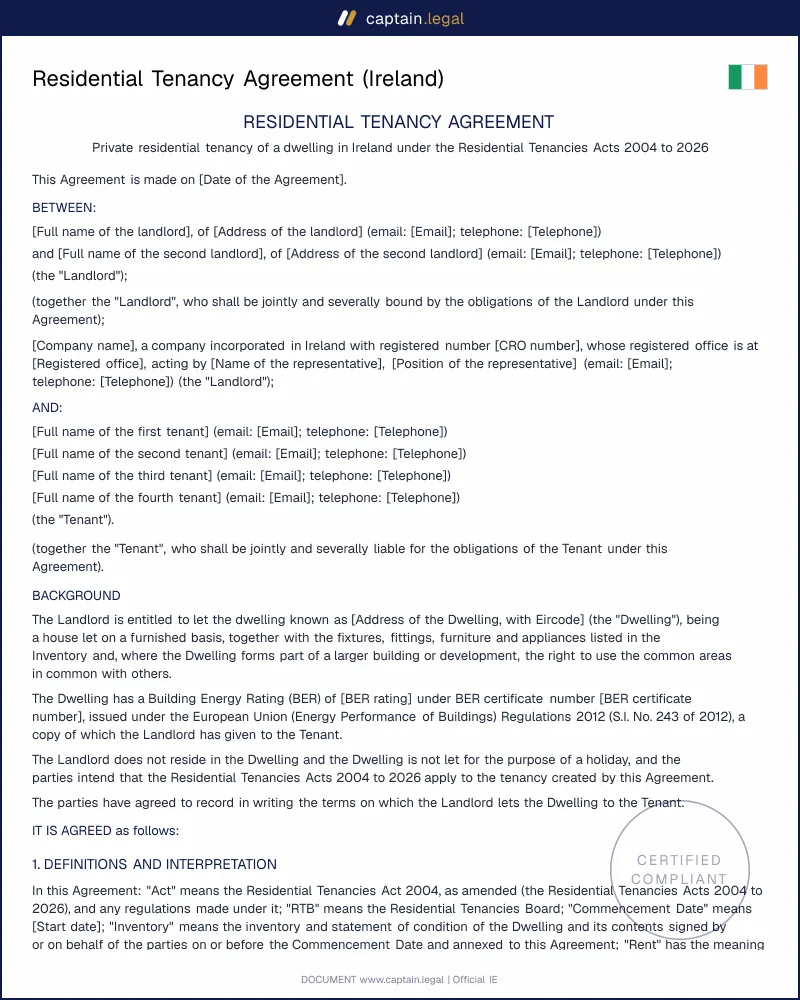
First come the parties, with their email addresses since notices under section 6 can now be served electronically, then the dwelling with its Eircode, type, furnishing and BER rating. The term clause adapts to your choice of a fixed term or a periodic tenancy from month to month, and both versions explain that the tenancy becomes a Part 4 tenancy after six months.

Most of the legal risk sits in the money clauses. The rent clause states the monthly figure, the payment day and the IBAN, confirms the deposit and advance rent cap, and records the landlord's duty to give the tenant the rent information required by section 12(1)(i): the previous rent, how the new rent was calculated and three comparable dwellings from the RTB register. A rent review clause applies the national cap and the 90-day notice copied to the RTB. Deductions from the deposit are limited to arrears and damage beyond normal wear and tear, as section 12(4) allows, and Local Property Tax stays with the landlord in every version.

On exit, the template follows Part 5 of the Act: the statutory notice periods from section 66 for both sides, the grounds in the Table to section 34, the extra limits of section 35B for company and small landlords, and the rule that a landlord's notice of termination is invalid unless a copy is served on the RTB within seven days. If you choose a guarantor, a signed guarantee follows on its own page, with a fourteen-day warning to the tenant before any demand.

How to fill out this residential tenancy agreement

You start by saying who the landlord is: one person, two joint owners or a company, in which case the form asks for the CRO number and the person who signs for it. Next comes the letting agent, if there is one, so the agreement can name the authorised agent as section 12(1)(e) requires. You then choose how many tenants will sign, from one to four, and enter each tenant's name, email and phone number.

Property questions cover the address with its Eircode, the type of dwelling, the furnishing and the BER details. The term screen asks for a fixed term or a periodic tenancy, and the end date field only appears for a fixed term. You then enter the rent, the day it falls due, the deposit and the bank details, and decide who pays the utilities, whether pets are allowed and whether a guarantor will sign. The preview on the right rewrites the clauses as you answer. When you click Finish and your order is complete, the agreement downloads in Word and PDF. Attach a signed inventory and have every party sign in front of a witness; the inventory and later notices are among the legal document templates for Ireland you will need as the tenancy goes on.

Common mistakes to avoid

The mistake we see most often is a deposit of six weeks or two months' rent. Since the section 19B cap, anything above one month's rent for the deposit, or above one month in advance, is unlawful, and the tenant can bring the overpayment to the RTB as a dispute. The second is treating a twelve-month fixed term as a guaranteed exit. After six months the tenant has a Part 4 tenancy, and the end date on the lease is no longer a reason to leave. A landlord who wants possession back needs a valid ground and the full notice period, which reaches 180 days once a tenancy has lasted a year.

Paperwork errors follow close behind. Landlords forget the rent information statement owed to the tenant at the start and to the RTB within one month, or let the annual registration lapse. Others serve a notice of termination but never send the copy to the RTB within seven days, which makes the notice invalid. A joint tenancy signed by only one sharer leaves the others outside the contract, with no direct liability for the rent. Finally, some agreements still refer to "section 21 notices" or similar terms borrowed from English letting practice, which make an Irish lease look careless to an adjudicator.

Key takeaways

RTA 2004 S.19B

Deposit and advance rent: one month each at most

To secure a tenancy, a landlord may ask for only two payments: a deposit no greater than one month's rent and rent in advance no greater than one month's rent. The agreement cannot require more rent in advance at any point during the tenancy either. Six-week deposits or two months up front are unlawful, and the tenant can take the overpayment to the RTB. The template states both amounts and the cap.

RTA 2004 SS.19-22

Rent reviews: once a year, capped at 2% or CPI

No rent review can take place in the first 12 months of the tenancy, and after that no more than once every 12 months, unless the dwelling is substantially changed. Save for statutory exemptions, the increase cannot exceed the lower of 2% a year and the rise in the Consumer Price Index, and the new rent can never exceed market rent. The landlord must give 90 days' notice in the prescribed form, with a copy to the RTB within 7 days.

RTA 2004 S.35B

Six-year cycles limit how a landlord can end it

After six months the tenancy becomes a Part 4 tenancy of unlimited duration, running in six-year cycles. A company landlord, or one with more than three tenancies, can then end it only for tenant breach or because the dwelling no longer suits the household. A small landlord can sell, refurbish or change use only by a notice served before a six-year period ends and expiring on or after its end, or sell earlier for undue hardship.

Frequently Asked Questions

Once the landlord and every tenant have signed it, the agreement binds them. Irish law does not require a solicitor, a notary or registration of the document itself for a residential letting; what must be registered with the RTB is the tenancy, within one month of its start. The template gives a signed written lease, as required for terms over one year, with witness lines for each party. The agreement cannot take away statutory rights: where a clause conflicts with the Residential Tenancies Act 2004, the Act wins, and the template says so expressly.

The application must be made within one month of the date the tenancy begins, and again within one month of each anniversary of that date (section 134). Late registration can lead to sanctions from the RTB. Separately, for a tenancy created on or after 1 March 2026, the landlord has one month from the commencement to send the RTB the rent information statement given to the tenant. Putting both deadlines in the calendar on the day the agreement is signed avoids most of the problems we see later.

After you click Finish and complete your order, the agreement can be downloaded as a Word file and as a PDF. The Word version is useful if you and the tenant want to adjust a house rule before signing, while the PDF is the cleaner copy to print, sign and keep with the inventory. For paperwork during the tenancy, our notices and other letting documents for Irish landlords use the same details you entered here.

Less than many landlords expect. If the tenant has been in occupation for six months without a valid notice of termination, the tenancy is already a Part 4 tenancy and continues after the fixed term on the same terms. From then on the landlord can end it only on a ground in section 34, with the notice periods in section 66. The tenant can leave at any time after the fixed term by giving the statutory notice, which runs from 28 days in the first six months up to 112 days after eight years.

No, and it is usually better not to. A single joint agreement signed by every sharer makes them jointly and severally liable for the whole rent, so the landlord can recover a shortfall from any of them. This template supports up to four tenants. Where sharers change, each newcomer should be added in writing with the landlord's consent, because section 16 forbids sub-letting or assignment without it. A refusal of consent lets the tenant end the tenancy by notice under section 186, which is worth knowing before saying no.

Not fully. Where the right to occupy depends on an office or employment, Part 4 security of tenure does not apply (section 25(4)(b)), and ending it still needs a Part 5 notice of termination but no section 34 ground. The accommodation terms are then usually written into the contract of employment, and the Irish employment contract templates are a better starting point. For a normal private letting to someone whose job has nothing to do with the property, a residential tenancy agreement is the right document.

4.6/5

14 verified reviews · 50 000+ downloads

Residential Tenancy Agreement Ireland (Residential Tenancies Acts)
  • Immediate access to the document
  • PDF + Word download
  • Compliant with 2026 legislation
  • Reviewed by lawyers
Fill in the template
Secure payment
Updated on November 3, 2026

You might also like

Lodger (Licence) Agreement (Ireland)
Landlord Notice of Termination (Ireland)