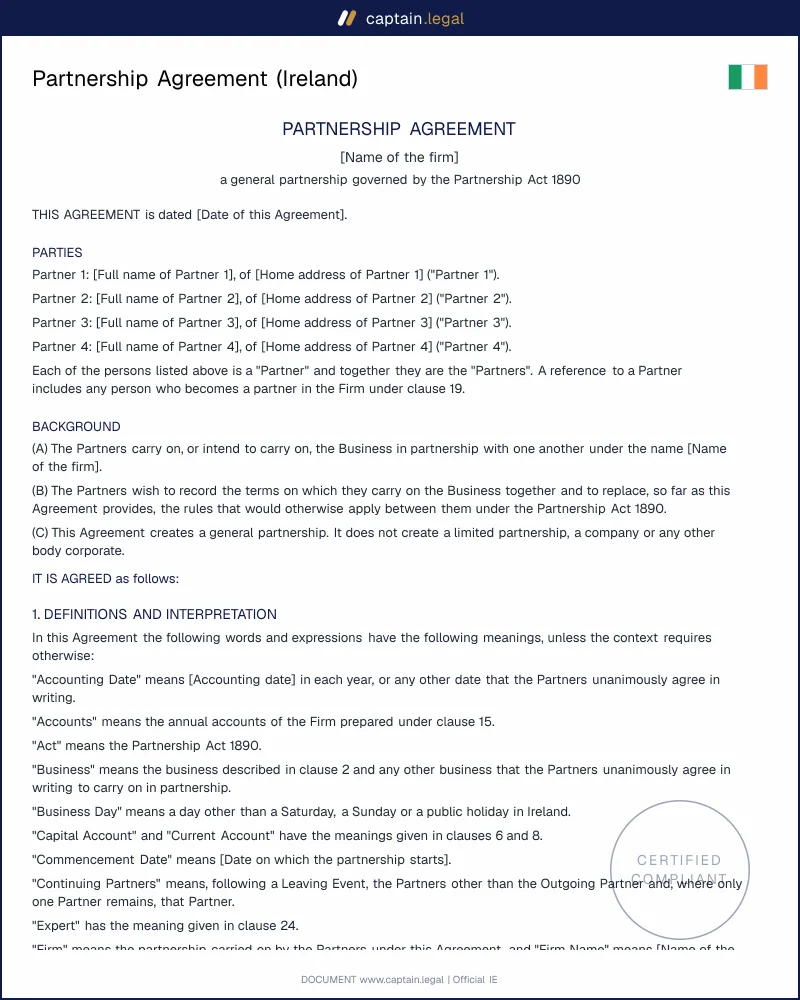
The Partnership Act 1890 still governs Irish partnerships, and most of its rules apply only "subject to any agreement" between the partners. Section 24 gives every partner an equal share of capital and profits, refuses interest on capital, allows 5% a year on advances, denies any salary, and requires unanimity to admit a partner or change the nature of the business. Section 25 adds that no majority can expel a partner without an express power. Where no fixed term is agreed, sections 26 and 32(c) let any partner dissolve the firm by notice, and section 33 dissolves it on the death or bankruptcy of a partner. A written partnership agreement can displace any of those rules. This one keeps the sensible ones (no interest on capital, no salary unless everyone agrees, unanimity to admit a partner) and overrides the rest: profit shares follow what each partner agreed, a partner can be expelled for cause, nobody can dissolve the firm by a simple notice, and the others can carry on after a death or bankruptcy.
Two other regimes sit alongside the Act: business name registration and tax. The Registration of Business Names Act 1963 requires a firm to register its name with the Companies Registration Office unless the name consists only of the true surnames of all the partners, with or without first names or initials. Registration is due within one month after the name is adopted, on Form RBN1A, and the certificate must be displayed at the principal place of business. On the tax side, the firm is not assessed on its profits; each partner files a personal Form 11, while the partner first named in the partnership agreement, if resident in the State and active in the business, acts as precedent partner and delivers the firm's return under section 959I of the Taxes Consolidation Act 1997, as Revenue's Form 1 (Firms) partnership tax return confirms.