Business

Share Transfer Agreement and Stock Transfer Form Ireland

Agreement for the sale of shares in an Irish private company limited by shares between two individuals, with a stock transfer form: price in full or deferred, pre-emption waivers, section 95 approval, warranties, stamp duty and registration, under Irish law.
4.6/5— 16 reviews50 000+ downloadsInstant download
Share

A share transfer agreement records the sale of existing shares in an Irish private company limited by shares from one shareholder to a buyer. It fixes the price, the completion date and the seller's warranties, and it comes with the stock transfer form the company needs before it can enter the buyer in its register of members. The template suits two individuals dealing directly: a founder buying out a co-founder, a retiring member selling to a colleague, or an investor taking a minority stake in a family company. It follows the Companies Act 2014 and Revenue's stamp duty rules.

Compliant

2026 Legislation

50,000+ clients

trust us

Affordable

From €4.90 / doc

Secure payment

Instant download

Share Transfer Agreement and Stock Transfer Form Ireland

Secure payment

Fill in the template

What is a share transfer agreement?

Two documents do two jobs in an Irish share sale. The instrument of transfer, usually a stock transfer form, is what the company acts on: under section 94(4) of the Companies Act 2014 it cannot register a transfer unless a proper instrument has been delivered. The share transfer agreement is the contract behind that form. It says what the buyer pays and when, what must happen before completion, which documents change hands and what the seller promises. A one-page transfer form says nothing about a deferred price, a refused registration or a seller who turns out not to own what was sold, which is why this template attaches the form as Schedule 1.

The agreement is lighter than a share purchase agreement for a whole business, with its disclosure letter, tax deed and weeks of due diligence. It also differs from an allotment of new shares under section 69, which attracts no stamp duty, and from a shareholders' agreement, which governs the members' relationship over time. The constitution and shareholders' agreement sit among our Irish company and business templates.

When do you need this document?

The most frequent use is a co-founder exit. Two people set up a company, one leaves, and the other buys the departing stake, often in instalments, which the deferred payment option covers. Succession in a family company comes next: a parent sells part of a holding to a son or daughter already working in the business, sometimes alongside employment contracts and HR documents for the new role. A third case is a minority investment, where a key manager or a long-standing adviser buys from an existing member instead of subscribing for new shares.

If the other members have not yet waived their pre-emption rights, completion cannot happen on signing, so the template lets you set a later completion date with conditions and a firm exit if they fail. Where the seller sits on the board, the sale and the resignation usually go together. Two edge cases need a solicitor's view. A company whose value comes mainly from non-residential property in Ireland can face a higher charge under section 31C. Separately, where the shares derive their value from Irish land and the price exceeds 500,000 euro, the buyer must withhold 15% unless the seller produces a CG50A clearance certificate.

Key clauses included in our template

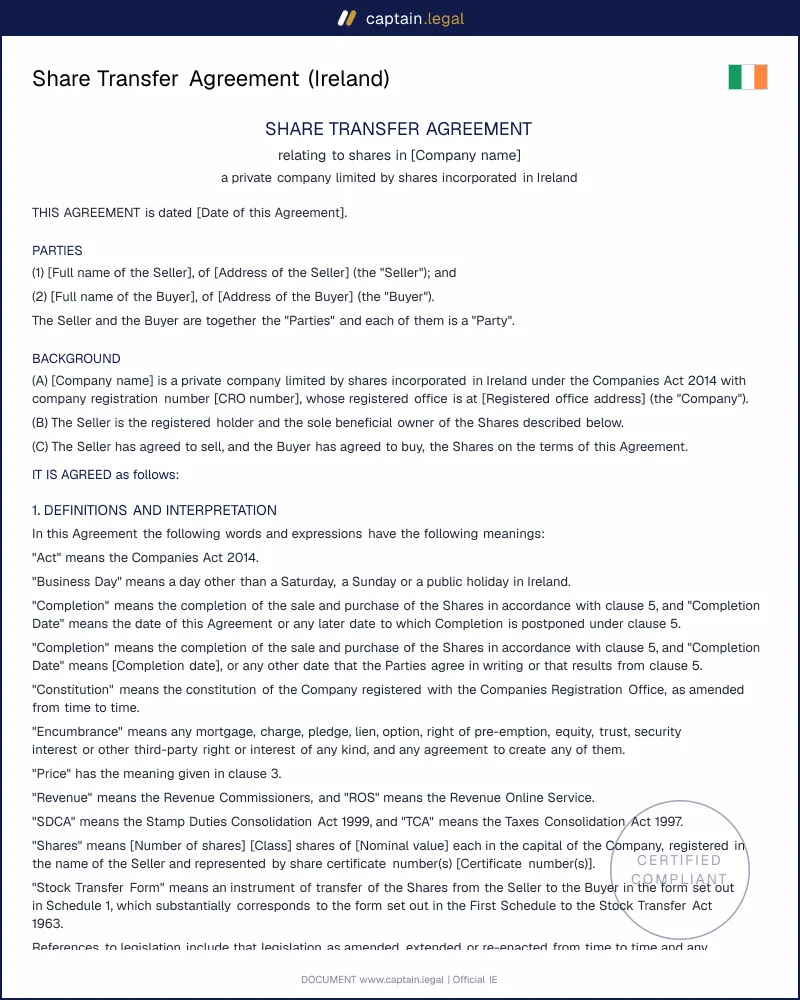
The agreement opens with the parties, the company's CRO number and registered office, and a definition of the shares by number, class, nominal value and certificate number. The price clause offers payment in full at completion or a part payment with a Deferred Price, which carries interest at 8% a year if late and falls due at once if the buyer defaults or becomes insolvent. A separate clause covers pre-emption waivers and the directors' approval, and spells out the section 95 timetable.

At completion the seller hands over the signed stock transfer form, the share certificate or an indemnity for a lost one, any waivers, a certified copy of the board resolution approving the transfer and a proxy in favour of the buyer. Until registration, the seller holds the shares on trust for the buyer and votes as the buyer directs, which covers the gap left by section 94(3). If the directors refuse to register, or nothing happens within two months of lodging, the buyer can end the agreement and recover what was paid. Most homemade share transfer agreements forget that clause.

Warranties come in two levels. Title and capacity warranties are always given: the seller owns the shares outright, they are fully paid and free from any charge, and no bankruptcy or insolvency arrangement exists. You can add limited business warranties on accounts, tax, disputes and statutory registers, with a claim period in months. Liability is capped at the price, except for fraud. Capital gains tax stays with the seller, stamp duty with the buyer, and a resigning seller signs the letter in Schedule 2.

How to fill out this share transfer agreement

You start with the company: its registered name, CRO number and registered office. The next screens ask for the seller and the buyer, with names as they appear in the register of members and postal addresses including the Eircode. The shares come next, by number, class, nominal value and certificate number. Then you give the price and choose how it is paid; a deferred payment opens an extra screen for the amount paid at completion and the date of the balance. Choosing a later completion reveals a completion date, and the conditions appear in the preview. The last questions cover warranties, with a claim period if you keep the business warranties, and whether the seller resigns as a director.

Move through the screens with Next and Back, then click Finish to download the agreement in Word or PDF. Schedule 1 is already filled in with the same details. Other forms for Irish companies and individuals sit in our library of Irish legal documents.

Common mistakes to avoid

Ignoring the constitution is the most expensive mistake. A buyer who pays first and then finds a pre-emption clause can watch the directors refuse registration while the seller still owns the shares in law. Read the constitution and any members' agreement built from our constitution and shareholders' agreement templates for an LTD, collect written waivers and get the board resolution before money moves. Close behind is the forgotten stamp: the form sits in a drawer, the 44 days pass, interest runs from signing, and the company will not register an unstamped transfer. A "friendly" price to a relative does not shrink the duty either, because Revenue can charge on market value.

Selling directors make their own errors. Nobody tells the CRO, although section 149(8) requires notice within 14 days, or the resignation leaves a sole director who is also secretary, which section 129(6) forbids. Check the board before the resignation letter is signed. A last trap: the stock transfer form cannot be used for partly paid shares, which need a full instrument signed by both parties.

Key takeaways

CA 2014 S.94(3)

The seller stays the holder until registration

Under section 94(3) of the Companies Act 2014, the transferor remains the holder of the shares until the buyer's name is entered in the register of members. Paying the price is not enough. The template closes that gap: from completion until registration, the seller holds the shares on trust for the buyer, votes as the buyer directs and passes on any dividend, and a signed proxy is handed over at completion.

CA 2014 S.95

A refusal must be notified within two months

Unless the constitution says otherwise, the directors of an LTD may decline to register a transfer in their absolute discretion. Under section 95, that power lapses two months after delivery, save for an unpaid fee, a missing certificate or mixed share classes, and a refusal must be notified within two months of lodging. The template makes board approval a completion document and lets the buyer terminate and recover the price.

STAMP DUTY

1% duty, filed through ROS within 44 days

The buyer pays stamp duty of 1% of the consideration on the stock transfer form. Revenue charges no interest or surcharge if the ROS return is filed and the duty paid within 44 days of signing. A sale at 1,000 euro or less is exempt only if it is not part of a larger transaction, the shares do not draw the bulk of their value from property and the buyer signs the certificate on the form. A sale at undervalue can be charged on market value.

Frequently Asked Questions

It is, once both parties have signed it. Irish law requires no special form for a sale of shares between individuals, and the agreement can be signed electronically under the Electronic Commerce Act 2000. Legal title is a separate step. The buyer becomes the holder only when the company enters the buyer's name in its register of members (section 94(3) of the Companies Act 2014), which needs a stamped stock transfer form and, where the constitution gives them discretion, the directors' approval. Meanwhile the seller holds the shares on trust for the buyer.

After you click Finish, the agreement and the stock transfer form in Schedule 1 are generated together, in Word for last edits or in PDF for signing. Both parties sign the agreement. The seller signs the transfer form by hand, unless the directors have agreed in writing to accept an electronic signature on it. Keep the signed originals with the share certificate, because the company asks for both when the buyer lodges them.

The return is due within 30 days of signing the stock transfer form, but Revenue charges no interest or surcharge if it is filed through ROS and the duty paid within 44 days of signing. After that, interest runs from the date of execution and surcharges apply. The rate is 1% of the consideration. Where the consideration is 1,000 euro or less, the sale is not part of a larger transaction and the shares do not draw the bulk of their value from immovable property, no return is needed: the buyer signs the exemption certificate on the form, which goes straight to the company.

Not at the time of the sale. A transfer of shares in an LTD is recorded in the company's own register of members, and the change appears in the next annual return delivered under section 343. Two other filings often follow. If the transfer changes the company's beneficial owners, the company updates its internal register and notifies the RBO within 14 days. If the seller resigns as a director or secretary, the company notifies the CRO within 14 days under section 149(8).

Under section 95(3) the directors must send the buyer notice of the refusal within two months after the transfer is lodged. The seller then stays the legal owner. The template handles that risk twice. Completion normally requires a board resolution approving the transfer, subject only to stamping, so a later refusal should be rare. If it happens anyway, or registration stalls for two months, the buyer may terminate and recover every sum paid, plus the stamp duty where the seller breached the pre-emption clause.

Stamp duty is charged on the market value of the shares in most cases. Section 30 of the Stamp Duties Consolidation Act 1999 treats a gift, or a sale well below value, as a voluntary disposition, and the 1,000 euro exemption is then tested against market value. This template is built for a sale at a real price. For a pure gift the recipient also looks at capital acquisitions tax, the donor is still taxed on any gain at market value, and families planning wider succession usually pair the transfer with a will and other documents from our range of personal and family legal documents.

The seller does, and the agreement says so, while stamp duty stays with the buyer. A specific rule applies where the shares derive their value from land in Ireland, typically a company that owns its premises or holds rental property. If the consideration exceeds 500,000 euro, section 980 of the Taxes Consolidation Act 1997 requires the buyer to deduct 15% unless the seller produces a CG50A clearance certificate. Such companies usually also hold leases, and our Irish property and tenancy documents include a commercial lease.

4.6/5

16 verified reviews · 50 000+ downloads

Share Transfer Agreement and Stock Transfer Form Ireland
  • Immediate access to the document
  • PDF + Word download
  • Compliant with 2026 legislation
  • Reviewed by lawyers
Fill in the template
Secure payment
Updated on November 3, 2026

You might also like

Partnership Agreement (Ireland)
Shareholders' Agreement (Ireland)