Business

Consultancy Services Agreement Ireland (B2B)

Business-to-business consultancy services agreement under Irish law: scope and deliverables, daily, hourly or fixed fee, VAT, statutory late payment interest, copyright assignment, confidentiality, GDPR processor terms, liability cap and an independent contractor status clause.
4.5/5— 21 reviews50 000+ downloadsInstant download
Share

A consultancy agreement sets the terms on which an Irish business hires an outside expert for a defined piece of work: a process review, a software build, a marketing plan, an HR project. It suits companies and sole traders who engage a self-employed consultant, and consultants who want their own terms on the table before the first invoice. Our template is a business-to-business contract for services governed by Irish law, covering scope, deliverables, a daily, hourly or fixed fee, VAT, late payment interest, transfer of copyright, confidentiality, GDPR processor terms and a liability cap, with a status clause built around the five questions the Supreme Court set in the Karshan case.

Compliant

2026 Legislation

50,000+ clients

trust us

Affordable

From €4.90 / doc

Secure payment

Instant download

Consultancy Services Agreement Ireland (B2B)

Secure payment

Fill in the template

What is a consultancy agreement in Ireland?

Irish law draws a hard line between a contract of service, which makes someone an employee, and a contract for service, which governs an independent contractor. A consultancy agreement sits on the second side of that line. The client buys a result, the consultant decides how to produce it, and nobody owes the other holiday pay, sick pay or statutory minimum notice. The document records what is being bought, who owns the output and how the money moves, and it has to be in writing because the protection that matters most, ownership of copyright, does not pass to the client by default.

People often confuse it with neighbouring documents. A letter of engagement is the short version professional firms send. An employment contract is what you need when the person will work under your direction, inside your team, on hours you set; you will find one among our employment contracts and HR letters for Irish employers. Our consultancy services agreement is a standalone contract for a defined project or a continuing advisory role, and it sits with the other contracts and company documents for Irish businesses in our catalogue.

When do you need a consultancy agreement?

The classic case is a company bringing in a specialist it cannot staff internally: an IT consultant migrating systems, a lean manufacturing expert, a grants writer, an interim finance lead brought in for a year-end close. Each engagement creates documents, code or data the client will want to own and reuse, which is reason enough to sign before work starts. Consultants use the template the other way round, sending it as their standard terms so that payment periods, scope changes and liability follow their wording rather than the client's purchase order.

A second group is the former employee who goes independent and keeps working for the old employer. In practice this is where status disputes start, because the daily reality often stays the same. Change the arrangement, not just the paperwork: real control over method and hours, a genuine right to send a substitute and other clients on the books count for far more than a title.

Charities and community bodies are frequent users too, typically for fundraising, governance reviews or funder reporting, alongside the governance documents for Irish charities and clubs we publish. Sole traders can sit on either side, and many sort out their own personal legal documents for Ireland at the same time. One edge case: construction, forestry and meat processing work falls under Relevant Contracts Tax and needs a sector contract.

Key clauses included in our template

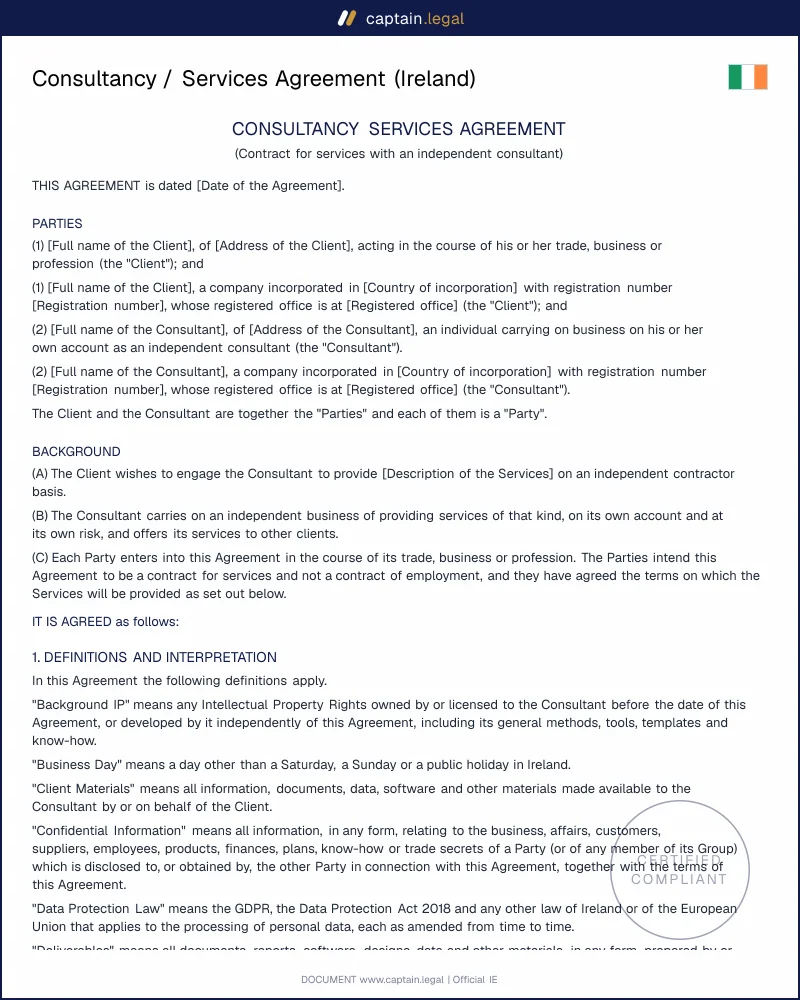
The opening clauses of the consultancy agreement identify each party as an individual in business or a company, with registration number and registered office. The status clause follows the Karshan questions: no obligation to offer or accept further work, method and hours left to the consultant, its own equipment and insurance, freedom to work for other clients and a promise to review the arrangement if the facts change.

  • The client can object to a substitute only on grounds of skills, vetting or confidentiality, the consultant pays whoever it sends, and every substitute signs up to confidentiality, the copyright transfer and a moral rights waiver.
  • Choose a daily rate, an hourly rate or a fixed fee. Day and hour work is invoiced monthly in arrears with a timesheet, a fixed fee follows the schedule you type in, and disputed invoices must be challenged within 10 business days.
  • Late payment carries the statutory interest and compensation in full, with a right to suspend work 14 days after a written reminder.
  • Copyright in the deliverables passes to the client as it is created, while the consultant keeps its background know-how and grants a permanent licence of anything built into them.
  • If something goes wrong, each side's liability is capped at the fees paid and payable up to the claim, or at a fixed amount. Death or personal injury caused by negligence, fraud, wilful misconduct, unpaid fees and the tax and intellectual property indemnities sit outside the cap.

The rest covers confidentiality for five years (without limit for trade secrets and personal data), GDPR processor terms, insurance, optional non-solicitation of staff, termination, force majeure, anti-corruption and Irish law, with negotiation and optional mediation before court.

How to fill out this consultancy services agreement

You start with the client: full name, address and whether it is a sole trader or a company, in which case you add the country of incorporation, the registration number (the CRO number for an Irish company) and the person signing. The consultant follows the same pattern, and a consultant company also names the individual who will mainly do the work, so the substitution and moral rights clauses can refer to that person.

The scope screen asks for the services, the deliverables and the place of work. Describe a result to be achieved, such as "a review of the warehouse picking process with recommendations", because a list of hours to attend reads like a job. You then set the start date, a fixed end date or completion of the services, and the notice period for early termination. The fee screen offers a daily rate, an hourly rate or a fixed fee, and the fixed fee opens a field for the invoicing schedule.

Later screens of the consultancy agreement cover the payment period and VAT, personal data, non-solicitation, the liability cap and insurance, and the date and email addresses for notices. The preview updates with every answer; use Back to change anything, then Finish to generate the document. Our full range of Irish legal templates covers the other paperwork the same client may need.

Common mistakes to avoid

The most damaging mistake is treating the consultancy agreement as a shield against reclassification. A consultant who works fixed hours at a desk in your office, under your managers, on your laptop and with no real right to send anyone else may be an employee whatever the agreement says, and the business then owes PAYE, USC and PRSI with interest. The second mistake is silence on intellectual property: without a signed assignment, the client pays for a report, a codebase or a brand and ends up with a licence at best.

Payment terms cause their own trouble. Clients sometimes impose 90-day terms, yet a payment date more than 60 days after the service must be expressly agreed and must not be grossly unfair to the supplier. A clause that waives late payment interest can be struck down by the Circuit Court as grossly unfair, so the template keeps the statutory rights intact. Many consultants also take on personal data without a processor clause, leaving both sides exposed if the Data Protection Commission asks questions after a breach. Finally, parties often set the liability cap far above the fee, a figure the consultant's professional indemnity cover rarely reaches.

Key takeaways

KARSHAN 2023

The label does not decide employment status

Since the Supreme Court judgment in Karshan, Revenue asks five questions: pay for work, personal service, control over what, how, when and where, the overall facts, and any statute. A consultant who works set hours under your managers with no real right to send a substitute may be an employee whatever the contract says. The template leaves method and hours to the consultant and gives a genuine right of substitution.

CRRA 2000 S.120

Copyright stays with the consultant unless assigned

Under section 23 of the Copyright and Related Rights Act 2000, the author owns the copyright unless an employee makes the work in the course of employment. An assignment must be in writing and signed by or on behalf of the assignor (section 120(3)). The template assigns future copyright so each deliverable vests in the client on creation, keeps the consultant's background know-how, and provides for written moral rights waivers under section 116.

S.I. 580/2012

Late payment interest runs without a reminder

Between businesses, an invoice is payable 30 days after receipt unless another period is agreed, and a date more than 60 days after the service must be expressly agreed and not grossly unfair. Interest then runs automatically at the ECB reference rate plus eight percentage points, with fixed compensation and reasonable recovery costs. The template sets the payment period you choose and keeps these statutory rights intact.

Frequently Asked Questions

It binds both parties once signed, because Irish contract law needs offer, acceptance, consideration and an intention to create legal relations, and the agreement records all four. No witness, stamp or registration is required for a contract for services, and electronic signatures are accepted under the Electronic Commerce Act 2000 with each party's consent, which the agreement records. Two points depend on you. Keep the signed copy, because the copyright assignment rests on the signatures, and check that whoever signs for a company has authority to bind it.

Yes. Once you click Finish and complete your order, the agreement is available as a Word file and as a PDF. The Word version helps when the other side wants to negotiate a clause or attach a schedule of milestones, and the PDF is the one to circulate for signature. If something changes before signature, go back into the questionnaire, edit the answer and download a fresh copy instead of retyping the document.

Under S.I. No. 580 of 2012, payment is due 30 days after the invoice is received when the contract is silent. The parties can agree another period, and the agreement asks you to set one, but a date more than 60 days after the service is provided must be expressly agreed and not grossly unfair to the consultant. From the day after the due date, interest runs automatically at the ECB reference rate plus eight percentage points, with a fixed compensation sum and reasonable recovery costs on top.

The consultant does, unless the contract says otherwise. Section 23 of the Copyright and Related Rights Act 2000 makes the author the first owner, and only work made by an employee in the course of employment belongs to the employer automatically. That is why the template assigns future copyright, so each deliverable passes to the client as soon as it exists, and requires a written moral rights waiver, signed under section 116 by each individual who creates the work. The consultant keeps its own tools and know-how and licenses whatever is built into the deliverables. For a confidentiality agreement before the project is scoped, see our NDAs and shareholder agreements for Irish companies.

PAYE becomes the business's problem: the income tax, USC and PRSI that should have been deducted from the payments, with interest. Revenue decides tax status and the Department of Social Protection decides the PRSI class separately, and one decision does not bind the other. The template includes a tax indemnity from the consultant, but it cannot recover amounts the law reserves to the employer, such as employer's PRSI. Prevention works better: leave method and hours to the consultant and honour the substitution clause.

Only if it is registered for VAT, or obliged to register because its turnover from services passes the registration threshold. A registered consultant adds VAT at the rate in force, the standard 23% for most consultancy work, and shows its VAT number on each invoice. If the consultant is not registered, the consultancy agreement says so and requires it to tell the client within 10 business days of a later registration, after which VAT is added.

4.5/5

21 verified reviews · 50 000+ downloads

Consultancy Services Agreement Ireland (B2B)
  • Immediate access to the document
  • PDF + Word download
  • Compliant with 2026 legislation
  • Reviewed by lawyers
Fill in the template
Secure payment
Updated on November 3, 2026

You might also like

Terms and Conditions of Sale (Ireland)
Shareholders' Agreement (Ireland)