Real Estate

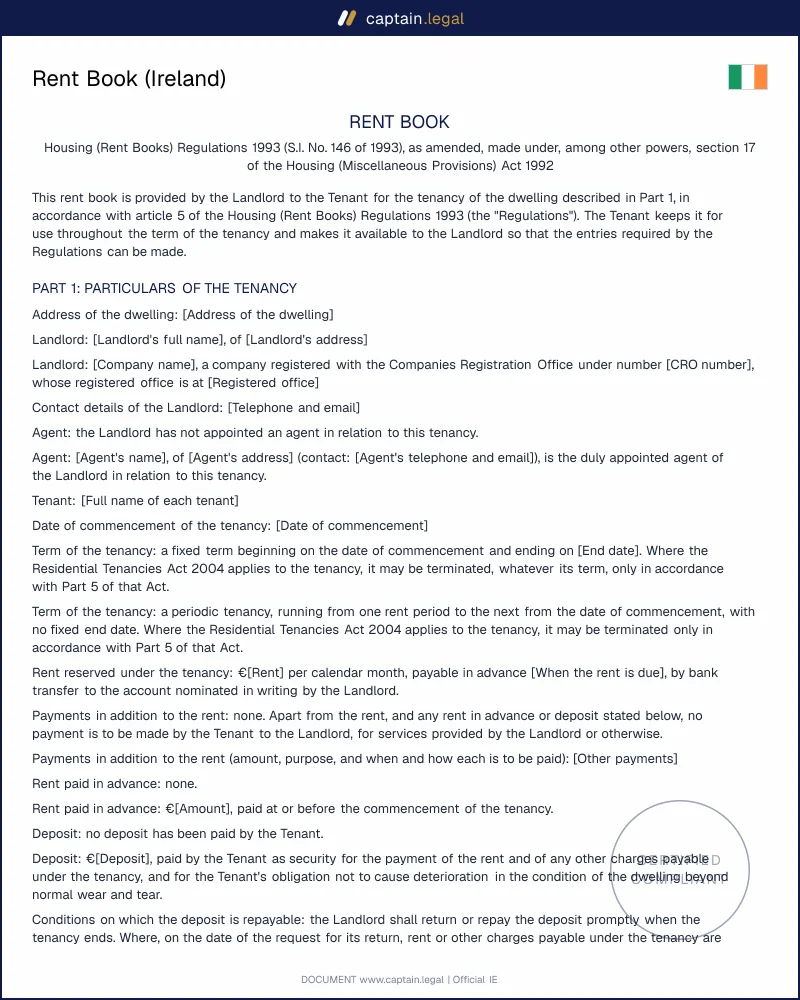
Rent Book Ireland (Housing (Rent Books) Regulations 1993)

Rent book for a private letting in Ireland, as required by the Housing (Rent Books) Regulations 1993: tenancy particulars, deposit terms, inventory, the prescribed statement of information and a signed record of payments and changes, for individual or company landlords.
4.5/5— 13 reviews50 000+ downloadsInstant download
Share

A rent book is the record a landlord in Ireland must give the tenant when a tenancy begins: the particulars of the letting, a statutory statement of information and a running log of every payment. Most private landlords know they must register with the Residential Tenancies Board (RTB), yet far fewer realise that the Housing (Rent Books) Regulations 1993 still require this separate document, and that the local council enforces it. Our template follows the Regulations line by line, with the deposit terms, an inventory of furnishings and appliances, the prescribed statement and a full year of payment lines. It suits individual and company landlords as well as letting agents, and tenants can use it to check what they are owed.

Compliant

2026 Legislation

50,000+ clients

trust us

Affordable

From €4.90 / doc

Secure payment

Instant download

Rent Book Ireland (Housing (Rent Books) Regulations 1993)

Secure payment

Fill in the template

What is a rent book in Ireland?

Legally, it is the "rent book or other documentation to the like effect" that article 5 of the Housing (Rent Books) Regulations 1993 obliges a landlord to provide on the commencement of a tenancy. It is not a contract. The lease sets the rights and obligations of the parties, while the book records them: the address of the dwelling, the landlord and any agent, the tenant, the term, the rent and how it is paid, other charges, rent paid in advance, and the deposit with the conditions for its return. For a new tenancy it also lists the furnishings and appliances supplied for the tenant's exclusive use, and it must carry the statement of information set out in the Schedule to the Regulations.

The words "or other documentation" matter in practice. No printed booklet is needed; a document holding every prescribed particular does the same job. A receipt proves one payment, whereas this record proves the terms of the letting and the whole payment history in one place. Landlords who already use a written lease from our Irish property and tenancy templates still need it on top, because a standard lease does not contain the prescribed statement.

When do you need a rent book?

The obvious moment is the start of every new tenancy. The Regulations require the book on the commencement of the tenancy, so the sensible routine is to hand it over with the keys, the signed lease and the inventory. A buyer who takes over a let property with a sitting tenant must enter the new landlord's details within a month, and many simply issue a fresh one.

A new rent after a review, a newly appointed letting agent, a new bank account or a move to another address must likewise be entered within a month. Landlords who let through a company, a structure covered in our Irish company and commercial templates, are in the same position as individuals; the company simply gives its registered office as its address.

In an arrears claim before the RTB, signed entries made at the time are far easier to rely on than a patchwork of banking-app screenshots. Local authorities are covered as landlords, and so are approved housing bodies, many of which run on the charity structures in our Irish nonprofit and charity templates.

Key clauses included in our template

Every particular listed in article 5(2) has its own line, and the inventory of furnishings and appliances is completed even for an unfurnished letting.

  • Identification comes first: the address with its Eircode, the landlord's name, address and contact details, any agent, and the Companies Registration Office (CRO) number when the landlord is a company.
  • Because disputes so often turn on money, the rent line states the amount, the frequency (monthly, fortnightly or weekly), the due date and the payment method, while separate lines record advance rent and extra charges such as refuse collection.
  • On deposits, the book records the amount and its purpose and sets out the conditions for its return taken from section 12(1)(d) and (4) of the Residential Tenancies Act 2004: prompt repayment at the end of the tenancy, less arrears or the reasonable cost of putting right damage beyond normal wear and tear.
  • Paragraphs 1 to 11 of the Schedule appear unchanged, starting on a new page, with the housing authority's details at the end of paragraph 11 and a separate tenant note on RTB registration, the deposit cap, rent setting and the 90-day review notice under section 22.
  • Signed payment and change records close the document, with 12, 26 or 52 payment lines depending on the rent frequency and six lines for changes, after a signature block for the landlord and every tenant.

How to fill out this rent book

The questionnaire starts with the dwelling: its full address with the Eircode and the date the tenancy began. You then say whether the landlord is one or more individuals or a company; choosing a company opens the CRO number field and turns the address into the registered office, as article 3 requires. If an agent manages the letting, a separate screen collects the agent's details.

Next come the tenant's name, the term (fixed with an end date, or periodic) and the rent. The frequency you choose also sets the length of the payment record, so a weekly rent gets 52 lines without any extra step. The deposit and advance rent screen hides each amount field when you answer no, and the text switches to the wording that says none was paid.

The last screens cover the inventory and the housing authority, whose name, address and phone number land at the end of paragraph 11 of the statement, exactly where the Regulations want them. Pick the handover date, check the preview, then click Finish. Print the result, sign the provision page together and keep using the payment pages as rent comes in. Leases, notices and other Irish legal document templates follow the same question flow.

Common mistakes to avoid

The most frequent error is treating RTB registration as a substitute. Registration is a duty owed to the Board, the book is a duty owed to the tenant, and a fully registered landlord can still be in breach. Another is the missing inventory on an unfurnished letting: under regulation 7 of the Housing (Standards for Rented Houses) Regulations 2019, most rented houses must have a hob with an oven and grill, a fridge-freezer and a microwave even without furniture, and those appliances belong in the inventory. Some landlords edit the statement of information because parts look dated. Leave the prescribed paragraphs exactly as they are and put any update in a separate note, as the template does.

Payment records cause the rest of the trouble. Rent handed over in person, cash or cheque, must be recorded or receipted on receipt, while transfers and standing orders allow up to three months, yet many landlords stop recording after a few months. An unsigned or patchy payment record is weak evidence in an arrears dispute. Tenants make their own mistake by refusing to hand the book back for updates, although the Regulations oblige them to make it available. A landlord living abroad who leaves a relative to collect the rent, with paperwork from our personal and family document templates, should appoint that person formally as agent, since only the landlord or a duly appointed agent should sign the entries.

Key takeaways

S.I. 146/1993

A rent book is due when the tenancy begins

Every house let for rent solely as a dwelling needs a rent book or equivalent documentation from the start of the tenancy, holiday lets and the rare Part II 1982 dwellings aside. It must state the address, the landlord and any agent, the tenant, the term, the rent and how it is paid, other charges, advance rent and the deposit, and carry the prescribed statement of information. RTB registration does not replace it, and the council enforces it.

ARTICLES 6-7

Every payment must be recorded and signed

Rent handed over in person must be entered in the rent book or receipted on receipt. Payments by transfer, standing order or direct debit must be recorded, or acknowledged by a written statement to the tenant, within three months of receipt. Each entry shows the amount, purpose, date and period covered and is signed. Any change to the particulars, such as a new rent, must be entered within one month.

RTA 2004 S.12

Deposit terms and inventory belong in the book

The rent book records the deposit, its purpose and the conditions for its return: prompt repayment when the tenancy ends, less arrears or the reasonable cost of repairing damage beyond normal wear and tear. For a new tenancy it also lists the furnishings and appliances supplied for the tenant's exclusive use. Even an unfurnished home must normally have a hob with oven, a fridge-freezer and a microwave under the 2019 standards.

Frequently Asked Questions

Yes. The 1993 Regulations remain in force, and the power behind them in section 17 of the Housing (Miscellaneous Provisions) Act 1992 remains in force. The amendments made by S.I. No. 751 of 2004 and S.I. No. 357 of 2010 updated the statement of information rather than removing the duty. Holiday lettings and dwellings under Part II of the 1982 Act are the exceptions; every other house let for rent solely as a dwelling needs one, including one let by a company or a local authority.

Provided it is completed accurately and signed, it is. The Regulations accept "other documentation to the like effect", so a printed document is as good as a traditional booklet if it carries every particular listed in article 5(2) and the full statement of information. What makes it effective in a dispute is the follow-through: each payment and each change has to be entered and signed. For the wider terms of the letting, pair it with a written lease from our Irish residential letting documents.

Both formats are available once you click Finish. The PDF suits most landlords, since the document is meant to be printed, signed and kept by the tenant, and the layout keeps the statement of information and the payment record on separate pages. The Word file helps when you want to add continuation sheets or adjust the inventory after the check-in inspection. Either way, the copy signed and handed to the tenant is the one that counts.

That depends on how the money arrives. When the tenant, or someone paying for the tenant, hands rent over in person, article 7 requires the landlord to record it in the book or give a receipt at the moment it is paid. Payments made any other way, such as a bank transfer, standing order or direct debit, must be recorded or acknowledged by a written statement to the tenant not more than three months after the landlord receives them. Every record shows the amount, purpose, date and period covered, and it must be signed.

Not on its own. A bank statement shows money leaving the tenant's account, but it says nothing about the term, the deposit conditions or the inventory, and it lacks the prescribed statement of information. The Regulations do let a landlord acknowledge transfers instead of making an entry, so a written statement from the landlord giving the amount, purpose and date of each transfer within three months can satisfy article 7. The particulars and the statement must still exist somewhere, and the rent book is where they belong.

Start by asking in writing and pointing to article 5 of the 1993 Regulations; many landlords simply do not know the rule exists. If nothing happens, contact the housing authority for the area, which is the city or county council responsible for these rules and the rental standards. Its authorised officers can require the landlord to produce records, and the council can prosecute under section 34 of the 1992 Act. A dispute about rent, the deposit or the condition of the dwelling can also go to the RTB, and your own payment records will help either route.

The record of changes does. A new rent is a change in one of the particulars, so the landlord has to enter it within one month of the date it takes effect, under article 6(2). The increase itself follows the Residential Tenancies Act 2004: a notice in the prescribed form at least 90 days before the new rent applies, a copy to the RTB within 7 days, and the national limit on increases. The book records the result; it cannot make an unlawful increase valid.

4.5/5

13 verified reviews · 50 000+ downloads

Rent Book Ireland (Housing (Rent Books) Regulations 1993)
  • Immediate access to the document
  • PDF + Word download
  • Compliant with 2026 legislation
  • Reviewed by lawyers
Fill in the template
Secure payment
Updated on November 3, 2026

You might also like

Tenancy Inventory and Condition Report (Ireland)
Lodger (Licence) Agreement (Ireland)