Business

Terms and Conditions of Sale Ireland (Consumer Rights Act 2022)

Standard terms of sale for an Irish company or sole trader selling goods to consumers, business customers or both, online or in person: orders, VAT, delivery, risk, consumer remedies, 14-day cancellation with model form, trade payment terms, retention of title and complaints.
4.6/5— 14 reviews50 000+ downloadsInstant download
Share

Terms and conditions of sale are the standard rules an Irish trader publishes once and then applies to every order: who the seller is, how a contract is formed, when payment is due, how delivery and risk work, and what happens when goods are faulty or a customer changes their mind. This template is written for Irish law only, around the Consumer Rights Act 2022 for consumer sales and the Sale of Goods Act 1893 for business buyers. It suits online shops, retailers with a counter and a website, and wholesalers who invoice trade customers, whether the seller is a company registered with the CRO or a sole trader.

Compliant

2026 Legislation

50,000+ clients

trust us

Affordable

From €4.90 / doc

Secure payment

Instant download

Terms and Conditions of Sale Ireland (Consumer Rights Act 2022)

Secure payment

Fill in the template

What are terms and conditions of sale in Ireland?

In legal terms, they are standard contract terms. You draft them in advance, the customer accepts them by placing an order, and they become part of each contract of sale without being negotiated line by line. Irish law treats them differently depending on who is buying. Against a consumer, meaning an individual acting wholly or mainly outside their trade, business, craft or profession, the rules that matter are mandatory, and any term that cuts back the remedies, delivery rules or cancellation rights of the Consumer Rights Act 2022 does not bind the consumer. Against a business customer, you have far more room to set payment periods, cap liability and retain ownership until you are paid, subject to a test of fairness for some exclusions.

They are not website terms of use or a privacy notice. A shop that sells to the public and to trade accounts needs one set of terms and conditions of sale that switches between the two regimes clause by clause, and that is how this template is built. Owners who are also putting the rest of their paperwork in order will find shareholder, partnership and confidentiality documents among our Irish company and commercial agreements.

When do you need this document?

Any trader who sells goods more than occasionally needs written terms, but the trigger is usually a specific event. Opening an online shop is the obvious one, because the information duties of Part 5 apply from the first distance sale and a missing cancellation notice extends the consumer's right to cancel by up to 12 months. A counter business that starts taking phone or email orders is in the same position, often without realising it, since those are distance contracts too.

The second common trigger is a first trade account. A builders' merchant, a print supplier or a food wholesaler that begins invoicing businesses on credit needs a payment period, a late payment clause and retention of title, none of which belong in consumer terms. Growth brings the next cases: adding installation or a digital product changes the rules, while hiring delivery staff is a job for our Irish employment contracts and HR letters.

Two edge cases catch traders out. A sole trader who buys a laptop mainly for family use is still a consumer under the 2022 Act, so a tick box cannot switch the consumer rules off. And a charity shop run by a company limited by guarantee is a trader when it sells goods, so the same terms apply alongside the documents in our Irish charity and club governance templates.

Key clauses included in our template

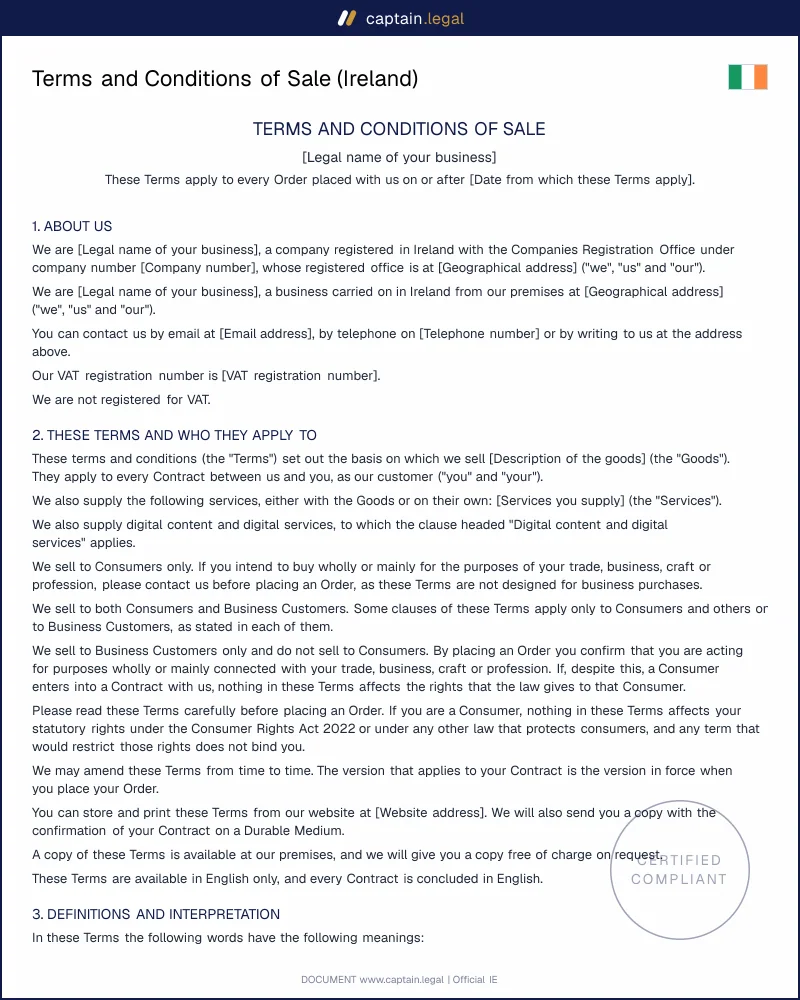
The opening clauses identify the seller (legal name, CRO number for a company, address, contact details, VAT position) and define the customers, the goods and any services or digital content. Contract formation follows the sales channel: checkout steps, error correction and the order button for website orders, payment at the till for counter sales. Price clauses show VAT inclusive for consumers and exclusive for trade buyers, ban payment surcharges above cost and refuse pre-ticked extras.

Consumer clauses restate the statutory remedies rather than hiding them, in the plain language section 134 requires of consumer terms. The cancellation clause reproduces the official model wording of Schedule 4: the 14-day period, the address for notices, the online cancellation function, refunds within 14 days and the choice of who pays return postage, plus the section 111 exceptions for personalised, perishable or unsealed hygiene goods. A model cancellation form sits in a schedule at the end. Shops can add a goodwill returns policy for counter purchases, written as a promise on top of statutory rights.

For trade customers, the template sets your own payment period, statutory late payment interest and compensation, a duty to inspect goods on delivery, a defect reporting window, retention of title until payment in full, and a liability cap at the contract price. General clauses cover events outside your control, complaints and ADR, personal data and Irish governing law.

How to fill out your terms of sale

You start with the business itself: its legal name and address, then whether it is a company, a sole trader or a partnership, which decides whether a CRO number appears. VAT registration comes next, and the answer changes the price clause, followed by the contact details customers will use and the date from which the terms apply.

The two questions that shape the document come after that. You choose who you sell to (consumers, business customers or both) and how contracts are concluded (through a website, in person at your premises, or both). Those answers add or drop whole clauses, so a counter-only wholesaler never sees a cancellation schedule. You then describe the goods and say whether you also supply services or digital content.

Payment methods, delivery area and usual delivery times follow. Trade sellers enter a payment period in days and a defect reporting window in months. Distance sellers decide who pays return postage after a cancellation, shops decide on a goodwill returns policy, and anyone selling to consumers says whether they use an ADR entity. The preview updates as you answer, and every Irish template on the Captain.Legal Ireland homepage follows the same answer, review and Finish flow.

Common mistakes to avoid

The mistake we see most often is a UK template with the currency changed. It cites the Consumer Rights Act 2015, quotes British time limits and names English courts that have no jurisdiction here. Close behind is the "no refunds" sign or clause. A trader can refuse a change-of-mind return in a shop, but no term can refuse a refund or repair for faulty goods, and a clause that tries to will not bind the consumer and can expose the trader to prosecution. Many sites also still carry a link to the old EU ODR platform, which closed in July 2025, or omit the website cancellation function that section 115A now requires.

On the trade side, two errors cost money. The first is relying on terms the buyer never saw: terms printed on an invoice issued after delivery usually come too late to form part of the contract. The second is a retention of title clause with nothing behind it in practice: goods mixed with other stock, never marked, never stored apart. When a customer enters examinership or liquidation, the examiner or liquidator will ask you to identify your goods, and a clause alone will not do it. If you are also taking a shop unit, our property and lease templates for Ireland handle the premises side.

Key takeaways

CRA 2022 S.115A

Web sales need a 'cancel contract here' function

A consumer who buys at a distance can cancel within 14 days of receiving the goods, without giving a reason. Since S.I. No. 309 of 2026 inserted section 115A into the Consumer Rights Act 2022, a contract made through a website must also be cancellable on that website, through a function labelled 'cancel contract here', followed by an acknowledgement on a durable medium. The template sets out both routes and the model form.

CRA 2022 SS.22-26

Faulty goods: 30 days to terminate, then repair

Where goods do not conform to the contract, a consumer may terminate within 30 days of delivery and get a full refund, or ask for repair or replacement, then a price reduction or final termination. A defect appearing within 12 months is presumed to have existed at delivery. No term can cut these rights down, and a 'no refunds' clause does not bind the consumer. The template states the remedies in plain words instead.

S.I. 580/2012

Trade buyers pay late payment interest and costs

Business customers can agree to your own payment period. If they pay late, the 2012 Late Payment Regulations add interest at the ECB rate plus 8 percentage points and a fixed compensation sum, without any reminder. A period over 60 days must be expressly agreed and not grossly unfair. Exclusions of the quality conditions in the Sale of Goods Act 1893 must be fair and reasonable.

Frequently Asked Questions

They bind a customer who had a fair chance to read them before ordering and accepted them, for example by ticking a box at checkout or by buying at a counter where a notice refers to them. That is ordinary Irish contract law. Two limits apply. A term that is unfair or that restricts consumer rights under the Consumer Rights Act 2022 does not bind a consumer, while the rest of the terms continue to apply. And for business buyers, a limitation of the implied quality conditions must be fair and reasonable under section 55 of the Sale of Goods Act 1893.

Yes. Once you click Finish and complete your order, the completed terms can be downloaded as an editable Word file or as a PDF. The Word version suits your website, since you will paste the text into a terms page linked from the checkout and adjust wording later. The PDF suits counter staff, trade account applications and email attachments. Both files carry the same clauses and the model cancellation form when your answers include distance sales to consumers. Keep a dated copy of each version you publish.

A consumer who buys goods at a distance has 14 days from the day they, or someone they nominate other than the carrier, receive the goods. For several items delivered separately, the clock starts at the last delivery. You then have 14 days from the cancellation notice to refund, although you may wait until the goods come back or you receive proof of postage, and the consumer has 14 days to return them. If you fail to give the cancellation information, the period is extended by up to 12 months under section 114 of the 2022 Act.

Not separate documents, but separate clauses. Consumer protections cannot be excluded, while a business buyer can agree to retention of title and a cap on liability. If you sell to both, choose that option in the form and the template keeps consumer and trade clauses in one document, each labelled so the reader knows which applies. Selling only to businesses changes more: the cancellation schedule disappears and the terms state that you do not deal with consumers, although a consumer who buys anyway keeps their statutory rights. Late payment interest applies only to commercial transactions.

For purchases made in person, Irish law gives no right to return an item simply because the buyer changed their mind, sale or not, so a shop may refuse those returns. Many choose a goodwill policy instead, and the template lets you set the number of days and the conditions. Faulty goods are a different matter. A reduced price does not reduce the consumer's rights, unless the consumer was told of that specific defect and expressly and separately accepted it before buying (section 18 of the 2022 Act). Online orders follow the 14-day cancellation rule even for discounted items, with the usual exceptions for personalised or perishable goods.

Most small traders do not, provided the business model matches the options in the form. The template already reflects the statutory wording for consumer cancellation, remedies and delivery, and it adapts to company or sole trader, VAT status and sales channel. Specialist advice makes sense if you sell regulated products, run subscriptions, operate a marketplace for other sellers or conclude contracts in customers' homes, since those raise rules outside this document. Traders setting up a company at the same time can find the related documents among our Irish templates for running a business.

4.6/5

14 verified reviews · 50 000+ downloads

Terms and Conditions of Sale Ireland (Consumer Rights Act 2022)
  • Immediate access to the document
  • PDF + Word download
  • Compliant with 2026 legislation
  • Reviewed by lawyers
Fill in the template
Secure payment
Updated on November 3, 2026

You might also like

Non-Disclosure Agreement (Ireland)
Share Transfer Agreement (Ireland)