Employment

Part-Time Employment Contract Ireland (Part-Time Work Act 2001)

Permanent part-time contract of employment under Irish law, applying equal treatment under the Part-Time Work Act 2001, with fixed, rostered or variable hours, guaranteed paid hours, reference hours and notice, pro rata pay and leave, sick pay, pension and the full statement of terms.
4.7/5— 16 reviews50 000+ downloadsInstant download
Share

A part-time contract sets out the terms on which an employer in Ireland takes on an employee for fewer hours than a comparable full-time colleague: the guaranteed weekly hours, how the days and times are fixed, pay, annual leave, sick pay, pension and notice. Irish law adds two layers on top of an ordinary contract. The Protection of Employees (Part-Time Work) Act 2001 forbids treating a part-time employee less favourably than a comparable full-timer, and the Terms of Employment (Information) Act 1994 requires the core terms in writing within 5 days of the start date. Our template covers both. It suits shops, cafés and offices hiring staff on fixed hours, a weekly roster or a variable pattern.

Compliant

2026 Legislation

50,000+ clients

trust us

Affordable

From €4.90 / doc

Secure payment

Instant download

Part-Time Employment Contract Ireland (Part-Time Work Act 2001)

Secure payment

Fill in the template

What is a part-time contract of employment in Ireland?

Under section 7 of the 2001 Act, a part-time employee is someone whose normal hours of work are less than those of a comparable full-time employee. There is no minimum or maximum number of hours, so a student working eight hours a week at weekends and a parent working four days out of five are both part-time employees. The comparator is usually a full-time colleague of the same employer doing the same or similar work; where there is none, the Act looks to a collective agreement and then to the same industry or sector. A written part-time contract records the hours that define the relationship and shows how pay and benefits relate to them.

It differs from two documents people often mix up with it. A casual or "if and when" arrangement guarantees no hours and leaves the worker free to refuse work; once an employee must be available for set hours, the Organisation of Working Time Act 1997 requires those hours to be greater than zero outside emergencies and short-term relief cover. A fixed-term contract ends on a date or event and is governed by the Protection of Employees (Fixed-Term Work) Act 2003. Employers recruiting for other roles can browse the employment templates for Irish employers.

When do you need this document?

The obvious trigger is the first part-time hire. A café taking on weekend staff and a dental practice hiring a morning receptionist face the same deadline: the core terms within five days. Sports clubs and charities that pay a coach or administrator for a few hours keep this contract alongside their governance documents for Irish charities and clubs. Existing staff are different. When a full-time employee moves to reduced hours after a flexible working request under the Work Life Balance and Miscellaneous Provisions Act 2023, a fresh part-time contract dated from the change can blur the original start date and service, which carry over, so many employers confirm the new hours in writing under section 5 of the 1994 Act instead.

Retail and hospitality bring the harder cases. Where a weekly rota makes the work pattern mostly unpredictable, the contract must state a guaranteed number of paid hours, the window of days and times in which work can be scheduled and the notice the employee will get, or the employer is exposed to a WRC complaint for breach of section 3(1)(p). Restaurants where customers leave tips must also write the tips policy into the statement itself, and a business still being set up will usually need the company and commercial templates for Irish businesses before its first hire.

Key clauses included in our template

Hours come first, because they define a part-time employee in law. The contract records the hours expected per day and per week and the full-time hours of a comparable employee, then adapts to the way the employer organises work: fixed days and times written into the contract, a weekly roster published in advance, or a variable pattern built on guaranteed paid hours with additional hours on top. For rostered and variable patterns, the reference hours and days and the minimum notice (from 24 hours to two weeks) are written in, together with the statutory right to refuse work scheduled outside them.

A dedicated equal treatment clause applies sections 9, 10, 12 and 15 of the 2001 Act, and pay is stated as not less favourable than a full-timer's, with salaries calculated pro rata. Additional hours are voluntary, paid at the basic rate up to full-time hours and then on full-time overtime terms. A separate clause covers requests for more hours under the Code of Practice on Access to Part-Time Working, S.I. No. 16 of 2026, banded hours under section 18A and the section 6F request for more predictable work.

Annual leave is either the statutory 8 per cent or a contractual entitlement in working weeks matching full-time staff. Public holidays apply the 40-hour test and the one-fifth rule for days the employee does not normally work. Statutory sick leave gives part-time staff the same number of paid days as full-timers, and the pension clause points to MyFutureFund or to the employer's scheme on equal terms. Probation, second jobs, confidentiality, procedures, lay-off, notice and optional non-solicitation covenants complete the contract; the Irish legal templates for employers and individuals cover the paperwork that comes before and after it.

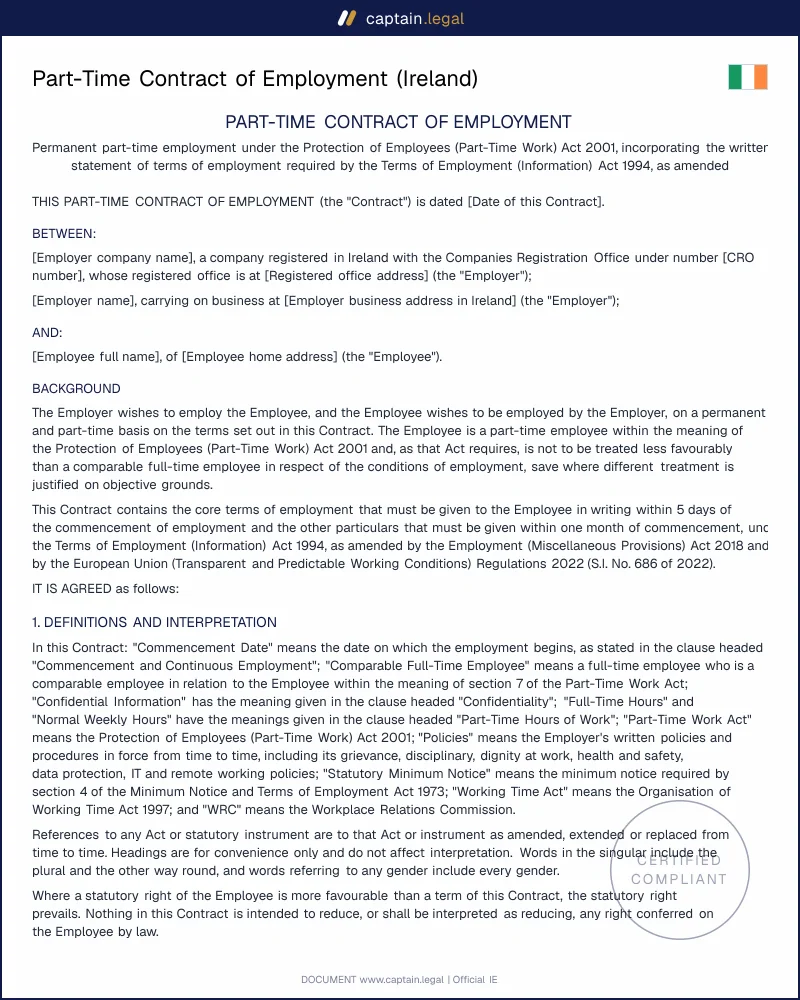
How to fill out this part-time contract

You start with the employer (a company with its CRO number, or a sole trader or partnership), then the employee, the employment permit question and the job itself.

The key step is the one on hours. You give the normal hours per day and per week, the full-time hours of comparable staff and the way days and times are set. Choosing fixed hours opens fields for the working days and times; choosing a roster or a variable pattern opens the reference hours and days and the notice period instead. Each answer appears in the preview on the right as you type, so you can read the clause before clicking Next, or go Back to change an earlier answer.

Pay, tips, leave, sick pay, pension, notice, restrictions and collective agreements follow, each opening an extra field only when needed. Check the preview, click Finish after the signature step and download the contract, then have it signed and handed to the employee within five days of the first day of work. Later requests for family leave are covered by the leave request letters for employees in Ireland.

Common mistakes to avoid

The most frequent error is a part-time contract that states hours the employee never actually works. An employer who writes 10 hours a week and then rosters 25 week after week has given the employee a ready-made banded hours claim after twelve months. The mirror image is just as common: a token guarantee of one or two hours used as a disguised zero-hours arrangement. Those hours are owed every week, and once the real hours settle higher, section 18A lets the employee claim the matching band. A third mistake is to set the roster the night before. Without 24 hours' notice and a stated window of reference hours and days, the employee can lawfully refuse the shift.

Benefits cause the rest of the disputes. Fewer leave weeks, no company sick pay or a lower hourly rate than full-timers doing the same job will not survive section 9 without an objective ground. Holiday pay is often miscalculated as a fixed number of days instead of 8 per cent of hours worked, and public holidays are refused to staff who did meet the 40-hour test. Finally, many employers copy a UK precedent with references to the Employment Rights Act 1996 and to British sick pay rules, neither of which has any effect in Ireland.

Key takeaways

PTWA 2001 S.9

Part-time staff cannot be treated less favourably

Section 9 of the Protection of Employees (Part-Time Work) Act 2001 forbids treating a part-time employee less favourably than a comparable full-time employee in pay, leave, sick pay or other conditions, unless an objective ground unrelated to part-time status justifies it. Benefits that depend on hours worked are given pro rata under section 10. The template writes these rules into a dedicated equal treatment clause.

OWTA 1997 S.17

Rosters need notice and reference hours and days

Where the contract does not fix starting and finishing times, section 17 of the Organisation of Working Time Act 1997 requires at least 24 hours' notice, and the work must fall within reference hours and days set in advance. If either rule is broken, the employee may refuse to work without adverse consequences. Under section 3(1)(p) of the Terms of Employment (Information) Act 1994, unpredictable patterns must state the guaranteed paid hours.

OWTA 1997 S.19

Annual leave is usually 8% of the hours worked

Under section 19 of the Organisation of Working Time Act 1997, the employee receives whichever statutory method gives the most leave. For most part-time staff that is 8 per cent of the hours worked in the leave year, capped at four working weeks. Public holiday benefit requires 40 hours worked in the five weeks before the holiday. Where full-time staff get more leave, the template grants the same number of working weeks.

Frequently Asked Questions

Once both parties accept it, the contract binds them like any other employment contract. No witness, notary or registration is needed, but the deadline is strict: the core terms within five days of the start date, signed and dated by or on behalf of the employer under section 3(4) of the Terms of Employment (Information) Act 1994. A clause that conflicts with the 2001 Act, such as fewer leave weeks than a comparable full-timer without an objective reason, is void to that extent under section 14. The employee need not sign, but a signed acknowledgement of receipt is useful evidence before the WRC.

Where the contract does not fix the days and times, section 17 of the Organisation of Working Time Act 1997 requires at least 24 hours' notice before the first day of work in the week, and the work must fall within the reference hours and days stated in the contract. A part-time contract made with our template can promise longer notice, up to two weeks. If the rules are not respected, the employee may refuse the work without any adverse consequence.

Both formats are available once you click Finish and complete your order. The Word file suits an adviser who wants to add a staff handbook reference or a bonus scheme, while the PDF is ready to print, sign and hand over. Clauses that do not match your choices, such as the roster provisions in a fixed-hours contract or company sick pay, are left out entirely, so nothing has to be deleted by hand before signing.

Section 19 of the Organisation of Working Time Act 1997 offers three methods and the employee gets whichever is most generous. For most part-time staff the relevant one is 8 per cent of the hours worked in the leave year, capped at four working weeks, a working week being the number of days the employee usually works. Someone working 1,000 hours in the year therefore earns 80 hours of paid leave. If full-time colleagues receive more than the statutory minimum, the part-time employee should normally receive the same number of working weeks.

Only in narrow cases. Since 2019, section 18 of the Organisation of Working Time Act 1997 requires the contract hours to be greater than zero, except for work in emergency circumstances or short-term relief cover for routine absences. Where an employee is required to be available but is given less than 25 per cent of the contract hours in a week, a minimum payment based on three times the national minimum hourly rate applies. Genuinely casual work, with no obligation to be available, falls outside section 18 altogether. Our template always states guaranteed paid hours, so the employer knows the minimum weekly cost from the outset.

Yes, and the employer has to take the request seriously. After twelve months, an employee whose contract does not reflect the hours actually worked can ask in writing to be placed in a band of weekly hours under section 18A, and the employer must do so within four weeks unless a statutory ground for refusal applies. After six months and the end of probation, section 6F also allows a request for more predictable and secure work, answered in writing within one month. When the relationship ends instead, see the templates for ending an employment in Ireland.

4.7/5

16 verified reviews · 50 000+ downloads

Part-Time Employment Contract Ireland (Part-Time Work Act 2001)
  • Immediate access to the document
  • PDF + Word download
  • Compliant with 2026 legislation
  • Reviewed by lawyers
Fill in the template
Secure payment
Updated on November 3, 2026

You might also like

Contract of Employment (Ireland)
Dismissal Letter (Ireland)