Real Estate

Tenancy Inventory and Condition Report Ireland (Check-in and Check-out)

Room-by-room inventory and condition report for a residential tenancy in Ireland, at check-in or check-out, with meter readings, keys, safety alarms, photographs and the deposit rules of the Residential Tenancies Act 2004.
4.5/5— 12 reviews50 000+ downloadsInstant download
Share

An inventory and condition report is the room-by-room record of what a rented home in Ireland contains and what state it is in, signed when the tenant moves in and compared again when the tenant leaves. It is the document landlords, letting agents and tenants reach for when the conversation turns to the deposit, because it puts the condition of the home on paper, with a date. This template produces either a check-in report or a check-out report from the same questions, with meter readings, keys, alarms, photographs and the Irish deposit rules. The landlord or agent prepares it and the tenants sign it, so both sides keep the same record.

Compliant

2026 Legislation

50,000+ clients

trust us

Affordable

From €4.90 / doc

Secure payment

Instant download

Tenancy Inventory and Condition Report Ireland (Check-in and Check-out)

Secure payment

Fill in the template

What is an inventory and condition report?

In practice, the report is a schedule attached to a tenancy that lists each room, the fixtures and furniture in it, and a short verdict on their condition, backed by numbered photographs. At check-in it fixes the baseline: the scratch on the worktop, the stained carpet, the blind that sticks. At check-out the same headings are filled in again, and the difference between the two versions is what any deduction for damage turns on. Nothing in the Residential Tenancies Act 2004 obliges either side to prepare one. Its value is evidential. Before the Residential Tenancies Board, a signed record made on the day outweighs two conflicting recollections a year later.

The report is not the tenancy agreement and does not change it. The lease or written agreement sets the rent, the term and the obligations; the inventory records facts about the property at two moments in time. It therefore sits alongside the other Irish tenancy and property templates, from the agreement itself to the notices served during the tenancy.

When do you need this document?

The first use is on the day the keys change hands. A landlord letting a furnished apartment in Dublin or a family home outside Cork should walk through every room with the incoming tenant, fill in the report and sign it there and then, because any defect left off the list becomes harder to prove later. When the landlord is a company, the person who attends signs for it and should hold that authority under the company's constitution; our documents for Irish limited companies include one.

When the tenancy ends, the report records what is returned (keys, fobs, furniture), the final MPRN reading, the gas or heating oil level, and any item the landlord says goes beyond normal wear and tear, with the tenant's position next to it. Joint tenancies add a wrinkle. If only one of three housemates turns up, the report says so, names who attended, and gives the others seven days to comment; no deduction is agreed on the spot. A tenant who has moved abroad is recorded as absent, even if a parent walks round with the landlord. If that tenant wants someone to act more widely while away, a written authority from our personal legal documents for Ireland is the cleaner route.

Key clauses included in our template

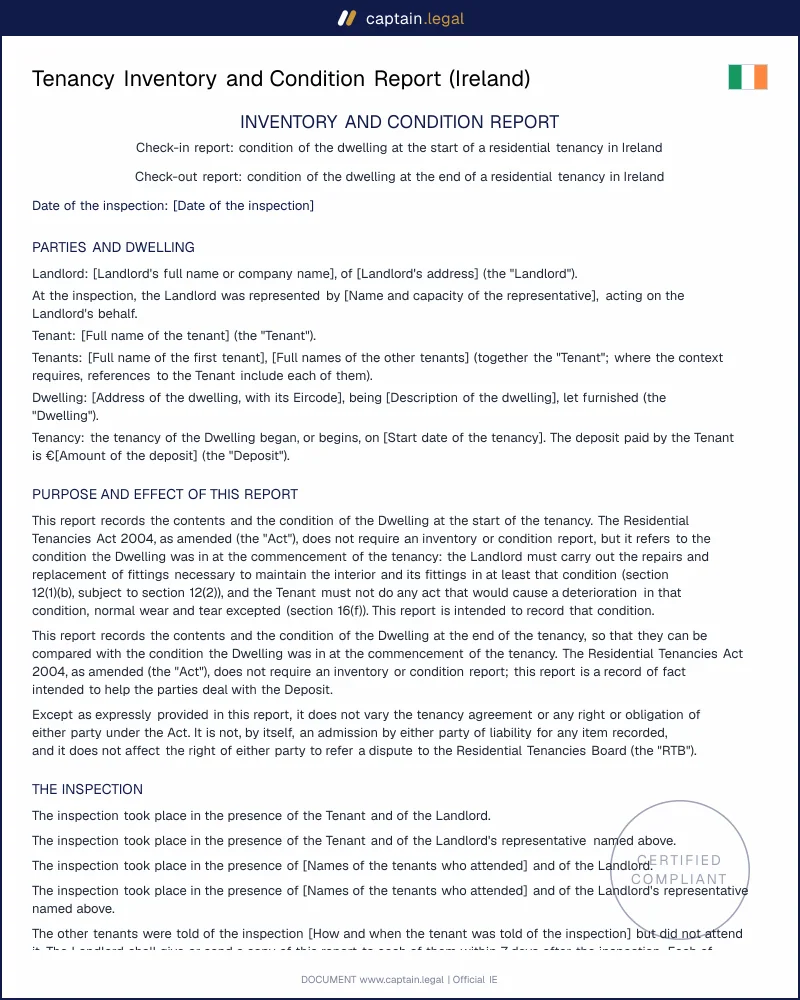
Each version opens with the parties, the dwelling with its Eircode and furnishing, the tenancy start date and the amount of the deposit, followed by a short purpose clause stating that the report is not legally required and is not an admission of liability. The inspection clause records who was present, how an absent tenant was told about the visit, and the method used.

  • Up to ten rooms or areas, each with its contents, a Good, Fair or Poor rating and observations wherever the rating is not Good, so the garden, shed or parking space can be listed as well.
  • Meter readings come with the MPRN and, where relevant, the GPRN or the oil tank level.
  • At check-in, any repair the landlord promises is written down with a deadline and is not treated as damage caused by the tenant.
  • Deductions are framed by section 12(4): normal wear and tear is excluded, age is taken into account, and unless an amount was agreed in the report, the landlord gives a written statement with evidence before keeping anything.
  • Smoke, heat and carbon monoxide alarms are tested and noted.

At check-out, a final clause records the outcome for the deposit: full return, an agreed amount for listed items only, or nothing agreed yet. The signature block distinguishes a party who attended from a tenant who signs only to confirm receipt.

How to fill out this inventory and condition report

You start by choosing whether this is a check-in or a check-out report and entering the date of the inspection. The questionnaire then asks for the landlord's name and address, whether the landlord attended in person or through an agent or other representative, and the names of every tenant. A short step asks whether all, some or none of the tenants attended, and if anyone was missing, how and when they were told about the visit. The preview on the right changes as you answer.

Next come the dwelling, the furnishing and the deposit, then the questions that only apply to one moment: repairs promised at check-in, or the end date, forwarding address and earlier check-in report at check-out. You choose how many rooms to record and describe each one in turn. Keys, the MPRN reading and the alarms follow, then the items raised by the landlord, the tenant's position and the outcome for the deposit. Use "Next" and "Back" to move between steps and "Finish" when the preview reads correctly; the inventory and condition report is then ready to download, print and sign. Other documents for Irish landlords, employers and families are listed on the Captain.Legal Ireland homepage.

Common mistakes to avoid

The usual failure is vagueness. "Living room: good condition" proves nothing eighteen months later, while "grey three-seater sofa, small tear on the left arm, photo 9" settles the point in seconds. Unshared photographs are almost as weak, since the tenant can claim they were taken later; send them on the day and say how in the report. Landlords also forget the meters, then argue over a final electricity bill that one MPRN reading would have settled. Another mistake is holding the check-out without inviting the tenant. The report can still go ahead, but invite the tenant in writing and keep a copy of that invitation, since an adjudicator is likely to ask whether the tenant had a fair chance to attend.

At the deposit stage, the errors are about money. Charging for a new carpet when the old one was eight years old ignores its age, which the RTB's guidance does not accept for an item already significantly worn. Deducting for faded paint or worn flooring after a long tenancy charges the tenant for normal wear and tear, which the Act excludes. Agreeing a deduction with one joint tenant while the others are absent invites a dispute from the rest. Finally, never let the check-out start without the check-in report to hand; without it, the landlord has to prove the starting condition some other way.

Key takeaways

RTA 2004 S.12(4)

What a landlord may keep from the deposit

The landlord must return the deposit promptly. Section 12(4) lets the landlord keep the part that covers rent, charges or taxes in arrears when the tenant asks for it back, and the reasonable cost of restoring damage beyond normal wear and tear. The template adds a written statement of each amount, with photos or quotes, before any amount not agreed in the report is withheld, and any dispute can go to the RTB.

RTA 2004 S.16(F)

Normal wear and tear is never the tenant's cost

The tenant must not cause a deterioration in the condition the dwelling was in at the start of the tenancy, but normal wear and tear is disregarded. The Act judges it by the length of the tenancy, the occupation the landlord should have foreseen and any other relevant matter. Worn flooring after five years is normal; a burn mark is not. A signed check-in report is the clearest way to show where the line falls.

NO STATUTORY FORM

Not compulsory, but the evidence that counts

No section of the Residential Tenancies Act 2004 requires an inventory, and the report says so. Its weight comes from being signed and dated on the day, with numbered photographs shared with the tenant. A tenant who did not attend gets a copy within 7 days and 7 days to comment, signs only to confirm receipt, and no deduction can be agreed in the report while any tenant is absent.

Frequently Asked Questions

It is not a statutory form, and no section of the Residential Tenancies Act 2004 requires one. What gives it force is the signature: a party who attended and signed has confirmed that the record is accurate, subject to any comments written in or attached. Clauses where the parties commit themselves, such as a repair the landlord promises at check-in or an amount both sides agree at check-out, bind them as a written agreement. The report never removes a statutory right. The landlord must still return the deposit promptly, normal wear and tear can never be charged, and either party can refer a deposit dispute to the RTB under section 78.

Yes. Once you click "Finish", the completed report can be downloaded in both formats. Word suits agents who want to insert photographs or adjust a heading for a particular property, and PDF is cleaner for signing and emailing to the tenant. If you edit the Word version, keep the deposit and wear and tear clauses intact, because they reflect sections 12 and 16 of the Act and a tenant will rely on them.

The Act sets no fixed number of days. Section 12(1)(d) requires the landlord to return or repay the deposit promptly, and the RTB's own guidance says as soon as possible once the tenancy has ended, allowing time to inspect the dwelling. If nothing is in dispute, the template records a full return; if an amount is agreed, the balance must follow promptly. Where a tenant did not attend, the report gives seven days for comments, after which the landlord should send a written statement of any deduction, with evidence, and pay back the rest without waiting further.

Normal wear and tear is the deterioration that ordinary living causes over time, and section 16(f) measures it by three factors: how long the tenancy lasted, how much occupation the landlord should have expected, and any other relevant matters. A family of four in a house for five years will leave more marks than a single tenant in an apartment for one year, and both are normal. The RTB gives worn flooring, leaking tap washers and a tired cooker element as examples. Burn marks, holes in walls, broken glass and torn curtains fall on the other side. A careful check-in record is the easiest way to tell the two apart.

The landlord can go ahead, but the report works differently. It records how and when the tenant was told about the visit, and the landlord must give or send a copy within seven days. The tenant has seven days from receiving it to send written comments, which are attached and form part of the report. A tenant who signs afterwards confirms only receipt, not agreement with the content, and no deduction from the deposit can be agreed in the report itself. The same applies to a joint tenant who stayed away while the others attended.

Attaching it is good practice, and the RTB recommends exactly that for the check-in inventory. Make sure the tenant holds the same signed version, photographs included. Our residential tenancy agreement and other Irish letting templates refer to an inventory signed at the start of the tenancy, so the two documents fit together. At check-out, prepare a new report rather than writing on the old one, and record the date of the check-in report so the comparison is clear.

It does. Where the right to occupy the home depends on keeping the job, for example on a farm or at a hotel, Part 4 security of tenure does not apply (section 25(4)(b)), but the rest of the Act, including the deposit rules in sections 12 and 16, still governs the letting when it is a tenancy. An inventory matters here because the tenancy often ends with the job. Record the condition when the employee moves in, and keep the arrangement separate from the employment terms, which belong in a contract chosen from our Irish employment contract templates.

4.5/5

12 verified reviews · 50 000+ downloads

Tenancy Inventory and Condition Report Ireland (Check-in and Check-out)
  • Immediate access to the document
  • PDF + Word download
  • Compliant with 2026 legislation
  • Reviewed by lawyers
Fill in the template
Secure payment
Updated on November 3, 2026

You might also like

Landlord Notice of Termination (Ireland)
Lodger (Licence) Agreement (Ireland)