Real Estate

Lodger Agreement Ireland (Licence, Rent-a-Room)

Licence for a lodger renting a room in an owner-occupied home in Ireland, for one or two owners: room and shared areas, weekly or monthly fee, bills, meals, deposit, house rules and agreed notice, outside the Residential Tenancies Act 2004.
4.6/5— 13 reviews50 000+ downloadsInstant download
Share

A lodger agreement is the written licence an Irish homeowner signs with a person who rents a room in the house where the owner lives. It records the room, the shared areas, the weekly or monthly fee, the deposit and the house rules, and it makes clear that the lodger is a licensee, not a tenant. Owners who take in a student for the college year, a worker on a contract or a long-term lodger for the extra income all need the same thing: a short document that sets expectations before the first argument about the heating. It is drafted under Irish law for the rent-a-room situation, where the owner stays in the home.

Compliant

2026 Legislation

50,000+ clients

trust us

Affordable

From €4.90 / doc

Secure payment

Instant download

Lodger Agreement Ireland (Licence, Rent-a-Room)

Secure payment

Fill in the template

What is a lodger agreement in Ireland?

In Irish practice, a lodger agreement is a licence to occupy: permission to live in a room and share the kitchen, bathroom and living space, without the exclusive possession that defines a tenancy. The owner keeps a key, keeps control of the whole house and can enter the room at reasonable times. The lodger pays a licence fee, which most people still call rent. Irish courts look at how the arrangement works in reality, not at the label on the document.

The line between a licence and a tenancy is what this document is for. A lodger has none of a tenant's statutory protections: the relationship rests on the contract and on the general law of licences, which only requires reasonable notice to end it. That is why a written lodger agreement carries so much weight. If you let an entire property, or a flat with its own front door, you are in tenancy territory, and the Irish property and letting documents for landlords are the right starting point.

When do you need a lodger agreement?

The classic case is the student lodger who arrives in September and leaves after the summer exams. Owners often set a fixed end date matching the academic year. Monday-to-Friday digs come next, typically a worker on a site or hospital rotation who goes home at weekends. People starting a new job in a different county, perhaps with an offer letter from the Irish employment contracts and letters section, use a room in a family home as a bridge before renting their own place.

Retired owners and empty nesters are the other big group. A spare room brings in income that rent-a-room relief usually keeps out of tax, and a lodger agreement lets them set the rules on guests, meals and quiet hours from day one. Two owners who both live in the house can sign together, and Revenue then splits the annual rent-a-room limit equally between them.

Some situations sit at the edge. If you plan to work abroad for a year and leave the lodger in the house, the arrangement stops being a lodging; you need a tenancy instead. Letting a room to your adult son or daughter is lawful, but the income will not qualify for the relief. Related family paperwork sits among the personal and family legal documents for Ireland.

Key clauses included in our template

The template targets the facts that keep the arrangement a licence and the money questions behind most disputes.

  • Nothing in the grant gives the lodger exclusive possession: the owner keeps a key, controls the whole home, may enter on 24 hours' notice and can, on the owner's notice period, move the lodger to another free bedroom of comparable size and standard.
  • On money, the fee is weekly or monthly, paid by bank transfer or in cash against a receipt, with bills either included or covered by a fixed contribution. Changes need the owner's notice period, and the lodger can walk away rather than accept them.
  • A deposit is optional. When one is taken, it must be repaid within 14 days of the lodger leaving and handing back the keys, less itemised deductions only.
  • Ending the licence works on agreed notice from either side, with faster exits for unpaid fees or serious breach, a ban on force, and a 28-day procedure for belongings left behind.
  • If the owner moves out, dies or sells, the agreement ends cleanly on notice, so the household does not drift into an accidental tenancy.

House rules cover smoking and vaping indoors, pets, overnight guests, noise between 11 p.m. and 7 a.m., fire safety and the security of the house, and you can add your own rules in free text. A signed record of the room's condition, with photos, becomes part of the agreement. Before signing, the owner also confirms that any consent needed from the mortgage lender, the home insurer or a management company has been obtained; an insurer that was never told about a lodger may dispute a later claim.

How to fill out this lodger agreement

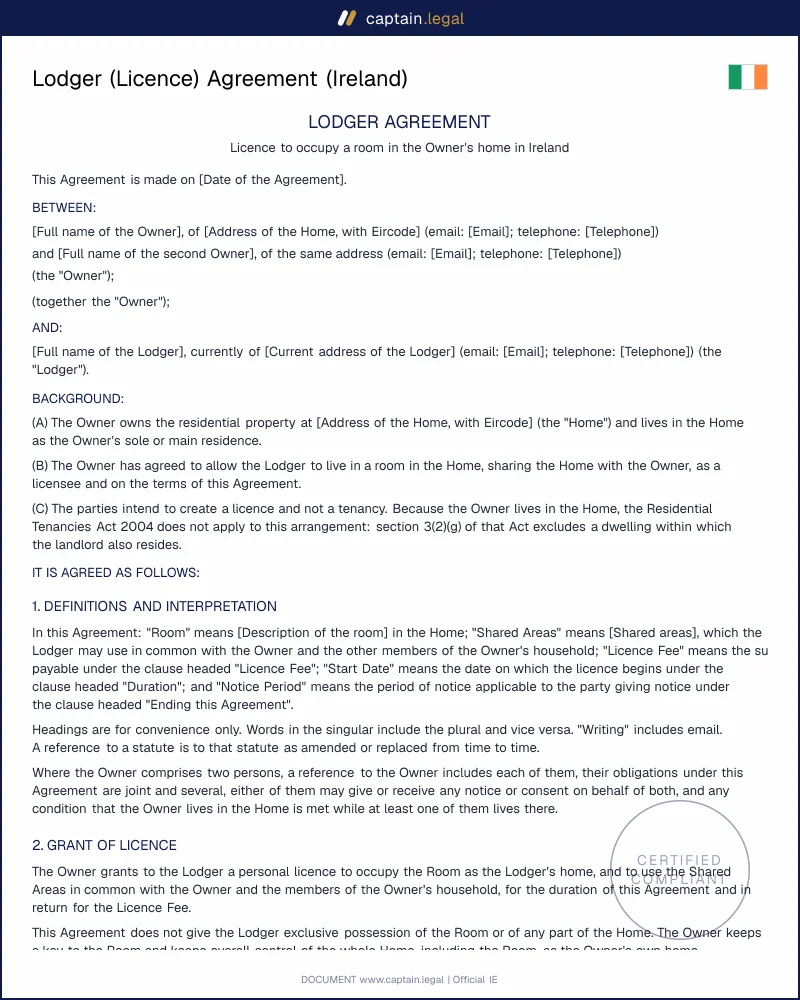
You start with the owner, or two owners if both live in the house, with names, email addresses and telephone numbers, since notices can be served by email. Next comes the property: the address with its Eircode, a precise description of the room (floor and position, so it cannot be confused with another bedroom), the areas the lodger may share and whether the room is furnished. The lodger's details follow, including a current address, and you then choose between an open-ended licence and a fixed end date, starting on a date you set.

On the money screens, you enter the fee, pick weekly or monthly payments, write the payment day as it should read in the agreement and choose transfer or cash. Two questions settle bills and meals, and the deposit question opens an amount field only when you answer yes. House rules and notice periods come last, followed by the place and date of signing.

The preview on the right updates as you answer. When you click Finish, the agreement is ready to download, print in two copies and sign. For other household paperwork, browse the full range of online legal documents for Ireland.

Common mistakes to avoid

Of all the errors, the self-contained unit costs the most. Owners convert a garage into a studio with its own entrance, call the occupant a lodger and assume the 2004 Act stays away. It usually does not: the owner does not live "within" a separate dwelling, so the occupant is usually a tenant who must be registered with the RTB, unless the unit is a detached garden house that meets the narrow conditions of section 3(2)(j). The second mistake is moving out. An owner who takes a job abroad and leaves the lodger in place has quietly removed the condition that kept the Act away. A licence only stays a licence while the owner keeps living in the home.

Money causes the rest. Owners forget that rent-a-room relief is measured on gross receipts, so a small fee increase or a meals charge can push the total over the limit and make all of it taxable. Others never sign a condition record, then try to keep part of the deposit for marks that were already on the wall. Short notice is another trap: a week's notice to a lodger who pays monthly is hard to defend as reasonable, and anything under four weeks becomes fragile if the arrangement is ever argued to be a tenancy. Finally, changing the locks while the lodger is out exposes the owner to claims that a properly served notice would have avoided.

Key takeaways

RTA 2004 S.3(2)(G)

Owner in the house: the 2004 Act does not apply

The Residential Tenancies Act 2004 does not apply to a dwelling within which the landlord also resides. A lodger in your home is a licensee: no RTB registration, no Part 4 security of tenure and no statutory notice table. The exclusion depends on facts. It is lost if the room is really a self-contained unit with its own entrance and kitchen, or if you move out and the lodger stays on in the house.

TCA 1997 S.216A

Rent-a-room relief is measured on gross receipts

Income from letting rooms in your sole or main residence, including charges for meals, laundry or bills, is free of income tax, PRSI and USC up to an annual limit, split equally between joint owners. Revenue counts the gross amount with no deduction for expenses, and above the limit the whole sum is taxed. Payments from your child and lets of 28 consecutive days or less are excluded, except students, weekday digs and people with an incapacity.

HMPA 1992 S.16

Notice is agreed in advance, never under 28 days

A licence can be ended on reasonable notice, so the agreement fixes the periods in writing: 28 days, one month or two months for the owner, and between 7 days and one month for the lodger. The 28-day floor also meets the four-week minimum for ending the tenancy of a house outside the 2004 Act, which protects the owner if a court ever treated the arrangement as a tenancy. Force is never allowed.

Frequently Asked Questions

It is a binding contract once both of you sign it. Irish law needs no witness, notary or registration for a licence of a room in an owner-occupied home, and the RTB has no role because section 3(2)(g) takes the house outside the 2004 Act. What a court will check is whether the facts match the paper: the owner lives in the house, shares it with the lodger and keeps control of the room. Where those facts hold, the written terms are the terms a court will apply between you.

Yes. After you click Finish, the completed agreement can be downloaded as a Word file, which you can still adjust, or as a PDF ready to print. Most owners print two copies, sign both on moving-in day and keep one each, with the signed record of the room's condition. Keep the Word version: if you both agree a new term later, such as a change to meals, you can prepare a short written variation signed by both of you. A fee change works differently: the owner gives written notice, and the lodger can leave rather than accept it.

Irish law only requires reasonable notice to end a licence, so the agreement fixes the period in advance. When the agreement is prepared, the owner's period is set at 28 days, one month or two months, and the lodger's at 7 days, 14 days, 28 days or one month, and both of you sign up to those figures. Twenty-eight days is the floor for the owner because it also satisfies the four-week minimum of section 16 of the 1992 Act if the arrangement were ever treated as a tenancy. Shorter exits exist for unpaid fees and serious breach. Violence, deliberate damage or illegal use allows termination with immediate effect, and the lodger then has 48 hours to leave, or longer where that is reasonable.

No registration is needed for a lodger who lives in your home with you. The Residential Tenancies Act 2004 does not apply to a dwelling where the landlord also resides, so the arrangement is not registered and neither of you can use RTB dispute resolution. The position changes if you let a self-contained flat with its own entrance and facilities, or if you move out and the lodger stays: that is a tenancy, and you should use the residential tenancy and landlord notice templates instead of a licence.

If you decide to stop living in the home, other than for holidays, work trips or a hospital stay, you must tell the lodger in writing and end the licence with your notice period. If the house is to be sold, or if you die, the agreement can be ended on 28 days' written notice by you or your personal representatives, even where a longer notice period was chosen. A lodger who stays on afterwards should sign a new agreement, as tenancy law may then apply.

Rent-a-room relief does not apply to lettings of 28 consecutive days or less unless the guest is a student or another excepted person, so income from holiday or booking-site guests is taxed in the ordinary way. A lodger agreement assumes someone who lives in the room as a home, with a deposit, notice periods and house rules to match. If you are setting up a guesthouse or trading through a company, the company and business templates for Ireland are a better fit than a lodger licence.

4.6/5

13 verified reviews · 50 000+ downloads

Lodger Agreement Ireland (Licence, Rent-a-Room)
  • Immediate access to the document
  • PDF + Word download
  • Compliant with 2026 legislation
  • Reviewed by lawyers
Fill in the template
Secure payment
Updated on November 3, 2026

You might also like

Landlord Notice of Termination (Ireland)
Tenant Notice of Termination (Ireland)