Non-Profit

CLG Constitution Ireland (Company Limited by Guarantee, Charity-Ready)

Memorandum and articles of association for an Irish company limited by guarantee under Part 18 of the Companies Act 2014, with optional charity clauses (Charities Act 2009 and Revenue standard clauses) and the section 1180 name exemption.
4.6/5— 32 reviews50 000+ downloadsInstant download
Share

A CLG constitution is the founding document of an Irish company limited by guarantee: the memorandum and articles of association, printed together, that the subscribers sign before the company is registered with the Companies Registration Office. Community groups, social enterprises and many Irish charities use this structure because it gives them a separate legal personality and limits each member's exposure to a small guaranteed sum. This template follows Part 18 of the Companies Act 2014 and the statutory form in Schedule 10, and it can switch on the clauses that the Charities Regulator and Revenue look for when a company applies for charity registration and charitable tax exemption.

Compliant

2026 Legislation

50,000+ clients

trust us

Affordable

From €4.90 / doc

Secure payment

Instant download

CLG Constitution Ireland (Company Limited by Guarantee, Charity-Ready)

Secure payment

Fill in the template

What is a CLG constitution?

A company limited by guarantee, or CLG, has no share capital. Its members do not buy shares; each one undertakes to contribute a nominal fixed sum, stated in the memorandum, towards the company's debts if it is wound up while he or she is a member or within one year after leaving. That promise is the guarantee, and it is the whole of a member's liability. This template, like most CLG constitutions, forbids any distribution to members, so surpluses stay in the company and fund its objects, which is why the CLG is the default not-for-profit vehicle in Ireland.

Under section 1176 of the Companies Act 2014, the constitution is the company's rulebook: a memorandum of association and articles of association contained in one document. The memorandum states the name, the company's status as a CLG registered under Part 18, its objects, the limited liability of members and the amount of the guarantee. The articles govern everything else. A private company limited by shares (an LTD) suits trading businesses better, and its formation documents sit with our Irish company and business templates. An unincorporated club has no legal personality at all, which leaves its committee personally exposed.

When do you need this document?

The classic case is a new charity that has outgrown a committee and a bank account. Once it wants to sign a lease, hire a first co-ordinator or apply for public funding, incorporation becomes the practical answer, and many funders insist on it. Community centres, youth projects and food banks reach this point sooner than their founders expect, and the board documents that follow sit among our Irish non-profit and charity templates.

Not every CLG is a charity. Residents' groups, sports clubs, professional networks and festivals often want limited liability and a not-for-profit lock without charity regulation, because their members benefit directly or their objects are not charitable in law. An unincorporated association converting to a company also needs a fresh constitution, since its old rules cannot simply be registered with the CRO. If the organisation will employ staff from day one, line up contracts with the Irish employment contract templates at the same time.

One edge case recurs: a single founder. A CLG may be formed by one subscriber, but the company still needs two directors, and the AGM can be dispensed with only while there is a single member.

Key clauses included in our template

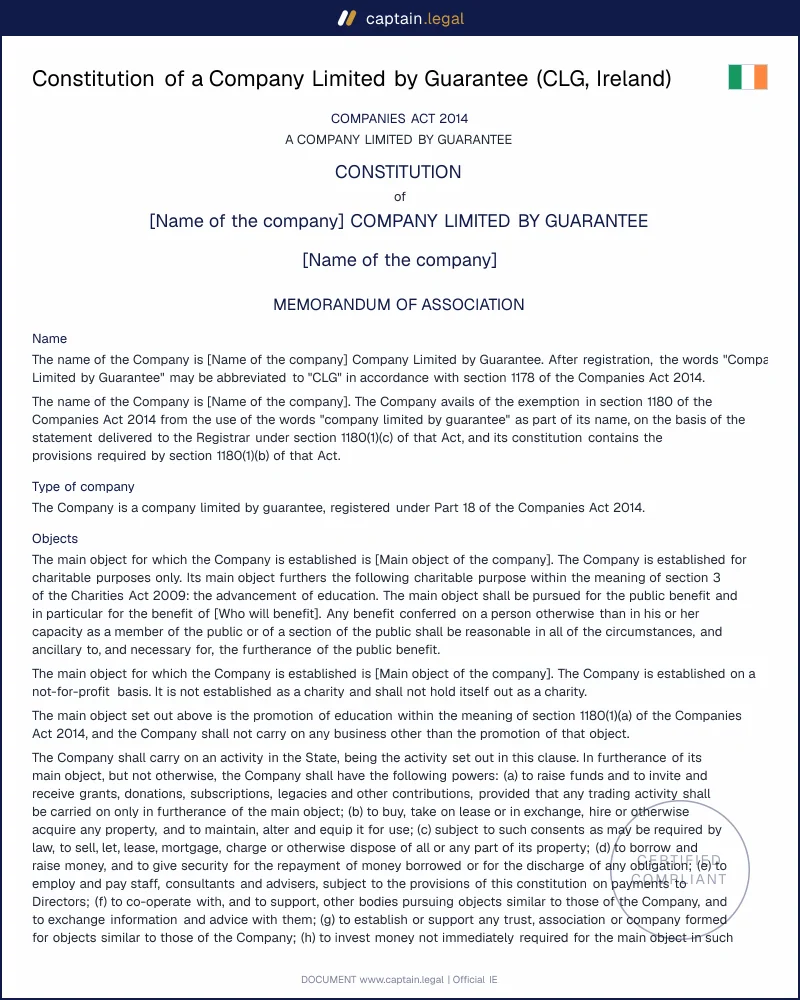
The memorandum opens with the name in the form your choice requires, either with "Company Limited by Guarantee" or under the section 1180 exemption, followed by the status statement, the main object and the guarantee. For a charity, the objects clause names the head of charitable purpose under section 3 of the Charities Act 2009, identifies the section of the public that benefits and confirms that any private benefit is reasonable, ancillary to and necessary for the public benefit, the test in section 3(3) in the Act's own words.

Most of the work sits in the articles, which cover the ground a solicitor would expect:

  • Membership rules come first, because most disputes in small CLGs start there; the board can remove a member only after 14 days' notice and a hearing, which displaces the bare statutory power in section 1199(8).
  • A non-distribution lock applies in both versions. In the charitable one, Revenue's wording bars any salary or fee to a director, with a short list of exceptions such as reasonable out-of-pocket expenses, capped loan interest and proper rent.
  • Board provisions set your minimum and maximum number of directors, rotation of one third at each AGM under section 1196, and removal by ordinary resolution on 28 days' extended notice.
  • Conflicts are declared at the board meeting where the matter is first considered, and the interested director neither votes nor counts in the quorum.
  • What happens to the assets if the company closes? Any surplus goes to another not-for-profit body, normally one with similar objects, that is itself barred from distributing to its members.

In the charitable version, an article on registration states plainly that adopting the constitution does not by itself make the company a registered charity or tax exempt; those decisions belong to the Regulator and Revenue.

How to fill out this CLG constitution

You start by typing the company name without any ending, then answering whether the company will be a charity and whether the name keeps "Company Limited by Guarantee". Those two answers drive the objects clause, the director payment rules, the amendment clause and one of four winding-up clauses, and the preview on the right updates as you click. Next comes the main object, written as a sentence beginning with "to". A charity then picks the head of charitable purpose and the people who benefit, while a non-charitable company using the section 1180 exemption picks the statutory object it promotes.

The next screens cover the guarantee, the number of subscribers, any annual subscription, the board's size and quorums, and each subscriber's name and address. When you click Finish, the CLG constitution is ready to download, print and sign in front of a witness, then file with Form A1, which names the first directors and the secretary. A company renting premises can draw up its lease from the Irish property and tenancy templates, and every other form starts from the Captain.Legal Ireland document library.

Common mistakes to avoid

The most frequent problem at the CRO stage is the name. Founders type "CLG" into the name field and the registered name ends up doubled, or they omit the ending without filing the section 1180 statement. A close second is an objects clause so broad ("to support good causes in Ireland") that the Charities Regulator cannot identify a charitable purpose; registration then stalls while the company passes a special resolution to amend its objects. Write the main object of your CLG constitution as precisely as you would explain it to a funder.

Quorums cause quieter trouble. A board quorum above the minimum number of directors, or a members' quorum above the number of subscribers, can leave the company unable to decide anything the first time someone resigns. Charities also get caught by director pay: a founder who plans to become the paid manager while staying on the board breaches the Revenue clause, because none of its exceptions covers a director's salary; the usual fix is to step down from the board before taking the job. Finally, many groups start fundraising as soon as the CRO number arrives. Until the Charities Regulator registers the company, it must not ask the public for money or accept donations, because section 41 of the Charities Act 2009 makes that an offence.

Key takeaways

CA 2014 S.1180

Dropping "CLG" from the name has conditions

Section 1178 requires the registered name to end with "company limited by guarantee", and "CLG" is only an abbreviation after registration. Section 1180 lets a company promoting commerce, art, science, education, religion or charity omit the ending, but only if a director or the secretary files the prescribed statement and the constitution locks income to the objects, bans distributions and sends any surplus to a company meeting the same tests.

CHARITIES ACT S.41

No public fundraising before charity registration

Incorporation at the CRO does not make a company a charity. Under section 39 of the Charities Act 2009 a charity operating in the State must register with the Charities Regulator, and section 41 makes it an offence for an unregistered charity to advertise, invite the public to give money or accept a gift. The template builds this sequence into the articles and never presents registration or tax exemption as automatic.

REVENUE CLAUSES

Charity directors are unpaid save narrow exceptions

Revenue's standard clauses, used in the charitable version, bar any salary, fee or benefit to a director, subject to listed exceptions such as reasonable out-of-pocket expenses, capped interest on loans and proper rent. None of them covers a director's salary, and the services exception relies on section 89 of the Charities Act 2009, which is not yet in force. A founder who wants the paid manager role should leave the board first.

Frequently Asked Questions

It becomes binding once the company is incorporated. After registration, the constitution binds the company and its members as if each had signed a contract, and the CRO accepts it if it follows Schedule 10 of the Companies Act 2014 or a form as near to it as circumstances permit, which this template does. Two formalities matter: each subscriber signs in front of a witness who attests the signature (or authenticates electronically under section 888), and the memorandum and articles are printed as one document. A solicitor's review is sensible for unusual structures, such as membership classes, but it is not a legal requirement.

At least two directors, under section 1194, and both must be individuals aged 18 or over. One of them must normally be resident in the European Economic Area, unless the company holds the bond provided for in section 137 or qualifies for the exemption in section 140. On the membership side, one subscriber is enough to form the company, although most charities start with three or more. The articles record the number of members with which the company proposes to be registered, and any later increase beyond that number is notified to the CRO within 15 days.

Both formats are available once you click Finish, and they carry identical text. The PDF is the version to print, sign and witness for filing, and the Word file lets your solicitor or board add bespoke provisions before signing, such as membership categories or a patron. If you edit the Word version of a charitable constitution, leave the Revenue clauses unchanged, because the Regulator and Revenue compare them with their own models.

Completing the questionnaire takes about twenty minutes. CRO registration usually follows within a few weeks of a complete Form A1 filing, longer if the name is queried. Charity registration is a separate application to the Charities Regulator, which reviews the constitution, the activities and the trustees, and decisions often take several months. Charitable tax exemption from Revenue comes last, because Revenue requires registration with the Regulator first. Plan public fundraising around the Regulator's decision rather than the CRO certificate.

Members contribute no more than their guarantee, and only if the company cannot pay its debts. Past members are liable only if they left within the previous year and only for debts incurred while they were members, under section 1223. Assets left after paying creditors are never shared among the members; the winding-up article sends them to another not-for-profit body that cannot distribute its own income. In the charitable version, the Regulator's agreement is needed if the members fail to choose a recipient. Directors who let an insolvent company keep trading can still face personal liability.

Yes, by special resolution, which needs 75 per cent of the votes cast at a general meeting called on 21 days' notice, or a written resolution signed by every member. Objects are changed under section 1184, and members representing at least 15 per cent of the membership, none of whom voted for the change, can ask the court to cancel it within 21 days. A registered charity gives the Charities Regulator advance notice of any amendment that needs its approval, and the change takes effect only once approved. The amended text is then filed with the CRO. Trustees who need paperwork for their own affairs, such as a general power of attorney, can find it among the Irish personal legal templates.

4.6/5

32 verified reviews · 50 000+ downloads

CLG Constitution Ireland (Company Limited by Guarantee, Charity-Ready)
  • Immediate access to the document
  • PDF + Word download
  • Compliant with 2026 legislation
  • Reviewed by lawyers
Fill in the template
Secure payment
Updated on November 3, 2026

You might also like

Club or Association Constitution (Ireland)
Director / Charity Trustee Appointment Letter (Ireland)