Personal

Prenuptial Agreement Ireland: Template in Word and PDF

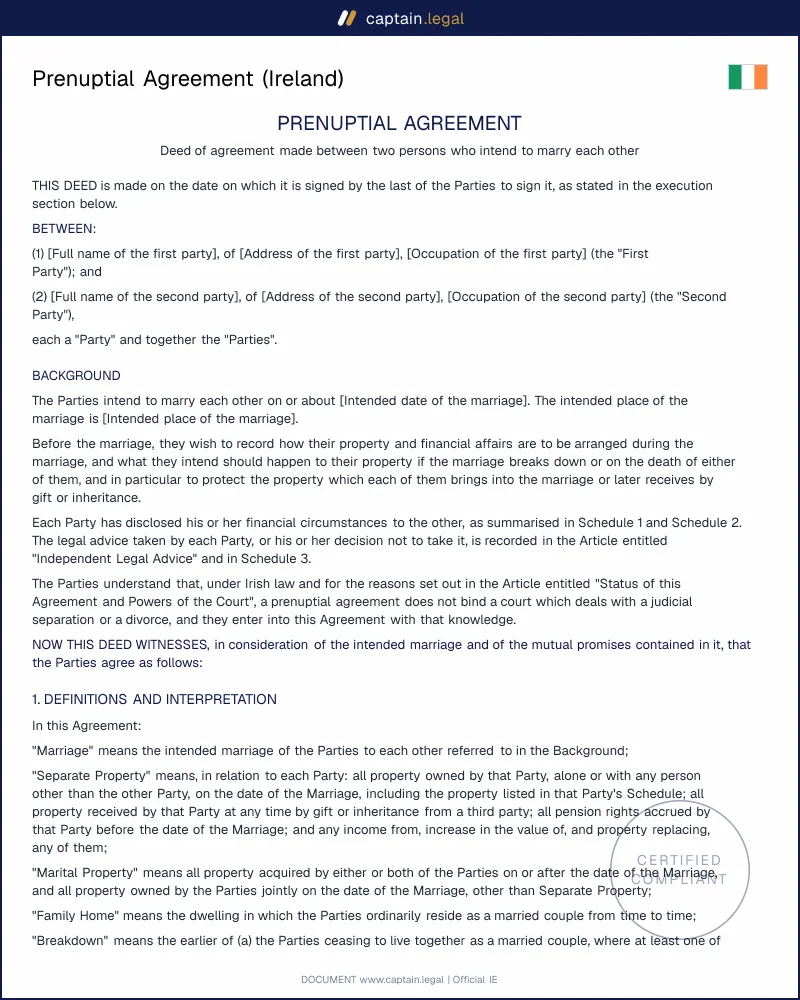
Irish prenuptial agreement executed as a deed: separate property, family business or farm, family home, maintenance intentions, optional renunciation of the legal right share under section 113 of the Succession Act 1965, disclosure schedules and legal advice certificates.
4.6/5— 17 reviewsIrish law 2026Instant download
Share

A prenuptial agreement is a written contract signed by two people before their wedding to record what each of them owns, how property bought during the marriage will be treated and what they intend should happen if the marriage breaks down or one of them dies. A prenuptial agreement in Ireland does not bind a judge in a judicial separation or divorce, so its value depends on how carefully it is prepared. This template is written for Irish couples who want to protect a home owned before the wedding, a family farm or business, an expected inheritance or children from an earlier relationship, and who want an agreement that a court can take seriously: full financial disclosure, independent legal advice for each party and signature well before the wedding day.

Compliant

2026 Legislation

50,000+ clients

trust us

Affordable

From €4.90 / doc

Secure payment

Instant download

Prenuptial Agreement Ireland: Template in Word and PDF

Secure payment

Fill in the template

What is a prenuptial agreement in Ireland?

Irish law has no community of property. Each spouse keeps what is in his or her own name during the marriage, but on judicial separation or divorce the court can transfer property, order lump sums or maintenance and adjust pensions, whoever holds the title. On death, a spouse also has a legal right share in the other's estate under the Succession Act 1965. A prenuptial agreement is the couple's own statement of how they want those questions answered: what stays separate property (assets owned before the wedding, gifts and inheritances, and their growth), what becomes shared, and what each of them expects by way of maintenance.

It is different from a cohabitation agreement for unmarried couples, which has a statutory footing in section 202 of the Civil Partnership and Certain Rights and Obligations of Cohabitants Act 2010 and can, in most cases, exclude statutory claims. A prenuptial agreement in Ireland has no equivalent statute. A separation agreement is different again: spouses sign it after the marriage has broken down, and the divorce court must consider it under section 20(3) of the Family Law (Divorce) Act 1996. Think of the prenup as evidence of what two informed adults agreed at the outset, rather than a contract that decides the outcome.

When do you need this document?

Farming families are the classic case for a prenuptial agreement in Ireland. A son or daughter who will inherit the home farm marries, and the parents want to know that the land will stay in the family if the marriage fails. The template ring-fences the farm, including its growth in value, and records that any work the other spouse does on it will be paid or documented. The same logic applies to shares in a family company, where the prenup should match the shareholders' agreement for an Irish company.

Second marriages are the other big group. A widow or divorced parent with adult children often wants each estate to pass to his or her own children, which is where the mutual renunciation of the legal right share earns its place, alongside a will drafted under Irish law made in contemplation of the marriage. Couples where one partner already owns the house, has significant savings or expects a large inheritance use the agreement to keep those assets separate. Couples who already own a home together can record who paid what towards the deposit. One edge case: civil partners marrying each other see their civil partnership dissolved on the wedding date, and different notice and will rules apply to them, so their solicitors should adapt the agreement.

Key clauses included in our template

The agreement opens with the parties, the intended date and place of the marriage and a recital that the couple know a court is not bound by it. A condition makes it take effect only on the wedding and lapse if the marriage has not taken place within twelve months of the intended date. The article on the status of the agreement sets out Article 41.3.2°, section 16 of the 1995 Act and section 20 of the 1996 Act, then asks the court to give the agreement the greatest weight the law permits. Independent legal advice is handled in four variants (both of you, only the first party, only the second party, or neither), and Schedule 3 prints a solicitor's certificate or a signed waiver for each party accordingly. Schedules 1 and 2 hold each party's disclosure.

On property, the deed defines separate and marital property, adds an optional article on a family business or farm, and treats the home in five ways: owned by the first party, owned by the second, already owned together, to be bought together, or not yet known. For a jointly owned home, the joint tenancy is severed by agreement at breakdown and a buy-out with a valuer from the Society of Chartered Surveyors Ireland comes before any open-market sale. Marital property is split equally, or each spouse keeps what is in his or her name, as you choose.

Maintenance is recorded as an intention only, in line with section 27. You then decide whether both of you renounce the legal right share under section 113, and whether to review the agreement on the birth of a child, every three, five or ten years, or both. Children, pensions, debts, mediation and Irish governing law complete the deed.


How to fill out this prenuptial agreement

You start with each party's name, address with Eircode and occupation, then the intended date and place of the wedding. The questionnaire moves on to legal advice, where a standing warning explains the risk of signing without a solicitor. Next come the family business or farm, which you describe in a sentence, and the home, where you choose between the five situations and give the address if the property is already owned. One screen covers property acquired during the marriage and your intention on maintenance; another settles the legal right share; a third sets the review triggers. The final questions collect each party's assets, debts, income and pensions for the schedules. Everything you type appears in the preview on the right, and Next and Back let you correct an answer before you click Finish. Other family documents are listed among our personal legal documents for Ireland.

Download the agreement and give it to your solicitors well before the wedding. Do not sign before each solicitor has advised you and completed Schedule 3. Each of you then signs and delivers the deed in front of an adult witness who is not the other party.

Common mistakes to avoid

Signing late is one of the most damaging errors for a prenuptial agreement in Ireland. A prenup produced the week of the wedding, with the venue booked and guests travelling, invites the argument that one party signed under pressure. Leaving at least 28 days between signature and wedding is good practice rather than a legal rule. The second mistake is thin disclosure: a pension left off the schedule, an expected inheritance not mentioned, a business valued at a guess. Each omission hands the other spouse a reason to ask the court to disregard the deal.

Many couples assume the renunciation of the legal right share protects their children on its own. It does not. If one spouse dies without a will, the other still takes the whole estate on intestacy, or two-thirds where there are children, under section 67. Make a will at the same time as the prenup, because a will made before the wedding is revoked by the marriage unless it was made in contemplation of it. Another trap is a clause promising that neither spouse will ever seek maintenance; section 27 makes that promise void, which is why the template records an intention instead. Finally, an agreement that is never reviewed ages badly. Review it when a child is born or a spouse stops working, because those are exactly the changes that lead a court to give an old agreement little weight.

Key takeaways

CONSTITUTION ART. 41

A prenup guides the court but does not bind it

On divorce, the court must ensure that proper provision exists or will be made for both spouses and any dependent children (Article 41.3.2° of the Constitution, section 20 of the Family Law (Divorce) Act 1996); on judicial separation, it must endeavour to do so (section 16 of the Family Law Act 1995). No Act makes a prenup binding: the court may at most treat it as one of the circumstances. Disclosure, separate advice and early signature help.

SUCCESSION ACT S.113

Renouncing the legal right share before marriage

A surviving spouse is entitled to one-half of the estate, or one-third if the deceased leaves children, whatever the will says. Section 113 of the Succession Act 1965 lets both of you renounce that legal right in a written contract made before the marriage. The renunciation does not touch the share taken on intestacy, so each spouse must also make a will in contemplation of the marriage or after it.

FAMILY HOME ACT

The family home stays protected after the wedding

Once you are married, section 3 of the Family Home Protection Act 1976 makes a sale or mortgage of the family home without the other spouse's prior written consent void, save limited exceptions, even if one of you owned the house before the wedding. The template keeps a premarital home as separate property but does not waive that protection. A spouse may later give a general consent in writing under section 3(9), ideally after independent advice.

Frequently Asked Questions

Not on the court. A judge dealing with a judicial separation or divorce must seek to ensure proper provision for both spouses and any dependent children, and no Act makes a prenup binding. Between the two of you, the deed is a contract that each party intends to honour, and the court may treat it as one of the circumstances of the case. It is likely to carry most weight where both parties had independent legal advice, full disclosure was made, it was signed well before the wedding and its terms still look fair when the marriage ends.

There is no statutory deadline, but timing is one of the first things a court is likely to examine. Aim to exchange drafts and financial disclosure a couple of months ahead and sign at least 28 days before the ceremony. Remember that the civil registration notice of an intended marriage must be given at least three months before the wedding, so starting the prenup at the same time keeps both on track. The template lapses automatically if the marriage has not taken place within twelve months of the intended date.

Separate solicitors give the agreement its strongest protection, even though no statute requires them for a prenup. A spouse who later says "I never understood what I was giving up" is likely to have a much weaker case when a solicitor acting only for him or her has certified the advice. If one of you declines advice, the template prints a signed waiver instead of a certificate and warns that the court may give the agreement little or no weight.

It can record clearly that the farm or business, its growth in value and assets reinvested from its profits stay with the owning spouse, and that work by the other spouse must be paid or documented. The court can still weigh the other spouse's contribution to the family, so the protection is strongest when the other spouse has independent means. Where the farm is run as a partnership, a partnership agreement under Irish law should be kept consistent with the prenup.

The agreement continues, but nothing in it can limit the guardianship, custody, access or maintenance of any child, and the court's duty to provide for a dependent child overrides any clause. A birth is also the moment when an agreement signed by two working adults can stop looking fair, especially if one parent reduces paid work. The template lets you set a review, with updated disclosure and fresh legal advice, on the birth or adoption of a child.

Both formats are available as soon as you click Finish: an editable Word file your solicitors can amend, and a PDF with page numbers and the three schedules, ready to print in two originals. If a solicitor changes a clause, keep the two signed originals identical and initial any handwritten correction. Related paperwork, such as a statutory declaration or a power of attorney, is in our catalogue of Irish legal templates.

4.6/5

17 verified reviews · Irish law 2026

Prenuptial Agreement Ireland: Template in Word and PDF
  • Immediate access to the document
  • PDF + Word download
  • Compliant with 2026 legislation
  • Reviewed by lawyers
Fill in the template
Secure payment
Updated on November 6, 2026

You might also like

Private Loan Agreement (Ireland)
Private Vehicle Sale Agreement (Ireland)