Employment

Settlement Agreement Ireland: Employee Exit Template

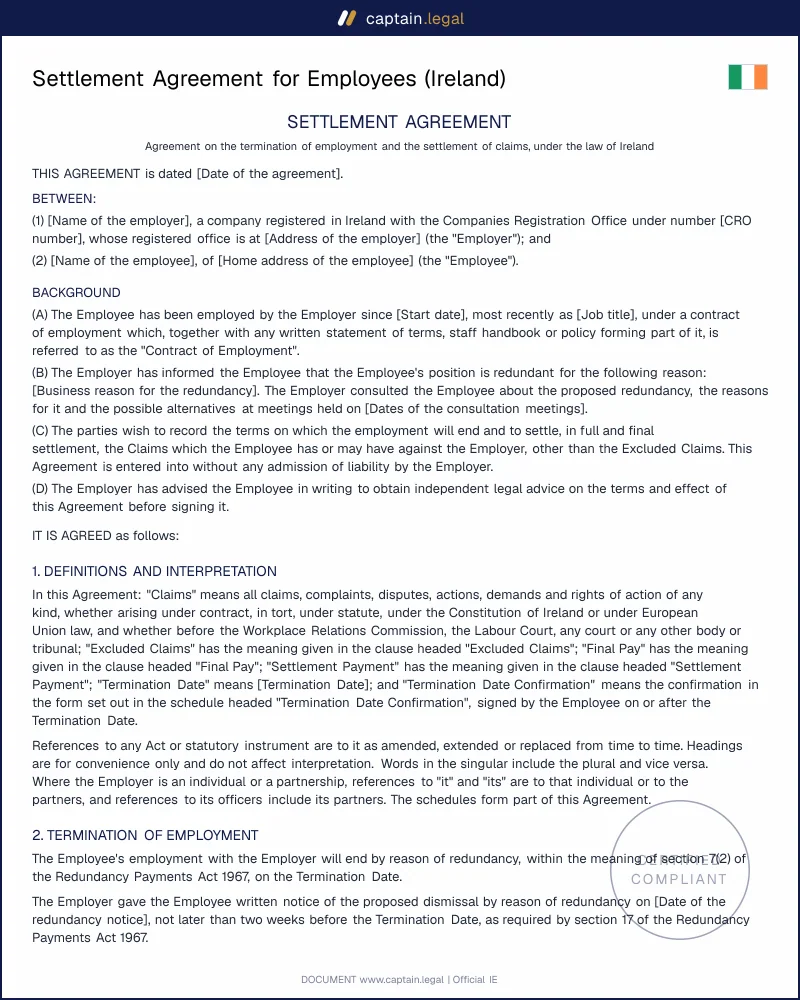
Settlement agreement between an Irish employer and an employee leaving by redundancy or mutual agreement: final pay, statutory redundancy, ex gratia payment, waiver of claims, independent legal advice, reference and confidentiality within the limits of section 14B.
4.5/5— 14 reviewsIrish law 2026Instant download
Share

A settlement agreement in Ireland is the contract an employer and an employee sign when a job ends on agreed terms: the employer pays an ex gratia sum, and the employee gives up the claims he or she could otherwise bring before the Workplace Relations Commission or the courts. Employers use it to close a redundancy or a difficult exit cleanly; employees use it to secure the money, the leaving date and an agreed reference. Our template covers redundancy with or without a statutory redundancy payment, termination by mutual agreement, worked notice, garden leave or pay in lieu, and three ways of recording independent legal advice, including a warning where the employee declines it.

Compliant

2026 Legislation

50,000+ clients

trust us

Affordable

From €4.90 / doc

Secure payment

Instant download

Settlement Agreement Ireland: Employee Exit Template

Secure payment

Fill in the template

What is a settlement agreement in Ireland?

Irish employment law has no statutory form called a settlement agreement. The document is a contract of compromise: the employee accepts a payment in full and final settlement of claims arising from the employment or its termination. It is also called a compromise agreement or a severance agreement. The content matters, because several employment Acts declare void any term that tries to exclude them, starting with section 13 of the Unfair Dismissals Act 1977 and section 51 of the Redundancy Payments Act 1967. Irish tribunals reconcile those provisions with private deals by asking one question: did the employee give up an accrued claim knowingly and freely? If yes, the waiver holds. If not, the employee can still bring the claim, and the employer has paid for nothing.

A settlement agreement is not a dismissal letter, even when it records a redundancy. The fair process comes first, and the statutory paperwork (notice of proposed dismissal, redundancy certificate, final payslip) runs alongside it. The letters that come before or after this stage sit among our Irish employment contracts and HR letters.

When do you need this document?

The classic case is a redundancy with an improved package. The employer pays statutory redundancy because the law requires it, adds an ex gratia sum, and wants certainty that the selection will not end up in an unfair dismissals hearing. Before that point, the employee should already have received the written notice and consultation described in our redundancy notice letter for Irish employers.

Some exits have nothing to do with redundancy. A relationship has broken down, or a senior employee and the board agree it is time to part. A termination by mutual agreement avoids a contested dismissal, and the employee leaves with a reference instead of a disciplinary record. Where the employer has decided to dismiss and will not negotiate, a dismissal letter that follows fair procedures is the right document.

If the employee has already referred a complaint to the WRC, this template is not the right tool: the parties can ask for WRC mediation, and a resolution recorded by the mediation officer binds both sides under section 39 of the Workplace Relations Act 2015. If the employee is on maternity, adoptive or paternity leave, take legal advice first.

Key clauses included in our template

The agreement opens with the parties, a short background and the Termination Date, then deals with money in a fixed order. Final pay comes first: salary to the last day, untaken annual leave (easier to agree when each absence went through an annual leave request form for Irish employees) and any public holiday entitlement under section 23 of the Organisation of Working Time Act 1997, plus any bonus or commission you list. Statutory redundancy follows, with the reckonable service and weekly pay used, and the agreement states that both are paid whether or not the employee signs. The ex gratia settlement payment comes next, with its tax treatment, deadline and conditions.

Notice is handled in one of three ways: the employee works it, goes on garden leave on full pay, or leaves early with pay in lieu. In the redundancy version with pay in lieu, the agreement records the rule in section 7(2) of the 1973 Act that service for redundancy purposes runs to the date the notice would have expired. If the employee's contract already contains post-termination restrictions, as in our Irish contract of employment, the agreement confirms them without extending them.

The protective core is the waiver clause, which names more than twenty Irish enactments, including the Unfair Dismissals Act 1977, the Employment Equality Act 1998 and the Sick Leave Act 2022. Separate clauses list the excluded claims and the disclosures nobody can prevent. The employee then signs a Termination Date Confirmation on or after the last day, extending the waiver to the weeks between signature and departure, including the termination itself. Mutual non-disparagement is standard; optional clauses cover an agreed reference, confidentiality within section 14B and a contribution to legal fees. Negotiations can run "without prejudice", and the agreement becomes open and binding once both parties sign.


How to fill out this settlement agreement

You begin by choosing why the employment is ending: redundancy with a statutory payment, redundancy without one, or mutual agreement. That answer decides whether the statutory redundancy clause appears. The questionnaire then asks for the employer's details (with the CRO number for a company), the signatory, the date of the agreement and the Termination Date.

Next come the employee's details, the notice period, the date notice was given and how notice is handled. For a redundancy you describe the business reason and the consultation meetings, then enter the reckonable service, weekly pay and statutory amount. Later screens take untaken leave, the gross settlement payment and the payment deadline.

The advice screen deserves the most care. You record whether the employee took independent legal advice confirmed by the adviser's certificate, took advice without one, or declined it, and the date the draft was handed over. Reference wording, confidentiality and the property to return close the questionnaire, and the preview on the right updates as you type, as it does for every template in our catalogue of documents for Ireland.

Common mistakes to avoid

The most expensive mistake is handing over the agreement and asking for a signature the same day. A waiver signed on the spot, with no written recommendation to take advice, is the kind of waiver the Circuit Court refused to enforce in Hurley. Send the draft with a covering email recommending independent legal advice, keep that email, and allow a few working days. Almost as common is making statutory redundancy or holiday pay conditional on signature: those sums are owed anyway, and using them to pay for the waiver suggests the deal gave the employee nothing.

Tax catches employers out too. Some pay the ex gratia sum gross on the assumption that it is all tax free, then discover that the exemption depends on service, previous termination payments and pension lump sums. Then there is the confidentiality clause copied from an old precedent that forbids any discussion of "the circumstances of the departure". A clause that silences an allegation of harassment or discrimination is void under section 14B. A settlement agreement also covers only the past: if the employee works three more weeks, claims arising in those weeks stay open unless a confirmation is signed on or after the last day.

Key takeaways

INFORMED CONSENT

A waiver only works if the employee understood

Several Irish employment Acts make void any term that excludes them, so a settlement only stops a claim if the employee gave up an accrued right knowingly and freely. Irish case law asks for the Acts to be listed and for a written recommendation to take independent legal advice before signing. The agreement names over twenty enactments and records the advice, with an optional certificate signed by the adviser.

MONEY OWED

Final pay is never the price of the waiver

Salary to the last day, untaken annual leave, notice pay and any statutory redundancy payment are due whether or not the employee signs, and the agreement says so. Only the ex gratia settlement payment buys the waiver. It is taxed as a termination payment, with the basic exemption (increased where its conditions are met) or the Standard Capital Superannuation Benefit applied through payroll; statutory redundancy is tax free.

SECTION 14B

Confidentiality cannot gag a harassment allegation

An employer cannot enter into a non-disclosure agreement that stops an employee disclosing an allegation of discrimination, victimisation, harassment or sexual harassment, save under strict conditions set by section 14B of the Employment Equality Act 1998. The confidentiality clause protects the terms of the deal but expressly allows those disclosures, protected disclosures and reports to regulators.

Frequently Asked Questions

Once both parties sign it, the agreement is an enforceable contract, and the employer can plead it as a full defence if the employee later brings a covered claim. The waiver of statutory employment claims only works if the employee's consent was informed: the Acts are listed, the employee was advised in writing to take legal advice, and ideally did take it. Protected disclosure claims survive whatever the agreement says, and the template also leaves accrued pension rights outside the waiver. The adviser's certificate option gives the strongest evidence that the employee understood what was being given up.

Strictly, no law forces the employee to see a solicitor. In practice, an Irish employer should insist on it, because without independent advice the waiver may not stop a claim to the WRC. The template records one of three situations: advice confirmed by the adviser's own certificate, advice confirmed only by the employee, or advice declined after a written recommendation, with a clear warning in the text. Many employers contribute to the fees. Revenue's practice is not to tax that contribution when it is paid directly to the employee's legal representative, on sight of the invoice, under a specific term of the agreement.

You choose the deadline in the questionnaire, between 7 and 28 days. The clock starts at the latest of three events: receipt of the signed agreement (with the adviser's certificate where that option is used), receipt of the Termination Date Confirmation signed on or after the last day, and return of the employer's property. Final pay and any statutory redundancy payment follow a different rule. They are paid on the next normal pay day after the Termination Date, with a payslip, whether or not the agreement is signed.

Partly, in most cases. The ex gratia sum is a termination payment, so the employer can apply the basic exemption, which grows with each full year of service and is topped up by the increased exemption where its conditions are met, or the Standard Capital Superannuation Benefit if that gives more. Income tax and USC apply to the balance, but the taxable balance is not reckonable for PRSI. A payment the employee was already entitled to under the contract, including a contractual payment in lieu of notice, is taxed as ordinary pay. Statutory redundancy is fully exempt.

Yes, within limits. The template's confidentiality clause covers the terms of the agreement and the negotiations, with sensible exceptions for family, advisers, Revenue and legal obligations. It cannot stop the employee from making a protected disclosure, reporting a crime or contacting a regulator, and it expressly allows disclosures about an allegation of discrimination, victimisation, harassment or sexual harassment. Keeping such an allegation confidential needs a separate agreement that meets every condition of section 14B, starting with a request from the employee after written legal advice.

Nobody can stop a complaint being lodged, but the employer will rely on the agreement as a full defence. The adjudication officer then looks at how the waiver was obtained: whether the Acts were listed, whether the employee was advised in writing to take independent legal advice, and whether there was time to do so. Where those conditions are met, the settled claims normally go no further. Some claims stay open in any event, including protected disclosure claims, claims to enforce the agreement itself, personal injuries the employee could not have known about, and anything arising after the Termination Date Confirmation.

Both formats are generated at the end of the questionnaire. The PDF is ready to sign and send; the Word file lets your solicitor or the employee's adviser propose changes in tracked form. The schedules (Termination Date Confirmation, adviser's certificate and agreed reference) are part of the same file, each on its own page. Keep the signed original with the covering email that recommended legal advice: together they are your evidence if the settlement agreement is ever challenged.

4.5/5

14 verified reviews · Irish law 2026

Settlement Agreement Ireland: Employee Exit Template
  • Immediate access to the document
  • PDF + Word download
  • Compliant with 2026 legislation
  • Reviewed by lawyers
Fill in the template
Secure payment
Updated on November 6, 2026

You might also like

Fixed-Term Contract of Employment (Ireland)
Redundancy Notice Letter (Ireland)