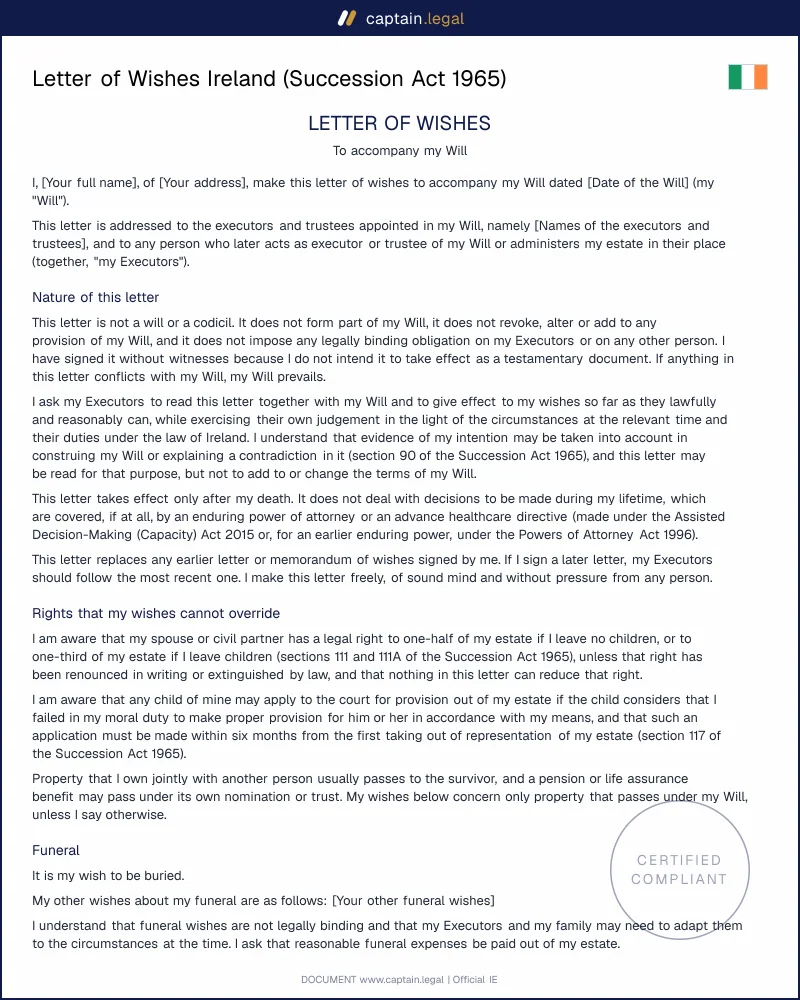
The starting point is the Succession Act 1965. Under section 78, a Will is valid only if it is in writing, signed at the end by the testator and witnessed by two people present at the same time. A letter of wishes is deliberately signed alone, without witnesses, so that nobody can argue it was meant to operate as a testamentary document. That choice is the legal backbone of the template: the letter states that it is not a will or codicil, that it does not alter the Will, and that the Will prevails if the two conflict.
The letter still has legal value. Section 90 allows extrinsic evidence to show the testator's intention and to help construe a Will or explain a contradiction in it, so a well written letter can help a court understand an ambiguous clause, although it can never add a gift that the Will does not contain. The full text of the Act, with every amendment, is published in the Law Reform Commission revised edition of the Succession Act 1965.
Several rights sit above anything you write. A spouse or civil partner has a legal right share of one-half of the estate where there are no children, or one-third where there are children (sections 111 and 111A). Under section 117, a child of any age may ask the court for provision if the parent failed in their moral duty to provide for that child in accordance with their means, and the application must be made within six months from the first grant of representation. A qualified cohabitant may apply under section 194 of the Civil Partnership and Certain Rights and Obligations of Cohabitants Act 2010. Guardians for children under 18 can be appointed only by will or by deed under section 7 of the Guardianship of Infants Act 1964. Finally, the Human Tissue (Transplantation, Post-Mortem, Anatomical Examination and Public Display) Act 2024 introduced a soft opt-out system for organ donation, with the next of kin always consulted.

 Irish law 2026