Business

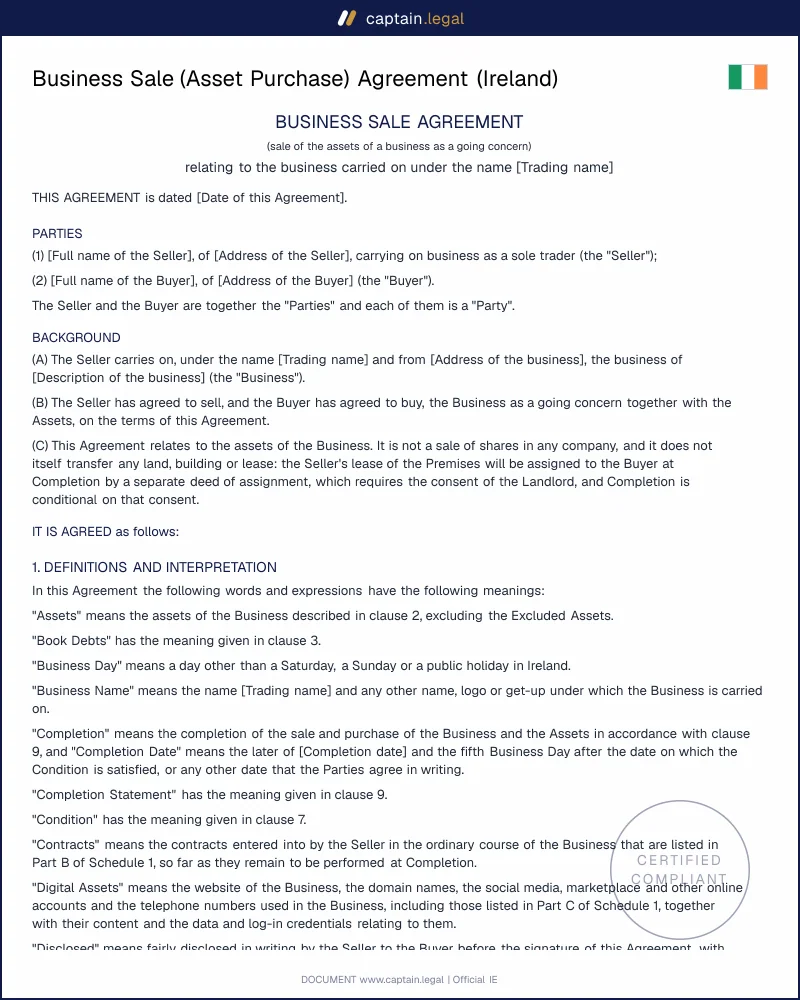
Business Sale Agreement Ireland: Asset Purchase Template

Sell or buy the assets and goodwill of a shop, café, salon, trade or online business under Irish law, with staff transfer, VAT and stamp duty clauses, instalments, warranties, a non-compete and lease assignment conditional on the landlord's consent.
4.6/5— 13 reviewsIrish law 2026Instant download
Share

A business sale agreement in Ireland is the contract by which the owner of a shop, café, salon, trade or online business sells the assets and goodwill of that business to a buyer who will keep it running. This template is written for sole traders, partnerships and small companies selling a business, and for individuals or companies buying one. It covers the points that usually go wrong in an asset purchase: equipment and stock, customer contracts, the website and social media accounts, the staff who transfer by law, VAT, stamp duty and the seller's promise not to compete.

The agreement is governed by Irish law only and deals with the business rather than with shares. It also says plainly that a lease or a building passes under its own conveyancing document.

Compliant

2026 Legislation

50,000+ clients

trust us

Affordable

From €4.90 / doc

Secure payment

Instant download

Business Sale Agreement Ireland: Asset Purchase Template

Secure payment

Fill in the template

What is a business sale agreement in Ireland?

It is a contract for the sale of a business as a going concern: the seller transfers the goodwill, the equipment, the trading name, the records and the benefit of its contracts, and the buyer carries on the same activity from completion. Lawyers call it an asset purchase agreement, because the buyer picks the assets it wants and leaves the rest behind. Cash, money owed by customers up to completion and the seller's old debts stay with the seller.

The alternative is a share sale, where the owner sells the company itself and the business never changes hands. If you are buying the shares of a limited company, the right document is a share transfer agreement with a stock transfer form. The asset route is the norm for sole traders and partnerships, who have no shares to sell, and for small companies whose owner wants to keep the company after the sale. Completion takes place on the date the parties choose or, where a lease is assigned, once the landlord has consented, and in between the seller runs the business in the ordinary course.

When do you need this document?

The classic case is the owner of a café or a small shop who is retiring and has found a buyer, often a member of staff or a nearby competitor. The buyer is paying for the customers and the location as much as for the coffee machine, so the agreement must pin down the goodwill, the trading name and the seller's undertaking not to open a rival business around the corner. Before the figures are shared, most sellers ask for a non-disclosure agreement for the sale negotiations, because turnover and customer lists are exactly what a competitor wants to see.

Plumbers and electricians sell differently. A tradesman handing over to a younger operator transfers a van, tools, a phone number and a book of servicing customers, usually with no premises at all. Online shops follow the same logic with a domain, a store, an Instagram account and a mailing list, which brings data protection into play.

Sole traders who incorporate are often caught by surprise. Moving the business into your own new company is also a sale, and the company is buying from one of its own directors. Section 238 of the Companies Act 2014 can then require the members to approve the purchase in general meeting, and the company's file should also hold a board resolution and written directors' resolution approving the agreement.

Key clauses included in our template

A business sale agreement in Ireland has to say who sells and what is sold before anything else. The template identifies the parties (sole trader, partnership or company on the seller's side, individual or company on the buyer's side), lists the assets and the excluded assets, and splits the price between intellectual property, goodwill and equipment. That price allocation drives stamp duty, capital gains tax and the buyer's capital allowances, so it has to reflect real values. Stock can be bought at a valuation counted on the eve of completion, included in the price or left out.

  • Where staff work in the business, a full employment clause applies the 2003 Regulations, apportions wages and untaken annual leave, and gives each side an indemnity for its own period.
  • Payment can be made in full at completion or partly by instalments. With instalments, the seller keeps ownership of the equipment until the last payment and can ask a director or relative to sign a personal guarantee.
  • If the premises are leased, completion waits for the landlord's written licence to assign, with a long stop date after which either side can walk away.
  • Warranties cover title, the accounts, licences, litigation, contracts, data protection and tax. Apart from title and capacity, claims must be notified within 12, 18 or 24 months and exceed a minimum amount, and the total is capped at the consideration.
  • Competition by the seller can be restricted for one, two or three years in a defined area (three years is usually justified only where know-how also passes), and a court can strike out an excessive part instead of discarding the whole covenant.

How to fill out this business sale agreement

You start by saying who is selling. A sole trader gives a name and address, a partnership lists every partner, and a company gives its CRO number, registered office and the director who signs. The next screens ask for the trading name, what the business does and where it operates, then the main equipment, the contracts the buyer takes over, the domains and accounts, and anything the seller keeps.

The price screen asks for the total and its three parts. From there the questionnaire branches: a stocktake or not, a deposit or not, payment in full or by instalments with an optional guarantor. A yes to the lease question adds the landlord, the lease details and a long stop date. The employee question adds Schedule 2 and the transfer clauses; if your staff have no written terms yet, a contract of employment drafted for Irish law is worth sorting out before the sale. You finish with the warranty period, the non-compete and the handover support.

Common mistakes to avoid

Treating the lease as part of the business sale agreement is the most expensive error. A buyer who pays for a café without a signed assignment and the landlord's consent has bought equipment in a building it has no right to occupy. Read the existing lease first, because its assignment clause and remaining term often decide what the business is worth; a buyer negotiating a fresh letting can start from a commercial lease template for Irish premises. Pretending the staff will not transfer is just as risky. They do, by law, and a buyer who refuses to take them on faces unfair dismissal claims.

Revenue looks hard at the price allocation. Sellers sometimes load the price onto the equipment to reduce stamp duty, which invites a challenge and a balancing charge on capital allowances. Buyers forget that the relief on equipment and stock only applies if they are, or will be at completion, an accountable person. Non-competes copied from an English precedent, with a five-year national ban, cause the last problem. Under section 4 of the Competition Act 2002 and the common law, a restriction wider than the goodwill it protects is unenforceable, so keep it to the activity, the area and the shortest useful period.

Key takeaways

STAFF TRANSFER

Staff transfer automatically with the business

When a business is sold as a going concern, Regulation 4 of the 2003 Regulations moves every employee's contract to the buyer with the same pay, terms and service. Neither party may dismiss because of the transfer, and both must inform the employees' representatives, or each employee in writing, where reasonably practicable at least 30 days before it. The agreement apportions wages and leave and gives each side an indemnity for its own period.

VAT AND STAMP DUTY

VAT relief turns on the buyer's VAT status

Section 20(2)(c) of the Value-Added Tax Consolidation Act 2010 treats equipment and stock sold as no supply only if the buyer is an accountable person, and section 26 relieves goodwill for a taxable buyer trading in the State. Stamp duty falls on goodwill and contracts (SDCA 1999, s.31), while qualifying intellectual property, but not customer lists, is exempt under s.101. Above the section 980 threshold, the buyer withholds 15% without a CG50A.

LEASE CONSENT

The lease passes by a separate deed and consent

The agreement does not transfer the lease on its own. The lease is assigned at completion by a separate deed, and completion is conditional on the landlord's written licence to assign. Under section 66 of the Landlord and Tenant (Amendment) Act 1980, a landlord may not unreasonably refuse consent to the assignment of business premises. Without consent by the long stop date, either party can end the deal and any deposit is returned.

Frequently Asked Questions

It is. Irish law does not require a solicitor or a notary for a contract selling business assets, and the agreement binds the parties once both sign it. Each side may sign electronically under the Electronic Commerce Act 2000, except documents that the law requires in another form, such as the deed of assignment of a lease. Independent advice is still sensible on a large transaction, and the template records that any guarantor was advised to take it. The agreement does not transfer a lease or land on its own: that needs a separate deed and the landlord's written consent.

Without premises or staff, completion can take place the day you sign. With a lease, the landlord's consent usually sets the pace, which is why the agreement includes a long stop date. Where employees transfer, both parties must inform their representatives or each employee in writing, where reasonably practicable, at least 30 days before the transfer. After completion, a buyer trading under a name other than its own registers it within one month under the Registration of Business Names Act 1963, files any stamp duty return through ROS and registers as an employer before the first pay date.

Both formats are available once the document is finalised. The PDF is the version to print and sign, with the schedules attached at the end. The Word file is useful when your accountant or solicitor wants to add a detailed inventory, a list of client contracts or special conditions negotiated at the last minute. If you edit it, keep the clause numbers consistent, because the warranties, the limitations and the completion clause refer to one another.

Their consent is not needed for the transfer itself. Under the 2003 Regulations, the contract of every employee working in the business moves to the buyer automatically, with continuity of service, the same pay and the same terms. What the employees are entitled to is information, and consultation on any measures the buyer plans, in good time before the transfer. An employee who objects can resign, but the buyer cannot dismiss someone simply because the business changed hands. Old-age benefits under a supplementary pension scheme follow separate rules, so check them before completion.

The template protects the seller in several ways. Interest runs on any late instalment. If a payment remains unpaid ten business days after its due date, or the buyer becomes insolvent or sells the business on, the seller can call in the whole balance at once. The seller also keeps ownership of the equipment until the last payment and can take it back if the balance is not paid after notice. Where a guarantor signs, the seller can claim the unpaid instalments directly from that person, up to the deferred price, interest and enforcement costs.

Selling the shares transfers the company with all its history, debts and contracts, and the buyer usually insists on wider warranties. Selling the business leaves the company with the seller, who keeps its liabilities and can wind it up later, while the buyer takes only the assets it chose. Tax treatment differs too, so ask your accountant before deciding. Both routes are covered by our business templates for Irish companies and sole traders, which also include partnership and shareholders' agreements.

4.6/5

13 verified reviews · Irish law 2026

Business Sale Agreement Ireland: Asset Purchase Template
  • Immediate access to the document
  • PDF + Word download
  • Compliant with 2026 legislation
  • Reviewed by lawyers
Fill in the template
Secure payment
Updated on November 20, 2026

You might also like

Directors' Written Resolution / Board Minutes (Ireland)
Company Constitution (LTD, Ireland)