Real Estate

Sublease & Lease Transfer Consent | s.75 NSW, s.81 Vic

Landlord consent drafted to s.75 RTA 2010 (NSW), s.81 RTA 1997 (Vic) and s.238 RTRA Act (Qld). Refusal grounds, liability and bond transfer covered.
4.8/5— 15 reviews50 000+ downloadsInstant download
Share

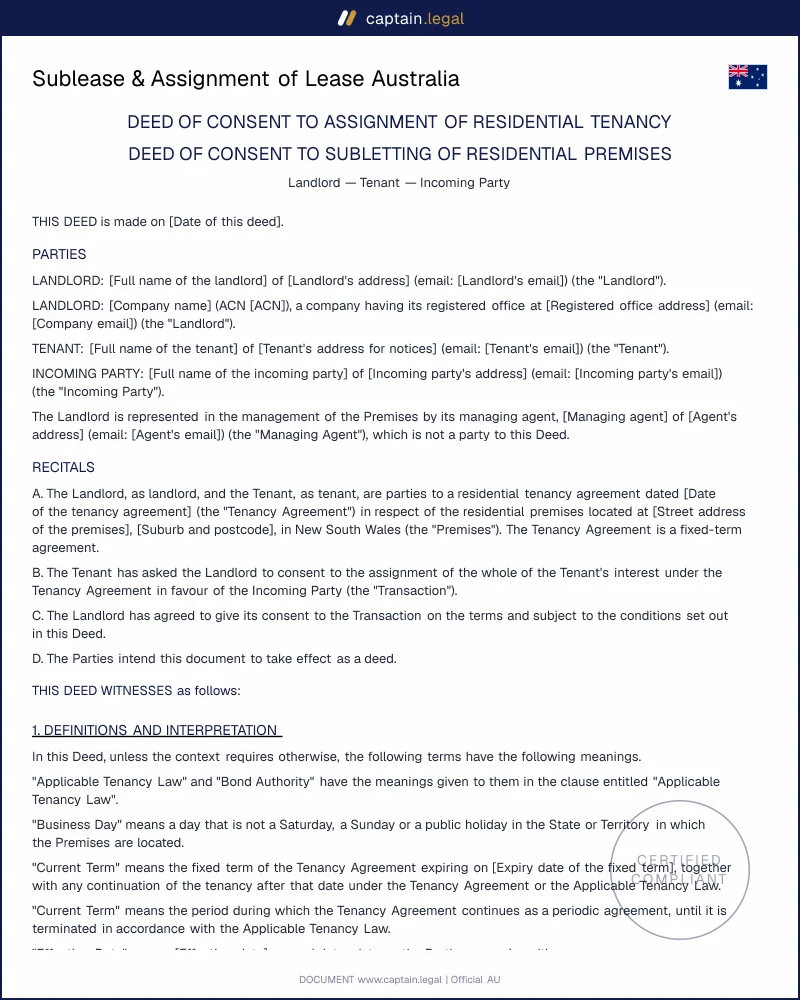
Handing over a lease or bringing someone new into a rented home is where tenancies quietly go wrong. Our sublease and assignment template records the landlord's written consent, names every incoming occupant, allocates liability between the parties and sets out how the rental bond is handled. It suits tenants relocating mid-lease, co-tenants replacing a departing housemate, head tenants letting a spare room, and landlords or property managers who want a clean record of what they approved. Each version follows the Residential Tenancies Act of the state or territory where the property sits, including its refusal grounds and fee limits.

Compliant

2026 Legislation

50,000+ clients

trust us

Affordable

From $4.90 / doc

Secure payment

Instant download

Sublease & Lease Transfer Consent | s.75 NSW, s.81 Vic

Secure payment

Fill in the template

What is a sublease and assignment of lease?

Australian tenancy law draws a firm line between two transactions that tenants often treat as one. An assignment, which the NSW and Queensland Acts call a transfer, moves the tenant's interest under the existing agreement to someone else. The incoming tenant steps into the lease on its current terms, including the remaining fixed term and the rent, and the outgoing tenant drops out for future obligations. A sublease works differently. The original tenant keeps the lease, becomes a head tenant and grants a second tenancy over all or part of the premises. The head tenant still answers to the landlord for rent and damage while acting as landlord to the subtenant.

The consent document sits alongside the prescribed residential tenancy agreement for your state rather than replacing it. It is not a new lease. It records that the landlord has agreed in writing to a named person taking over or sharing the tenancy, and it fixes the conditions of that agreement. It also differs from an informal additional occupant arrangement, where a partner or friend moves in without any tenancy rights, and from boarding or lodging, which most Residential Tenancies Acts do not cover.

When do you need this document?

The most common trigger is a tenant relocating mid-lease. A job transfer interstate or a home purchase settling before the fixed term ends leaves the tenant facing break costs. A sublease and assignment consent handing the lease to a suitable replacement is usually cheaper for everyone, and many landlords prefer it because the property never sits empty. If the landlord lawfully refuses, the fallback is to end the tenancy properly with a tenant's notice of intention to leave and negotiate the break costs.

Share houses generate the second wave of requests. When one co-tenant moves out and a new housemate moves in, the right instrument is a partial transfer that adds the newcomer and releases the departing tenant. Skip it, and the person who left stays jointly liable for later arrears. Head tenants letting a spare bedroom need the sublease version instead, because they keep living in the home.

Landlords use the same document to record who they approved and on what terms. One edge case deserves attention. Consent to sublet for residential occupation is not permission to list the property for nightly bookings, and strata by-laws may restrict short stays whatever the landlord allows. Social and community housing is another, since NSW, Victoria and South Australia give those landlords wider grounds to refuse.

Key clauses included in our template

  • The identification of the parties names the landlord, any managing agent, the outgoing or head tenant and every incoming adult occupant. Each person signs, so nobody can later claim they never agreed.
  • The nature of the transaction is stated expressly as a full assignment, a partial transfer, or a sublease of the whole or part of the premises. This election decides whether the original tenant leaves the tenancy or stays liable to the landlord.
  • The release and continuing liability clause fixes the effective changeover date. For an assignment, it records the outgoing tenant's release from obligations arising after that date and allocates responsibility for arrears or damage that accrued before it. For a sublease, it confirms the head tenant's continuing liability for the subtenant's conduct.
  • The bond arrangements clause records whether the bond stays lodged, is reimbursed privately between tenants or is replaced, and commits everyone to sign the bond authority's change form. Where a subtenant pays a separate bond, it reminds the head tenant to lodge it.
  • The condition of the premises clause ties the changeover to an updated ingoing condition report, so damage caused before handover is not charged to the incoming tenant.
  • The conditions of consent section lists any reasonable conditions the landlord imposes, such as an occupant limit or recovery of permitted expenses, within the limits of the relevant Act.

State-specific considerations

New South Wales gives landlords the widest discretion in the country. Under section 75(1) of the Residential Tenancies Act 2010 (NSW), a landlord may refuse a transfer or sublease of the whole tenancy whether or not the refusal is reasonable. A refusal must be reasonable, however, where the change only adds tenants alongside an original tenant or covers part of premises the tenant still occupies. Section 75(3) confirms that refusal is justified where occupant numbers would exceed the permitted limit, the applicant is listed on a tenancy database or the landlord reasonably believes the premises would be overcrowded. NCAT can authorise a partial arrangement, and section 74(2) limits charges to reasonable expenses.

Victoria uses the terms renter and residential rental provider. Section 81 of the Residential Tenancies Act 1997 (Vic) bars an unreasonable refusal for the whole or any part of the premises, and a refusal based on an attribute listed in section 6 of the Equal Opportunity Act 2010 is unreasonable by definition. A refused renter can apply to VCAT under section 82. Order matters here, because a provider can give a notice to vacate with at least 14 days' notice under section 91ZV if the renter assigns or sublets without consent.

Queensland gives the lessor a qualified discretion under section 238 of the Residential Tenancies and Rooming Accommodation Act 2008. The lessor must act reasonably, and a capricious or retaliatory refusal is unreasonable. QCAT may authorise the arrangement under section 239, and section 240 restricts payment to reasonable expenses on pain of 20 penalty units.

Western Australia takes a contractual approach. Section 49 of the Residential Tenancies Act 1987 (WA) allows the agreement to permit assignment and subletting, prohibit it, or allow it only with written consent, and the consent model applies where the agreement is silent. Under that model the lessor cannot unreasonably withhold consent or charge beyond reasonable expenses, and disputes go to the Magistrates Court.

South Australia is the strictest on cost. Section 74 of the Residential Tenancies Act 1995 (SA) bars unreasonable refusal for the whole or part of the premises and treats discrimination under the Equal Opportunity Act 1984 as unreasonable. Registered community housing providers keep eligibility-based grounds. SACAT can rule consent unnecessary under section 74A, and section 74B makes demanding any fee for consent an offence.

Common mistakes to avoid

The mistake tribunals see most often is moving first and asking later. A tenant hands the keys to a replacement, emails the landlord afterwards and discovers the arrangement is exposed and the tenancy at risk. Almost as common is confusing a sublease with an assignment. A tenant who believes they have walked away, but actually signed a sublease, stays liable for every week the subtenant fails to pay and for any damage the subtenant causes. Check the transaction type on the form before anyone signs.

The bond causes the next round of trouble. Parties settle up privately, never notify the bond authority, and the refund later goes to someone who left long ago. Departing co-tenants skip the written transfer altogether and stay jointly liable without realising it. Landlords make their own errors: charging an administration fee the Act does not allow, leaving a request unanswered for weeks, or refusing on grounds such as the applicant's age or family status. Finally, parties copy a commercial deed of assignment into a residential setting, importing guarantees and indemnities that residential legislation may override while omitting the statutory protections tribunals expect.

Key takeaways

CONSENT

Get written approval before any handover

State and territory Residential Tenancies Acts require the landlord's written consent before a tenant transfers, assigns or sublets a rented home. There is no Commonwealth tenancy law, so the property location controls the rule. An unauthorised arrangement can give the landlord a ground to end the tenancy, and in Victoria or South Australia it may be invalid unless a tribunal says consent was not needed.

LIABILITY

A transfer is not a sublease

A transfer or assignment moves the tenant's interest in the existing lease to the incoming tenant, on the current rent and remaining fixed term. A sublease leaves the original tenant in place as head tenant. That person still answers to the landlord for rent and damage, while also managing the subtenant under the separate arrangement.

BOND

Consent does not update the bond

The consent records who may move in or take over, but it does not change the names held by the bond authority. That must be handled separately. Fees are also controlled: NSW, Queensland and Western Australia allow only reasonable expenses for giving consent, while South Australia prohibits a consent fee under section 74B.

Frequently Asked Questions

Yes. Once the landlord or agent and every tenant involved have signed, it is a binding written record of consent under the Residential Tenancies Act of your state or territory. No witness, deed or registration is generally required. The document works alongside the existing tenancy agreement, and because terms that contract out of the Act have no effect, the template stays within statutory limits. If a dispute reaches a tribunal, the member will check that consent was given in writing, who it named and which transaction it covered, and the form records each of those points clearly.

Yes, within limits that depend on the state. In Victoria, Queensland and South Australia, and in Western Australia where the lease uses the consent model, a refusal must be reasonable. Legitimate grounds usually concern the applicant's ability to pay, rental history or overcrowding. In New South Wales a landlord can refuse a transfer or sublease of the whole tenancy without a reason, although partial arrangements are protected. If you believe a refusal is unreasonable, apply to the tribunal, or the Magistrates Court in Western Australia, with your written request and the landlord's reply.

Most Residential Tenancies Acts set no fixed deadline for answering a request to assign or sublet. In practice, give the landlord a clear period, commonly 14 days, with the applicant's details attached. A landlord who ignores a complete request for weeks is in a weak position, because tribunals can treat prolonged silence as a failure to consent when deciding whether to authorise the arrangement. Keep dated copies of every message. Our Australian real estate templates cover the notices that often follow a changeover.

The bond stays lodged with the state authority until the parties tell it otherwise. In a transfer, the incoming tenant usually reimburses the outgoing tenant's share privately, and everyone signs the authority's change form (in NSW, the Change of Shared Tenancy Arrangement form) so the refund reaches the right person. In a sublease the head tenant's bond is untouched, but any bond taken from the subtenant must be lodged like any residential bond. In New South Wales, a subtenant cannot be asked for more than four weeks' rent.

Yes. A sublease does not end your tenancy, so you remain the landlord's tenant and answer for the rent, the condition of the premises and your subtenant's conduct. If the subtenant stops paying, the landlord pursues you, and you then recover the loss from the subtenant under your own sublease. An assignment, by contrast, releases the outgoing tenant from obligations arising after the changeover. If you are leaving permanently, an assignment is almost always the better structure.

You receive the completed consent in both Word and PDF. The Word file lets a property manager adjust negotiated conditions or add another occupant without rebuilding the document. The PDF is formatted for printing or electronic signature, which the Electronic Transactions Acts in each state and territory generally accommodate. If the changeover needs other paperwork as well, browse the full catalogue of Australian legal documents.

4.8/5

15 verified reviews · 50 000+ downloads

Sublease & Lease Transfer Consent | s.75 NSW, s.81 Vic
  • Immediate access to the document
  • PDF + Word download
  • Compliant with 2026 legislation
  • Reviewed by lawyers
Fill in the template
Secure payment
Updated on September 16, 2026

You might also like

Rent Receipt Australia
Notice to Vacate Australia