Create my document
Login

Choose country

AustraliaAustraliaChoose country
Real Estate

Notice to Vacate Australia | Residential Tenancies Act

Landlord notice to vacate drafted to the Residential Tenancies Act of your state or territory. Prescribed forms, statutory notice periods, tribunal ready.
4.8/523 reviews50 000+ downloadsInstant download
Share

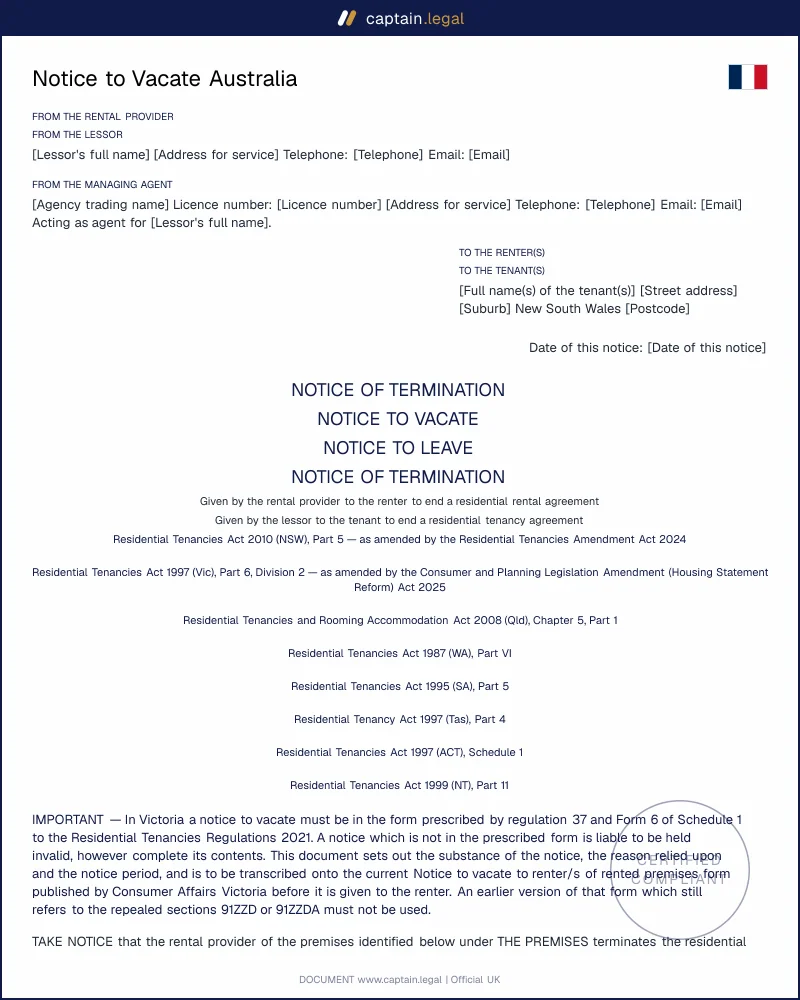
A notice to vacate is the written termination notice a landlord or agent gives a renter to bring a residential tenancy to an end, stating the ground relied on and the termination date. In Queensland the same instrument is called a notice to leave; in New South Wales it is a termination notice. Whatever the label, the document does the same work: it starts the clock on a statutory notice period, and it is the evidentiary foundation for any later possession application to a tribunal. This page covers when a landlord notice to vacate can lawfully be given, which grounds attract which notice periods across the states and territories, and how to draft one that survives scrutiny at VCAT, NCAT or QCAT.

Get the ground or the notice period wrong and the notice is void. Not defective, not curable at the hearing. Void, and you start again.

Compliant

2026 Legislation

50,000+ clients

trust us

Affordable

From $4.90 / doc

Secure payment

Instant download

Notice to Vacate Australia | Residential Tenancies Act

Secure payment

Fill in the template

What is a notice to vacate?

A notice to vacate is a unilateral statutory notice, not a contractual one. It takes its force from the residential tenancies legislation of the state or territory where the premises sit, and it only works if it matches the statutory template for the ground being used. This distinguishes it sharply from an ordinary contractual notice, where substantial compliance usually saves a flawed document. Under residential tenancies legislation, tribunals read notice requirements strictly, because the notice is the mechanism that displaces a person from their home.

Two related documents are constantly confused with it. A notice of intention to vacate runs the other way: it is given by the renter to the landlord, and the notice periods are shorter and structured differently. A breach of duty notice (Victoria) or remedy breach notice (Queensland, Form 11) is a precursor, not a termination: it gives the renter a compliance period to fix the problem, and only if they fail does a notice to vacate become available. Serving a notice to vacate where the statute required a breach notice first is one of the most common reasons possession applications fail. The instruments sit in sequence, and skipping a step in that sequence is fatal rather than merely untidy. If you are still drafting the tenancy itself, the underlying agreement and its termination clauses sit in our Australian real estate and tenancy document templates.

2

When do you need this document?

Rent arrears remain the single most frequent trigger. In New South Wales a landlord may give a 14-day termination notice for non-payment of rent, water usage or utility charges, and the notice can operate before the end of a fixed term. Victoria requires the renter to be 14 days in arrears before a 14-day notice to vacate becomes available. Queensland requires a Form 11 remedy breach notice with a 7-day remedy period first, and only then a Form 12 notice to leave. Same commercial situation, three different procedural paths.

The next cluster is what practitioners call the owner-purpose grounds: proposed sale, significant renovation, change of use, or the landlord or a family member moving in. These attract the long notice periods. In NSW a periodic agreement terminated on a sale ground requires 90 days, dropping to 60 days on a fixed term of six months or less. Victoria's equivalents run to 60 days for sale or renovation. Owner-purpose grounds almost always require supporting evidence, a contract of sale, a signed building contract, a statutory declaration, and tribunals now ask for it as a matter of course rather than accepting the landlord's assertion.

Breaches short of arrears cover the rest: unauthorised occupants, undisclosed pets after refusal, damage beyond fair wear and tear, illegal use of the premises. These generally require a breach notice first, then a termination notice if the breach is not remedied, and the sequencing is jurisdictional.

Two edge cases worth flagging. Where a sole tenant dies, most statutes permit immediate termination, but the notice goes to the personal representative and not to the deceased's address, and getting that wrong invalidates service. Where the premises become wholly unusable through fire or flood, the tenancy can end immediately, but a landlord who continues accepting rent after the event will struggle to argue the tenancy terminated on that ground.

3

Key clauses included in our template

  • The identification of the parties and premises names every tenant on the agreement, not only the one who pays the rent. A notice omitting a co-tenant is ineffective against that co-tenant, who remains in lawful possession, which makes the eventual possession order unenforceable against the household. The premises must be described by full street address including unit and lot references.
  • The statement of the ground, drafted to the statutory language of the applicable Act rather than paraphrased. Under section 82 of the Residential Tenancies Act 2010 (NSW) a notice must give particulars, so "breach of agreement" alone fails; the notice must identify the term breached and the conduct constituting the breach.
  • The termination date, calculated from the day after service and adjusted for the method of service. Postal service adds business days in every jurisdiction; VCAT's guidance requires additional days for registered post on top of the statutory minimum, and a date calculated from the day of posting rather than the day of deemed receipt is short by a week or more.
  • The particulars of the breach or ground, including arrears figures with the rent period they cover, or a description of the renovation works and the approvals obtained. This is the section that carries the notice at hearing.
  • The statement of the renter's rights, including the right to challenge the notice and the retaliatory eviction provisions, which several jurisdictions require on the face of the document.
  • The service and signature block, recording the method of service, date and time, signed by the landlord or an agent with written authority. An agent who signs without authority signs nothing.
4

State and territory considerations

New South Wales operates the strictest post-reform regime. Since 19 May 2025 every landlord termination notice must state a prescribed ground under Part 5 of the Residential Tenancies Act 2010. Proposed sale, significant renovations, change of use, or the landlord or their family moving in each require 90 days on a periodic agreement and on a fixed term of more than six months, and 60 days on a fixed term of six months or less. An actual sale ground requires 30 days. Breach of agreement, non-payment of rent and an occupant remaining in the property each attract 14 days. Death of a sole tenant and premises being unusable permit immediate termination. Matters go to NCAT.

Victoria works from the Residential Tenancies Act 1997 and a mandatory Director-approved form. Rent arrears attract a 14-day notice to vacate. End of a fixed-term agreement requires 28 days, and vacant possession grounds such as sale or significant renovation require 60 days. Where a no-reason notice remains available it carries a minimum of 120 days. The service rules are unusually technical: the minimum notice period starts the day after the notice is given, and posted notices are deemed received on the fifth business day after posting, with an extra day added for any public holiday falling in that window. VCAT hears the disputes.

Queensland uses the Residential Tenancies and Rooming Accommodation Act 2008 and the RTA's prescribed forms. A Form 12 Notice to Leave is the operative instrument. At the end of a fixed term, notice can be given up to one day before the end date, with a minimum notice period of two months, and the tenancy ends on the agreement end date or the end of the notice period, whichever is later. Rooming accommodation runs on a separate track: a Form R12 for the end of a fixed term carries a minimum of 14 days. Without-grounds notices to leave were abolished, so a ground must be identified.

The Australian Capital Territory applies the Residential Tenancies Act 1997 (ACT), where the standard terms sit in a schedule and the Tribunal is ACAT. A tenant intending to vacate must give at least three weeks' notice. Landlord notice periods vary by ground, and the ACT's occupancy framework for non-standard arrangements sits outside the tenancy regime entirely.

South Australia, Western Australia, Tasmania and the Northern Territory each run separate regimes with their own forms and periods, administered respectively by Consumer and Business Services, the Department of Energy, Mines, Industry Regulation and Safety, the Residential Tenancy Commissioner, and Consumer Affairs NT. Western Australia in particular retains structural differences that make NSW or Victorian precedents actively dangerous there. If the tenancy also involves a business use component, the applicable framework may sit with our Australian business contract and agreement templates instead.

5

How to fill out this notice to vacate

You begin by selecting the state or territory where the premises are located, because that single choice drives the form, the statutory citations and the notice period arithmetic. The template then asks whether the agreement is fixed term or periodic, and how long the fixed term runs, since notice periods in several jurisdictions turn on the six-month threshold. From there you select the ground, and the document adjusts: choosing rent arrears opens fields for the arrears amount and the rent periods covered; choosing sale or renovation opens fields for the evidence you will need to produce at the tribunal.

The termination date is calculated for you from the service method you nominate, with the deemed-service allowances built in, which removes the most common arithmetic error in the entire process. You then add the parties, confirming that every renter named on the agreement appears on the notice, and the premises description. The output downloads in Word and PDF, so you can amend the particulars before service if the arrears figure moves. A signed hard copy for personal service and a retained copy for your file are both produced. The full Australian catalogue is at our complete list of Australian legal document templates.

6

Common mistakes to avoid

The error that ends more possession applications than any other is miscalculating the termination date. Landlords count from the date they signed the notice rather than the date of deemed service, and post it, which in Victoria costs at least five business days. A notice specifying a date one day short is not a short notice; it is no notice, and the tribunal will refuse the possession order and send you back to the beginning. The second is using the wrong instrument: serving a notice to vacate in Queensland where the Act required a Form 11 remedy breach notice first, or serving a breach of duty notice in Victoria and treating it as termination.

Particulars drafted too thinly run a close third. "The renter has breached the agreement" tells the tribunal nothing and gives the renter nothing to answer, and in NSW it fails the express particulars requirement in section 82. State the clause, the conduct and the dates. Fourth, landlords omit a co-tenant from the notice, usually the partner who is not on the rent ledger but is on the agreement, and end up with an order that cannot clear the premises. Fifth, and increasingly, landlords serve a notice within weeks of a repair request or a regulator complaint and hand the renter a retaliatory eviction argument that no amount of technical compliance will cure. If the tenancy relationship is intertwined with employment, for example a caretaker or on-site manager, review the employment side using our Australian employment contract and termination templates before serving anything.

Key takeaways

Legal nature

It is a statutory notice, not contractual

A notice to vacate (or notice to leave/termination notice) only works because your state or territory Residential Tenancies Act gives it force. Tribunals treat the requirements strictly because it is the step that can remove someone from their home. That means you must state the correct ground and termination date and use the prescribed structure, not rely on broad lease clauses or “substantial compliance” arguments.

Sequence

Do not skip the breach step

Do not confuse a notice to vacate with a renter’s notice of intention to vacate, or with a breach of duty/remedy breach notice. In many situations the law requires a breach notice first, giving the renter time to fix the issue; only if they do not comply can a notice to vacate follow. Serving termination too early commonly sinks a possession application at VCAT, NCAT or QCAT.

Consequences

Wrong ground or period makes it void

If you choose the wrong ground, the wrong statutory notice period, or the wrong prescribed form, the notice is void, not “fixable” at hearing. You then start again and the clock restarts, delaying any tribunal possession application. Because each jurisdiction has different Acts, forms and timeframes, a template that works in Victoria may fail in Queensland or New South Wales.

Frequently Asked Questions

The template produces a document that satisfies the content requirements of the residential tenancies legislation in the state or territory you select, using the prescribed form where the jurisdiction mandates one, such as Victoria's Director-approved notice or Queensland's Form 12. Its binding effect comes from the statute, not from the template: a notice stating a valid ground, correct particulars and a compliant termination date, properly served, operates as a statutory termination notice and grounds a possession application. What the template cannot do is validate a ground that does not exist on your facts, or rescue a notice served for a retaliatory purpose.

It depends on the ground and the jurisdiction, and the range is wide. In New South Wales, non-payment of rent and breach of agreement each attract 14 days, an actual sale attracts 30 days, and owner-purpose grounds attract 60 or 90 days depending on the agreement type. In Victoria, rent arrears attract 14 days and sale or renovation grounds attract 60 days. In Queensland, a Form 12 at the end of a fixed term carries a minimum of two months. Always confirm the period against the current legislation for your state before you serve, because these figures have moved repeatedly in recent reform rounds.

In most of the country, no. New South Wales removed no-grounds termination for landlords on 19 May 2025, and every notice must now identify a prescribed ground with particulars. Queensland abolished without-grounds notices to leave. Victoria retains a no-reason pathway only in narrow circumstances and, where it applies, requires at least 120 days. Several remaining jurisdictions have reform in train. Treat no-grounds termination as unavailable and identify a proper ground; if you cannot identify one, serving a notice anyway simply produces a void document and a wasted tribunal fee.

They are the same instrument under different statutory names. Victoria's Residential Tenancies Act 1997 calls it a notice to vacate. Queensland's Residential Tenancies and Rooming Accommodation Act 2008 calls it a notice to leave and prescribes Form 12. New South Wales calls it a termination notice under Part 5 of the Residential Tenancies Act 2010. The naming difference matters practically, because using Victorian terminology on a Queensland notice signals to the RTA and to QCAT that the wrong precedent was used, and it invites the renter to challenge the form. Select the jurisdiction first and the correct terminology follows.

The notice downloads in both Word and PDF. The Word file lets you update the particulars before service, which matters for arrears notices where the figure changes with each rent period, and lets you insert additional grounds if your circumstances change. The PDF is the service copy: fixed content, clean pagination, suitable for personal delivery, registered post or electronic service where the jurisdiction permits it. Retain the PDF exactly as served, together with your record of the service method and time, because that record is what the tribunal will ask for.

It depends on the jurisdiction and on what the tenancy agreement says. Victoria permits electronic service, and where a notice to vacate is given electronically, service occurs in accordance with the Electronic Transactions Act 2000, with the minimum notice period starting the day after. Other jurisdictions require the renter to have consented to electronic service, usually through a nominated address in the agreement. Never assume email is valid because the parties have communicated by email throughout the tenancy. Check the Act and the agreement, and where there is any doubt, serve personally or by registered post and calculate the deemed-service allowance accordingly.

Yes, and the grounds are broader than most landlords expect. The renter can dispute the factual basis of the ground, argue that the form or particulars are defective, argue that the termination date is short, or apply to have the notice set aside as retaliatory. In New South Wales, a tenant who receives a termination notice given because they tried to enforce a legal right, such as asking for repairs, can apply to the Tribunal for an order that the notice was retaliatory and has no effect. Equivalent provisions exist across the states. A landlord who serves shortly after a repair dispute should expect the argument and should be able to document the timing of the underlying decision.

Almost always, yes. The notice ends the tenancy on the termination date, but it does not authorise you to change locks, remove belongings or take possession. If the renter remains after the termination date, you apply to the tribunal, NCAT in New South Wales, VCAT in Victoria, QCAT in Queensland, ACAT in the ACT, for a possession order, and enforcement runs through the sheriff or bailiff. Taking possession without an order is unlawful in every Australian jurisdiction and exposes the landlord to compensation orders. The notice is the first step of a two-step process, never a self-executing remedy. Related tenant-side and personal documents sit in our Australian personal legal document library.

4.8/5

23 verified reviews · 50 000+ downloads

Notice to Vacate Australia | Residential Tenancies Act
  • Immediate access to the document
  • PDF + Word download
  • Compliant with 2026 legislation
  • Reviewed by lawyers
Fill in the template
Secure payment
Updated on July 15, 2026

You might also like

Tenancy Application & Condition Report
Rent Increase Notice Australia