Create my document
Login

Choose country

AustraliaAustraliaChoose country
Business

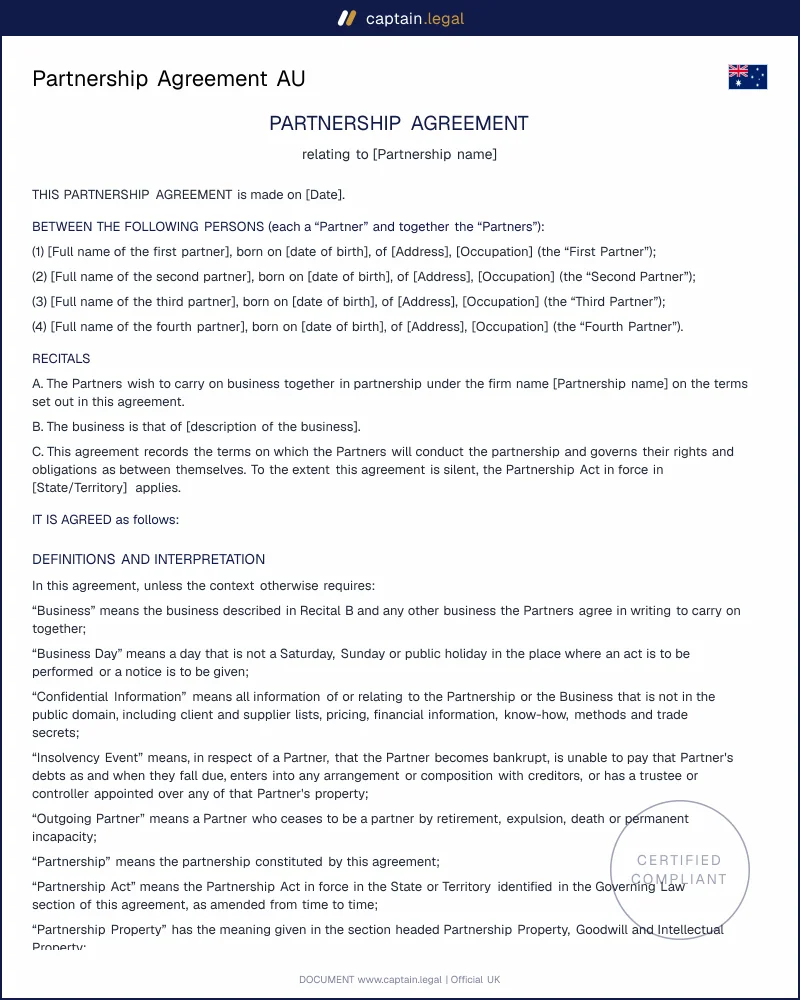
Partnership Agreement AU | Partnership Act Compliant

Partnership agreement drafted to the Partnership Act 1892 (NSW), 1958 (Vic) and state equivalents. Displaces equal-split and dissolution defaults.
4.8/517 reviews50 000+ downloadsInstant download
Share

A partnership agreement is the written contract that governs how two or more people run a business together, splitting profits, sharing losses, making decisions, and eventually parting ways. In Australia a partnership agreement is not what creates the partnership; the relationship arises the moment you carry on a business in common with a view to profit. What the agreement does is replace the default rules that would otherwise be imposed on you by your state or territory Partnership Act. Without it, the legislation decides everything from profit share to how the firm dissolves, usually in ways that suit nobody. This template is built for Australian general partnerships, covering capital contributions, profit distribution, partner authority, admission and exit of partners, and the winding-up mechanics that keep a break-up from becoming litigation.

Compliant

2026 Legislation

50,000+ clients

trust us

Affordable

From $4.90 / doc

Secure payment

Instant download

Partnership Agreement AU | Partnership Act Compliant

Secure payment

Fill in the template

What is a partnership agreement?

A partnership agreement is a legally binding contract between partners that sets the internal rules of their firm. Under Australian law a partnership is the relation which subsists between persons carrying on a business in common with a view of profit, and it exists whether or not anyone signed anything. That is the trap. Two people who open a cafe together and split the takings are already partners, and if they never wrote terms down, the Partnership Act of their state fills the gap with a set of default rules that treat every partner as equal regardless of what they actually put in.

The agreement is what displaces those defaults. It is worth distinguishing it clearly from three neighbours founders often confuse. A partnership is not a company: a company is a separate legal entity registered under the Corporations Act 2001 (Cth), while a general partnership has no legal personality of its own and the partners carry the firm's liabilities personally. A partnership agreement is also not a shareholders agreement, which governs the relationship between owners of a Pty Ltd company rather than partners in a firm. If you are unsure which structure you are actually running, our Australian shareholders agreement for Pty Ltd companies and this partnership template sit on opposite sides of that line. Finally, a partnership is not a joint venture, which is usually a single project rather than an ongoing business carried on in common. Getting the label right matters because it decides which statute governs you and how far your personal assets are exposed.

2

When do you need this document?

The clearest trigger is starting a business with one or more people and putting real money or property into it. The moment capital is unequal, silence becomes dangerous, because the statutory equal profit share ignores who funded what. A written agreement fixes each partner's contribution and the split before anyone earns a cent. The second common scenario is admitting a new partner into an existing firm, which under the default rules can reset terms and even dissolve the original partnership if not handled carefully. You want the entry priced, the incoming partner's liability for pre-existing debts settled, and the profit share recalculated in advance.

Exit planning is the third and most neglected reason. Most partners write nothing until someone wants out, by which point the leverage is gone and the Act's brutal default (dissolution on notice) is the only tool left. A firm that has drafted buy-out terms and a valuation method can lose a partner without losing the business. Death and incapacity sit alongside this: without a continuity clause, the death of one partner legally ends the firm, freezing accounts at the worst possible time for a grieving family. A fourth situation is the professional practice, common among accountants, architects, and medical practitioners, where partners share a licence-based business and need express rules on client files, restraint of trade, and drawings. One edge case worth flagging is the salaried partner who is called a partner but paid like an employee; if the relationship looks like employment in substance, entitlements under the Fair Work Act 2009 (Cth) can be claimed regardless of the label, so the agreement must be honest about whether someone is a true equity partner. If your working relationship is really employment, an Australian employment contract compliant with the Fair Work Act is the correct document instead.

3

Key clauses included in our template

  • The capital contributions clause records exactly what each partner brings in, whether cash, equipment, property, or goodwill, and fixes the value agreed at the outset. This is the single most important departure from the statutory default, because it lets you tie profit share to contribution rather than accepting the equal split imposed by s.24 NSW or s.28 Vic.
  • The profit and loss sharing clause sets the distribution ratio and the treatment of drawings, retained earnings, and interest on capital advances. It also states how and when partners may draw funds, closing off the common dispute where one partner quietly takes more than their share throughout the year.
  • The management and decision-making clause defines which decisions need unanimity, which need a majority, and which any partner can take alone. It works with a schedule of reserved matters so that large commitments, borrowings, or the hiring of staff cannot be forced through by a single partner exercising the statutory agency power.
  • The authority and binding clause limits the mutual agency the Acts otherwise grant, requiring co-signature above a stated threshold so that no partner can saddle the firm with a contract the others never sanctioned.
  • The admission and retirement clause governs how new partners join and how existing partners leave, including notice periods, the valuation method for a departing partner's share, and whether the firm continues rather than dissolving. Pairing this with a confidentiality obligation protects client and pricing information, and our Australian NDA drafted to breach-of-confidence law can sit alongside it for sensitive dealings.
  • The dissolution and winding-up clause sets the order in which assets are realised and debts paid, displacing the rigid statutory distribution rules and giving surviving partners a clean, agreed path when the firm ends.
4

State-specific considerations

New South Wales partnerships fall under the Partnership Act 1892 (NSW), where the equal-sharing default sits in s.24 and the dissolution rules in ss.32 to 44. NSW also recognises the incorporated limited partnership, a rare structure that is a separate legal entity under s.53, but the ordinary trading partnership is not. Partners should note that under s.5 any partner's act in the ordinary course of business binds the firm, so the agreement's authority limits carry real weight. A firm carrying on business in NSW must register its business name federally, and where partners hold land the agreement should record whether that land is partnership property under s.20, since title held in one name can still belong to the firm.

Victoria applies the Partnership Act 1958 (Vic), whose s.28 is the counterpart to NSW's s.24 and sets equal capital, profit, and loss sharing absent agreement. Victoria's Act spells the fiduciary duties out clearly across ss.32 to 34, covering accounts, private profits, and non-competition, and its dissolution framework runs from s.36 (dissolution by notice) through s.44. Victorian professional partnerships, common in law and accounting, rely heavily on express restraint and client-file clauses because the Act itself says little about post-exit competition beyond the general duty.

Queensland operates under the Partnership Act 1891 (Qld), one of the three 1891 Acts. Its default rules track the same equal-sharing model, and it treats the firm as an aggregate of partners rather than a separate person, meaning each partner is jointly liable for the firm's debts. Queensland registers limited partnerships and incorporated limited partnerships through the state authority, and a general partnership carrying on business under a name other than the partners' surnames must hold a registered business name. The agreement should be explicit on liability apportionment between partners, because the Act's default leaves each partner exposed to the full extent of firm debt.

Western Australia is governed by the Partnership Act 1895 (WA), the oldest of the state Acts, supplemented by the Limited Partnerships Act 2016 (WA) for limited structures. The 1895 numbering differs from the eastern states, but the substance is the same: equal sharing by default, mutual agency, and dissolution on notice for a partnership at will. WA partners running asset-heavy ventures such as mining services or agriculture should pay particular attention to the partnership-property clause, since the Act's default treatment of jointly used assets can produce unexpected results on dissolution.

5

How to fill out this partnership agreement

You begin by selecting the state or territory where the business is carried on, and the template loads the correct Partnership Act references and default rules for that jurisdiction so the drafting speaks to the law that actually governs you. From there you enter the partners' full names and the firm's business name, then record each partner's capital contribution, describing cash, property, or services and the value agreed. The form then asks how profits and losses are split, letting you choose an equal division or a fixed ratio tied to contribution, and it captures drawing rights and any interest on advances. Next you set the decision-making rules, marking which matters need unanimity and which a partner may decide alone, and you set the authority threshold above which co-signature is required. The exit section walks you through admission of new partners, retirement notice periods, the valuation method for a departing share, and whether the firm continues on a partner's death. You finish with the dissolution waterfall and the signing block. Once complete, you download the agreement in editable Word and ready-to-sign PDF, and you can revisit and adjust the terms as the firm grows. The full catalogue of Australian business and personal templates is available through the Captain.Legal document library for Australia.

6

Common mistakes to avoid

The most expensive mistake is having no agreement at all and assuming goodwill will hold. When it does not, the state Partnership Act takes over, and its equal-split rule ignores who funded the business while its notice-based dissolution lets any partner blow the firm up overnight. The second recurring error is silence on exit and death. Partners draft the fun clauses about profit and forget that without a continuity provision, one partner's departure or death legally dissolves the whole firm, freezing bank accounts and stranding clients. A third mistake is leaving the mutual agency power untouched, so one partner signs a lease or loan the others never approved and the entire firm is bound; the agreement should cap individual authority and require co-signature above a threshold.

Founders also routinely confuse structures, running what is legally a partnership while believing they have the liability shield of a company. A general partnership offers no such shield, and personal assets are on the line for firm debts, which is why choosing between a partnership and a Pty Ltd matters before revenue arrives. Our Australian company constitution drafted to the Corporations Act is the right starting point if you decide to incorporate instead. The final common error is vagueness on valuation. An agreement that says a departing partner is "paid out fairly" invites exactly the dispute it was meant to prevent; a defined method, whether book value, an independent valuer, or an agreed multiple, is what makes an exit clean. Browsing the wider business legal documents category for Australia helps you line up the supporting contracts a partnership usually needs alongside the core agreement.

Key takeaways

Reality check

You are partners before you sign

In Australia, a general partnership exists as soon as you carry on a business together with a view to profit, even with no paperwork. Two people running a cafe and splitting takings can already be partners. The agreement does not create the relationship; it sets the internal rules so you are not stuck with whatever your state or territory Partnership Act imposes by default.

Defaults

The Partnership Act fills every gap

Without a written agreement, your state’s Partnership Act decides key issues like profit share, loss sharing, decision-making power and how the firm ends. The defaults often assume equality regardless of what each person contributed. For example, section 24 of the Partnership Act 1892 (NSW) and section 28 of the Partnership Act 1958 (Vic) start from equal shares unless you agree otherwise.

Structure

A partnership is not a company

A general partnership is not a separate legal entity like a company registered under the Corporations Act 2001 (Cth). That distinction affects exposure: company-style protections do not attach automatically just because you call yourselves “founders”. Do not confuse a partnership agreement with a shareholders agreement for a Pty Ltd, or with a joint venture for a single project, because the wrong label can leave personal assets exposed.

Frequently Asked Questions

Yes. A partnership agreement is a contract, and once the partners sign it and there is consideration between them, it binds them under ordinary contract law. It also does something more specific: it displaces the default rules in your state or territory Partnership Act, which otherwise govern profit share, decision-making, and dissolution. The one limit worth knowing is that certain statutory protections cannot be contracted out of, particularly the liability a partner owes to outsiders dealing with the firm. Between the partners themselves, though, a clearly drafted agreement overrides almost every statutory default, which is precisely why practitioners treat the written agreement as essential rather than optional.

No registration is needed to form a general partnership. The relationship exists in law the moment two or more people carry on a business in common with a view to profit, with or without a document. What you usually must register is the business name, done federally through the national register unless you trade under the partners' own surnames. Limited partnerships and incorporated limited partnerships are different: those must be registered with the relevant state authority to exist at all. For an ordinary trading partnership, the written agreement is not lodged anywhere; it is a private contract kept by the partners and produced only if a dispute or a bank or the tax office asks for it.

The default rules in your state or territory Partnership Act apply automatically, and they are rarely what partners would have chosen. Profits and losses are split equally regardless of unequal contributions, every partner has an equal say in management, and no partner earns a salary or interest on extra capital advanced. Most damaging of all, a partnership at will can be dissolved by any partner simply giving notice, and the death or bankruptcy of one partner dissolves the entire firm. These outcomes are imposed by statute unless your agreement says otherwise, so the absence of a document is not neutral; it is a choice to accept terms written by parliament rather than by you.

Between the partners, yes; toward the outside world, largely no. The agreement can and should apportion liability internally, stating who bears what share of firm debts and requiring indemnities where one partner exceeds their authority. What it cannot do is protect partners from third parties. In a general partnership each partner is personally liable for the firm's debts, and a creditor can pursue any partner for the whole amount regardless of the internal split. If limited liability toward outsiders is the goal, a general partnership is the wrong structure, and a Pty Ltd company or a formally registered limited partnership is what you need instead.

However they agree. The template lets partners set any division they choose, most commonly a fixed ratio tied to capital contribution or an equal split where contributions are equal. It also handles drawings, retained profits, and interest on capital advanced beyond the agreed contribution, which under the Victorian Act attracts interest by default only where the agreement is silent. The key point is that the statutory equal-share rule is a fallback, not a mandate. Once your agreement specifies the split, that ratio governs, and it can differ entirely from the ownership or management shares, letting a partner who funds more take more profit while another who works more takes a salary-style drawing.

The agreement downloads in both editable Microsoft Word and ready-to-sign PDF. The Word version lets you adjust names, contributions, ratios, and bespoke clauses as the partnership evolves, which matters because partnership terms often change when a partner joins, leaves, or the profit split is renegotiated. The PDF is the clean execution copy for signing. Keeping the editable file is genuinely useful here, since a partnership is a living relationship and the agreement should be revisited whenever the firm's membership or economics shift rather than left frozen at day one.

It depends entirely on what your agreement says. For a partnership at will with no fixed term, the statutory default is stark: any partner can dissolve the firm by giving notice to the others, effective immediately or from the date stated in the notice, under provisions such as s.36 of the Victorian Act. That is why a written agreement almost always sets a longer, structured exit instead, requiring a defined notice period, a valuation of the departing partner's share, and continuation of the firm by the remaining partners. Without that, one partner's snap decision can wind up a profitable business, which is the outcome most agreements are specifically drafted to prevent.

By default, yes, and this surprises people. Under the mutual agency rule in every state Act, any partner acting in the ordinary course of the firm's business can bind all the partners to a contract, even without the others' knowledge. A supplier or landlord dealing with one partner can hold the whole firm to the deal. The agreement's job is to rein this in internally by setting authority limits and requiring co-signature above a threshold, so that a partner who exceeds those limits breaches the agreement and owes an indemnity. That internal control does not always protect the firm against an outsider who dealt in good faith, but it governs the reckoning between the partners afterward.

4.8/5

17 verified reviews · 50 000+ downloads

Partnership Agreement AU | Partnership Act Compliant
  • Immediate access to the document
  • PDF + Word download
  • Compliant with 2026 legislation
  • Reviewed by lawyers
Fill in the template
Secure payment
Updated on July 22, 2026

You might also like

Privacy Policy Template Australia
Shareholders Agreement Template Australia