Create my document
Login

Choose country

AustraliaAustraliaChoose country
Personal

Statutory Declaration | Statutory Declarations Act 1959

Statutory declaration compliant with the Statutory Declarations Act 1959 and state Oaths Acts. Authorised witness guidance, digital signing, Word and PDF.
4.7/522 reviews50 000+ downloadsInstant download
Share

A statutory declaration is a written statement of fact that you declare to be true, either in front of an authorised witness or, for Commonwealth declarations, through an approved digital identity service. It is the everyday workhorse of Australian administrative life: banks, insurers, superannuation funds, Services Australia, and professional bodies all accept a properly executed stat dec in place of sworn court evidence. This template gives you a Commonwealth and state compliant form, drafted in plain legal English, with the correct declaration wording, witness block, and signing instructions so the document is accepted the first time you lodge it.

Most people meet a statutory declaration when something has gone slightly sideways. A document is lost, a name does not match across records, a super nomination needs confirming, or an insurer wants a formal account of events. The form itself is short. What trips people up is the execution: the wrong witness, the wrong jurisdiction's wording, or an unsigned margin can send you back to the counter to start again.

Compliant

2026 Legislation

50,000+ clients

trust us

Affordable

From $4.90 / doc

Secure payment

Instant download

Statutory Declaration | Statutory Declarations Act 1959

Secure payment

Fill in the template

What is a statutory declaration in Australia?

A statutory declaration is a formal statement of fact that the declarant solemnly and sincerely declares to be true, made under the authority of a specific Act rather than under oath on a religious text. That distinction matters. A declaration is not sworn evidence in the way an affidavit is, and it is generally used for administrative rather than courtroom purposes. Where an affidavit supports litigation and is filed with a court, a stat dec confirms facts for a bank, a government agency, an insurer, or an employer. The legal weight comes from the criminal consequences attached to lying, not from a religious oath.

There are two parallel systems in Australia, and choosing the right one is the single most important decision you make. A Commonwealth statutory declaration is used for matters that fall under federal law or federal agencies, such as Centrelink, the Australian Taxation Office, Medicare, or many superannuation and passport matters. A state or territory statutory declaration is used for matters governed by state law, and each jurisdiction has its own prescribed form and its own list of who may witness it. Our template covers both tracks and flags which one your situation calls for, because a Commonwealth form lodged where a state form is required (or the reverse) is often rejected on sight, regardless of how truthful its contents are. If you are dealing with a broader life-admin task, our Australian personal legal documents collection sits alongside this form for wills, powers of attorney, and health-decision appointments.

2

When do you need this document?

The most common trigger is a mismatch or gap in official records. A birth certificate spells your name one way and your bank another, a marriage or deed poll has not filtered through to every institution, or a document has been lost and you need to formally declare that fact before a replacement is issued. Insurers lean on statutory declarations heavily, asking for a formal account of a car accident, a theft, or a loss where there is no police report to rely on. Superannuation funds request them to confirm dependency, identity, or the circumstances behind a death benefit claim.

Employment and business situations generate their own share. You might declare that you have no conflicting directorships, confirm your residency status for a visa or tax matter, or verify income when standard payslips do not exist because you are self-employed. Families use them constantly, from confirming a relationship for a Centrelink assessment to declaring who a child normally lives with. If you are setting up a company or confirming officeholder details, the form often pairs with a company constitution under the Corporations Act or sits beside an Australian employment contract when an employer needs a declared fact on file.

Two edge cases legitimately catch people out. First, a declaration made on information and belief rather than personal knowledge must say so and state the source, or an agency may reject it as overreaching. Second, if there is any question about the declarant's decision-making capacity, the timing and witnessing become critical, because a declaration signed under family pressure or late-stage illness is exactly the kind that gets challenged later.

3

Key clauses included in our template

  • The declarant identification block captures your full legal name, address, and occupation exactly as they appear on your identity documents. Institutions cross-check this against the identification you present, so a nickname or an abbreviated address is a frequent cause of rejection at the counter.
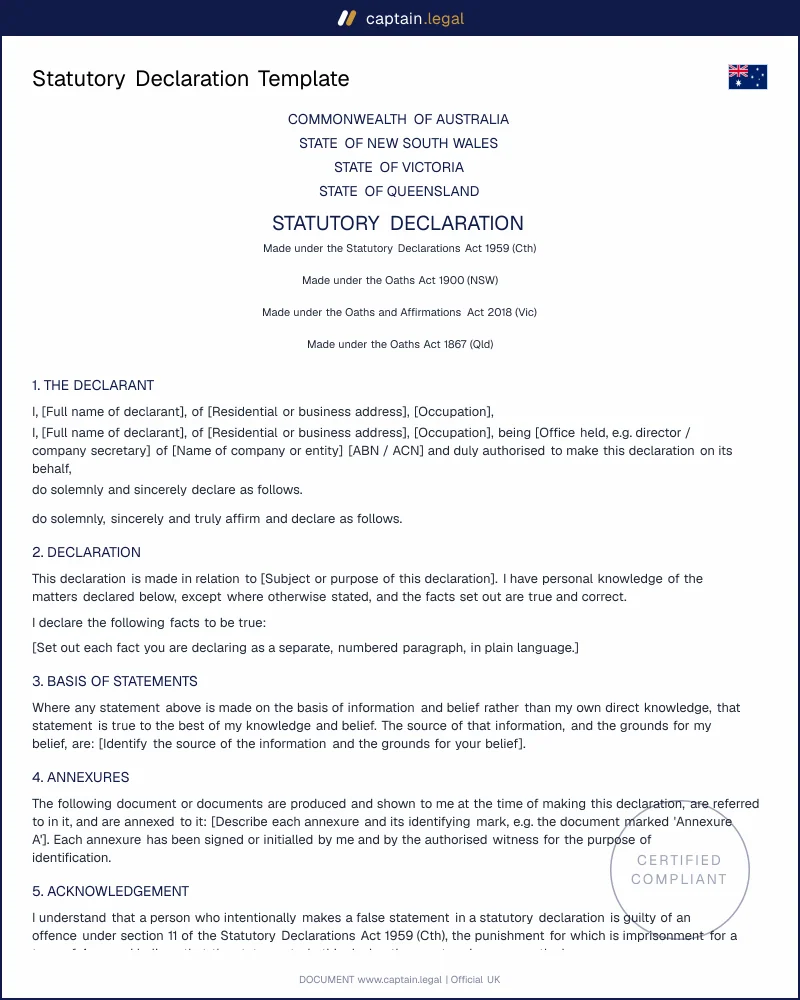
  • The solemn declaration wording reproduces the statutory language your jurisdiction requires, whether it is the Commonwealth form under the Statutory Declarations Act 1959 or a state form such as the Oaths Act 1900 (NSW) eighth schedule. Using the wrong jurisdiction's phrasing is the error that most often invalidates an otherwise honest declaration.
  • The statement of facts is where you set out what you are declaring, numbered by paragraph for clarity. Where your knowledge is second-hand, the template prompts you to identify it as based on information and belief and to name the source, which keeps the declaration defensible.
  • The witness attestation section records the authorised witness's name, their qualifying capacity such as Justice of the Peace, legal practitioner, pharmacist, or police officer, and their signature. For remote execution it includes the audio-visual link wording that confirms the witness saw you sign.
  • The false-statement warning carries the statutory caution that making a knowingly false declaration is a criminal offence. This is not decorative language. It is the mechanism that gives the whole document its legal force.
4

State-specific considerations

Victoria operates under the Oaths and Affirmations Act 2018, which replaced the older 2006 regime and prescribes a specific statutory declaration form. Only statements made on the current form are valid, and the list of authorised witnesses is defined by regulation rather than left open. The Act permits witnessing by audio-visual link under section 30A, subject to the witness seeing the declarant sign. A knowingly false statement is treated with real seriousness in Victoria, and the penalties for making false statements on oath or declaration are among the heaviest in the country. Anyone signing in Victoria should confirm their intended witness sits within the prescribed list before attending, because a well-meaning but unauthorised witness voids the document.

New South Wales uses the Oaths Act 1900 (NSW), which offers two alternative forms, the eighth and ninth schedules, differing mainly in their wording. Authorised witnesses within the state are typically a Justice of the Peace, an Australian legal practitioner, or a notary public, and the witness must see the declarant's face and be satisfied as to identity. Under section 25 of the Act, wilfully making a false declaration is an indictable offence carrying up to 5 years imprisonment, with substantial fines applying in the Local Court. NSW also penalises anyone who purports to witness a declaration without authority, so both sides of the signing carry legal exposure.

Queensland relies on the Oaths Act 1867, one of the oldest statutes still in force, supplemented by modern amendments that allow electronic signing and audio-visual witnessing. The authorised witness list is specific and includes Justices of the Peace, commissioners for declarations, legal practitioners, and certain special witnesses under part 6A. Queensland forms prompt the declarant to state the source of any fact declared on information and belief, and the witness must record their qualifying capacity precisely. A false statement is a criminal offence, and the declaration should never be signed before the witness is present.

Western Australia applies the Oaths, Affidavits and Statutory Declarations Act 2005, which requires the declaration to follow the form in Schedule 1. The Act sets clear witness categories and attaches a penalty of up to 12 months imprisonment for taking a declaration while not authorised to do so. As with the other states, WA now accommodates remote witnessing, but the declarant and witness must complete the process in a single continuous session so the witness genuinely observes the signature.

5

How to fill out this statutory declaration

You begin by telling the form whether your matter is Commonwealth or state, because that single choice sets the declaration wording, the witness rules, and the available signing methods. From there you enter your full legal name, residential address, and occupation as they appear on your identity documents, then draft the body of your statement in short numbered paragraphs, keeping each fact separate and precise. If any fact rests on what someone told you rather than what you saw yourself, the form guides you to flag it as based on information and belief and to name the source. Once the statement reads cleanly, you select your execution route. For a Commonwealth declaration you can print and sign before an authorised witness, sign electronically and witness over video, or complete the witness-free digital path through myGov if that suits your matter. For a state declaration you attend an authorised witness in your jurisdiction, sign in their presence, and let them complete the attestation block. The template outputs an editable Word and PDF personal document so you have a clean copy to lodge and one to keep.

6

Common mistakes to avoid

The mistake that sends most people back to the counter is choosing the wrong jurisdiction. A Commonwealth form presented to a state agency, or a NSW form used for a federal super claim, gets rejected on the wording alone even though every fact in it is true. Close behind is the unauthorised witness. People assume any respectable adult will do, but each state defines its list narrowly, and a retired professional who no longer holds the qualifying role no longer counts. Signing before the witness is present is another quiet killer, because the witness must actually see you sign for the attestation to be valid, whether in person or over an audio-visual link.

The remaining errors are about content and care. Declaring facts on information and belief without saying so, and without naming the source, can render a declaration unusable for the very purpose you needed it. Leaving margins, alterations, or attached pages uninitialled invites suspicion and delay. And the most serious of all is treating the form casually. A statutory declaration is a criminal instrument, and a knowingly false statement can lead to imprisonment. Read your own statement twice before you sign, because the liability is yours alone and the witness carries none of it.

Key takeaways

JURISDICTION

Use the right Commonwealth or state form

Australia has two parallel stat dec systems, and picking the wrong one is a common reason for rejection. Use a Commonwealth statutory declaration for federal agencies and matters (for example Services Australia/Centrelink, the ATO, Medicare, many superannuation and passport processes) under the Statutory Declarations Act 1959 (Cth). Use your state or territory prescribed form for state-law matters, under the relevant Oaths legislation.

SIGNING OPTIONS

Three valid ways to execute it

For Commonwealth stat decs, the rules changed from 1 January 2024. You can sign on paper with a wet-ink signature witnessed in person, sign electronically with the witness attending by audio-visual link, or complete a fully digital declaration through an approved online platform using verified digital identity. All three are equally valid in law if you follow the execution steps for the method you choose.

WITNESSING

Execution errors cause most knock-backs

The form is short, but the execution is where people get stuck: the wrong authorised witness, the wrong jurisdiction’s wording, or missed signatures can send you back to start again. A statutory declaration is for administrative proof (banks, insurers, super funds and government agencies), and its legal force comes from criminal consequences for false statements, not from being sworn evidence like an affidavit.

Frequently Asked Questions

Yes, provided you execute it correctly. The template reproduces the statutory wording required under the Statutory Declarations Act 1959 (Cth) for Commonwealth matters and the relevant state Act, such as the Oaths Act 1900 (NSW) or the Oaths and Affirmations Act 2018 (Vic), for state matters. A statutory declaration has legal force because a knowingly false statement is a criminal offence, not because a court has pre-approved the wording. What makes any given declaration binding is correct execution: the right form for the right jurisdiction, signed in the presence of an authorised witness or through an approved digital identity route. Get the execution right and the document is fully valid.

It depends on your jurisdiction. For a Commonwealth declaration, the witness must appear on the list in Schedule 1 of the Statutory Declarations Regulations 2023 and have a connection to Australia, which covers Justices of the Peace, legal practitioners, pharmacists, police officers, and many others. States run their own lists. New South Wales generally requires a Justice of the Peace, an Australian legal practitioner, or a notary public within the state. A witness who once qualified but has since retired from the relevant role no longer counts. You should confirm your intended witness is currently authorised before you attend, because a declaration taken by an unauthorised person is invalid.

For Commonwealth declarations, yes. Since 1 January 2024 you can sign on paper before a witness, sign electronically and be witnessed over an audio-visual link, or complete a witness-free digital declaration through the myGov platform using a verified digital identity. All three methods carry equal legal effect. State and territory rules vary. Most now permit remote witnessing by video link, where the witness must see you sign in a single continuous session, but the fully witness-free digital route is currently a Commonwealth feature only. The template sets the correct signing options once you tell it whether your matter is Commonwealth or state.

A statutory declaration confirms facts for administrative purposes such as a bank, insurer, or government agency, and is declared before an authorised witness or through a digital identity service. An affidavit is sworn or affirmed evidence intended for use in court proceedings and is generally filed with a court. Both carry criminal liability for false statements, but affidavits are the preferred vehicle for litigation while statutory declarations handle the everyday administrative confirmations. If an agency has asked you for a stat dec, a declaration is what you need. If a court or a lawyer has asked for sworn evidence, you likely need an affidavit instead.

You receive the document in editable Word format and print-ready PDF. The Word file lets you adjust the statement of facts, add numbered paragraphs, and tailor the identification details before you finalise. The PDF gives you a clean version for signing and lodgement. Many people keep the Word file in case an institution later asks for a slightly different statement, then produce a fresh PDF to sign. Whichever format you present, the witness block and statutory wording remain intact, which is what the receiving organisation checks first.

Making a knowingly false statutory declaration is a criminal offence throughout Australia. Under section 25 of the Oaths Act 1900 (NSW), a wilfully false declaration is an indictable offence carrying up to 5 years imprisonment, with fines applying in the Local Court. Victoria treats false statements on oath or declaration with similarly heavy penalties under the Oaths and Affirmations Act 2018, and Western Australia and Queensland attach their own criminal consequences. The liability is yours alone as the declarant; the witness carries none of it. This is precisely why you should read your statement carefully and only declare facts you know or, where relevant, clearly mark as based on information and belief.

The drafting itself takes only a few minutes because the template supplies the statutory wording and the witness block. Your timing then depends on the execution route. The witness-free Commonwealth digital path through myGov can be near-instant if your digital identity is already verified to the required level. If you need a witness, you attend an authorised person in person or over video, which is usually a same-day task given how many pharmacists, Justices of the Peace, and legal practitioners qualify. Once witnessed, the declaration is immediately ready to lodge with the requesting bank, insurer, fund, or agency.

4.7/5

22 verified reviews · 50 000+ downloads

Statutory Declaration | Statutory Declarations Act 1959
  • Immediate access to the document
  • PDF + Word download
  • Compliant with 2026 legislation
  • Reviewed by lawyers
Fill in the template
Secure payment
Updated on July 21, 2026

You might also like

Last Will and Testament Australia
Codicil to a Will Australia