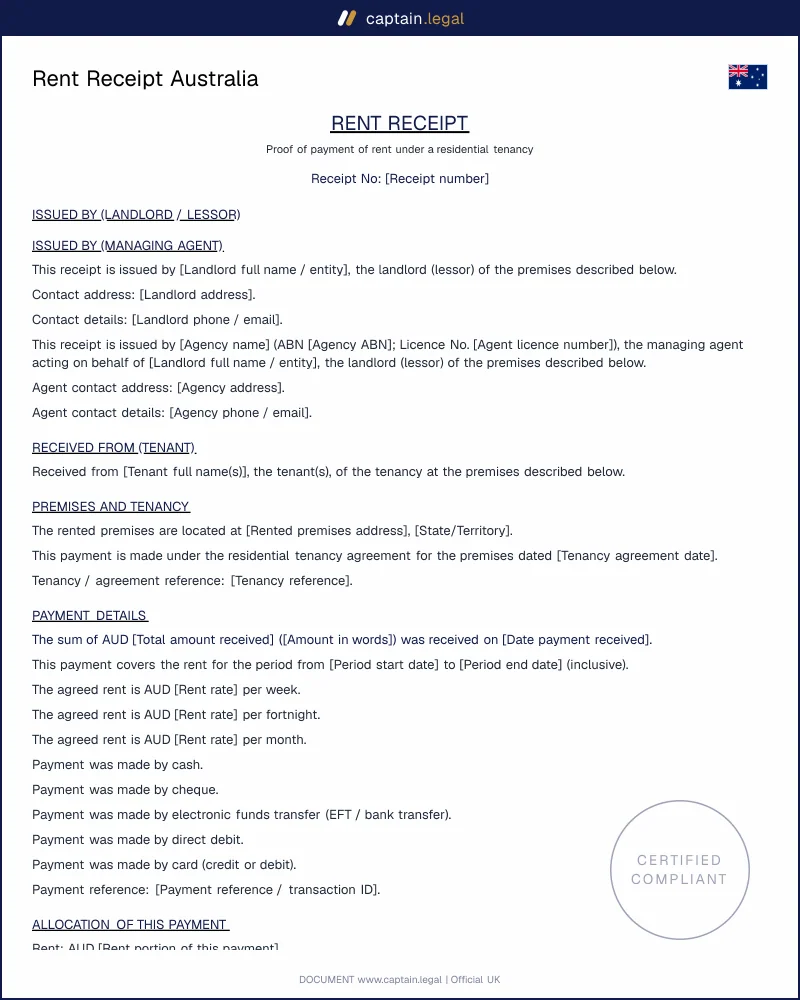
New South Wales treats the receipt as immediate for in-person, non-cheque payments under section 36 of the Residential Tenancies Act 2010, and where rent is paid by cheque the receipt must be made available for collection or given to the tenant. NSW law also requires landlords and agents to keep a proper record of every payment across the tenancy, and recent reform in the state has pushed hard toward fee-free electronic payment options, which shifts many tenancies onto bank records rather than paper receipts. A tenant paying cash in NSW should never leave without their receipt, because the record-keeping duty on the landlord does not replace the tenant's own copy.
Victoria is the strictest on form. Section 43 of the Residential Tenancies Act 1997 requires the receipt to be signed by the person who receives the payment and to state the renter's name and the rented premises, among other details. Victoria's 2021 rental reforms modernised much of the tenancy framework, and the signed-receipt rule survived intact. A Victorian landlord who accepts cash and issues an unsigned scrap of paper has not met the statutory standard, and the Victorian Civil and Administrative Tribunal will treat that as a breach if a tenant raises it.
Queensland runs the most detailed timing rules through section 88 of the Residential Tenancies and Rooming Accommodation Act 2008. Cash paid in person is receipted on the spot, cash paid otherwise by the next business day, and cheque payments within three business days. If a tenant asks for a copy of the rent payment record, the lessor must supply it within seven days. The Residential Tenancies Authority administers the Act, and false or misleading entries in a rent record carry penalties, so accuracy is not merely good manners.
Western Australia gives three days to issue a receipt under section 33 of the Residential Tenancies Act 1987, with a fine for failure, and the same exemption applies where rent goes into a nominated ADI account. Across all four states the direct-deposit exemption only works if the landlord keeps a compliant written record, so a landlord who takes cash and skips the receipt is exposed regardless of jurisdiction.