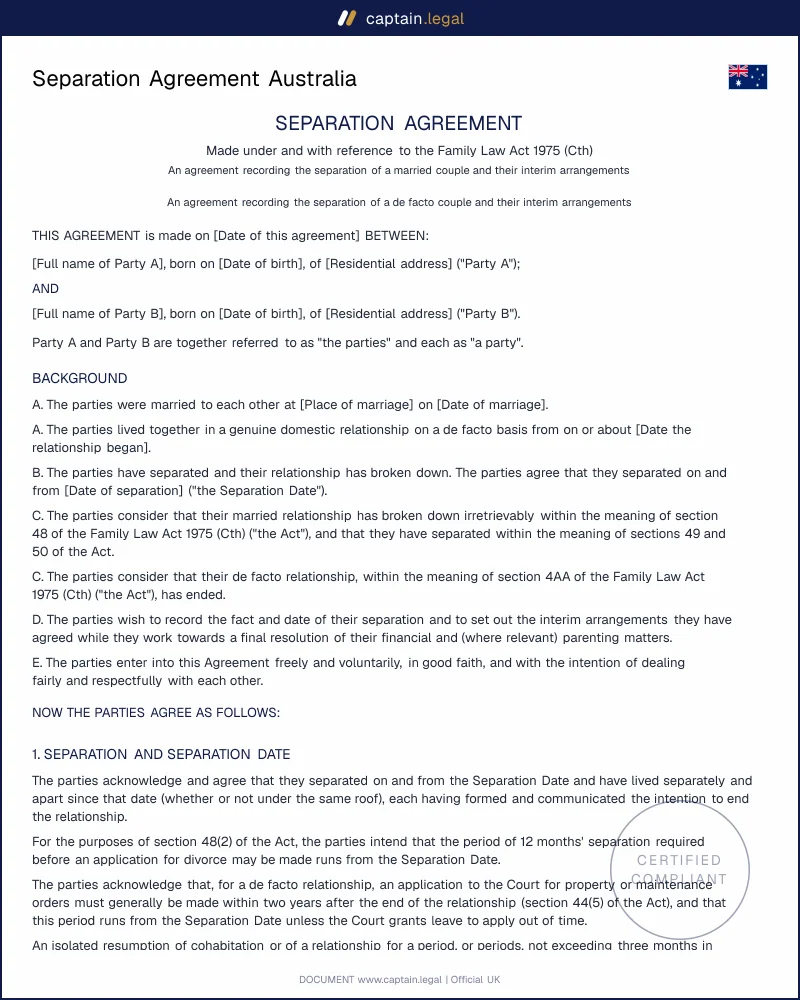
Every separation in Australia, whether the couple was married or de facto, is governed by the Family Law Act 1975 (Cth), administered by the Federal Circuit and Family Court of Australia. The Act is a no-fault system: the court has no interest in who caused the breakup, only in arrangements that are just and equitable and, where children are involved, in the best interests of the child. A separation agreement operates in the space the Act leaves open for couples to organise their own affairs, and the closer its language tracks the statutory framework, the more useful it becomes if matters later escalate.
The most significant recent change came into force on 10 June 2025, when the Family Law Amendment Act 2024 wrote the property settlement process directly into the Family Law Act 1975. The court now follows a structured approach: it identifies and values the whole asset pool, weighs each party's financial and non-financial contributions (homemaking and parenting counted alongside earning), considers each person's future needs such as age, health and care of children, and then checks the result is just and equitable. Two reforms deserve close attention when you draft. First, the duty of disclosure, the obligation to give the other party full and honest financial information, now sits in the Act itself rather than in court rules, so hiding an account or a liability carries statutory weight. Second, the court must now consider the economic effect of family violence, including financial abuse, when dividing property. Your agreement should reflect genuine, complete disclosure of assets and debts, because a document built on a hidden asset is a document waiting to be unwound.
Timing is where people quietly lose rights. For married couples, court proceedings for property or spousal maintenance must generally start within 12 months of a divorce becoming final. For de facto couples, the limit under section 44 is 2 years from the date of separation. The Attorney-General's Department publishes a plain-English summary of these obligations in its fact sheet on the June 2025 family law property changes, worth reading before you commit anything to paper. One structural limit to keep in mind: your agreement cannot bind third parties. A bank is not released from a joint loan just because the two of you agreed one name comes off it. Releases and refinancing need their own separate process with the lender.