Create my document
Login

Choose country

AustraliaAustraliaChoose country
Employment

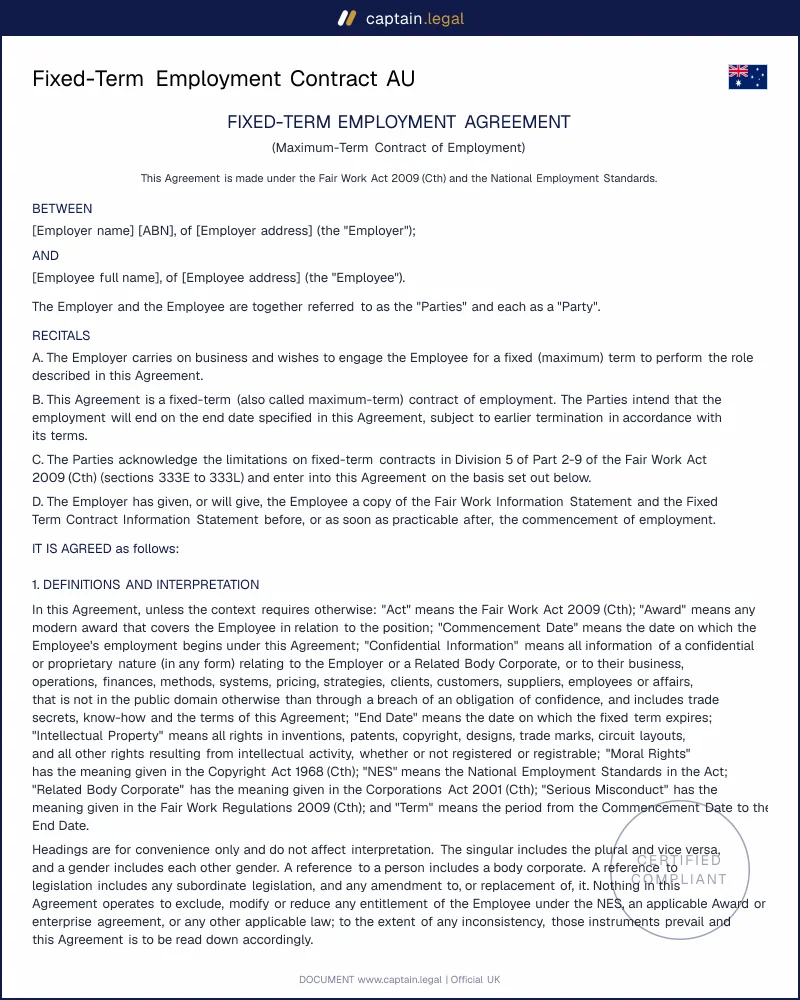
Fixed-Term Employment Contract | Fair Work Act s.333E

Maximum-term contract drafted to Fair Work Act s.333E and s.333F exceptions. High-income threshold, FTCIS obligation and lawful renewal built in.
4.8/526 reviews50 000+ downloadsInstant download
Share

A fixed-term or maximum-term employment contract is an agreement that ends automatically on a set date or after a defined period, used across Australia for project roles, parental-leave cover, grant-funded positions and genuine short engagements. Since the Secure Jobs, Better Pay reforms took effect, employers can no longer draft these contracts however they like: the Fair Work Act 2009 (Cth) now caps their length and restricts renewals. This template is built to those rules, with a compliant end-of-term clause, a single lawful renewal option where permitted, and the notice mechanics that keep an early exit clean. It suits any business hiring for a genuinely temporary need who wants the paper trail to hold up if the arrangement is ever questioned.

Compliant

2026 Legislation

50,000+ clients

trust us

Affordable

From $4.90 / doc

Secure payment

Instant download

Fixed-Term Employment Contract | Fair Work Act s.333E

Secure payment

Fill in the template

What is a fixed-term or maximum-term employment contract?

A fixed-term contract is one that terminates on an agreed end date or at the close of an identifiable period, with no right for either side to end it earlier for convenience. A maximum-term contract is the more flexible cousin: it still carries a fixed end date, but it also allows either party to terminate before that date by giving notice. In practice most Australian employers use the maximum-term version, because a pure fixed-term arrangement with no early-exit mechanism leaves you locked in even when the role stops making sense. Both sit under the same statutory umbrella, and the Fair Work Act 2009 (Cth) treats them identically for the purposes of the limitations discussed below.

The distinction that trips people up is fixed-term versus permanent. A permanent employee (full-time or part-time) has no agreed end date and continues until someone resigns or the employment is lawfully terminated. A fixed-term employee knows from day one when the engagement is scheduled to finish. That end date is the whole point, and it is also the feature the legislation now polices, because successive short contracts were being used to deny people the security and entitlements of ongoing work. If you need a standard ongoing arrangement instead, the general employment contract template for Australian businesses is the right starting point rather than this one.

2

When do you need this document?

The cleanest use case is genuine parental-leave or long-service cover, where you know almost to the week when the substantive employee returns and the role must end. This is a textbook maximum-term situation: you set the end date to the expected return, and you keep an early-exit notice clause in case the parent comes back sooner. Grant-funded and project roles are the next big category. A researcher hired against a two-year funding envelope, or a site coordinator engaged for the life of a build, both sit naturally in a fixed-term structure, and where the funding genuinely runs beyond two years with no prospect of renewal, the s.333F funding exception may lift the cap altogether.

Seasonal and peak-demand hiring is another frequent trigger, from summer hospitality rosters to end-of-financial-year finance surges. Here the term tracks the season rather than a calendar guess, and the contract should say so. Businesses also reach for this document when trialling a role they are not ready to make permanent, though a fixed-term contract is not a substitute for a probation period: probation is a clause inside an ongoing contract, not a reason to impose an artificial end date. One edge case worth flagging is the specialist brought in for a distinct, identifiable task requiring skills your standing team does not have. That scenario has its own s.333F exception, but it is read narrowly, and "we were busy" will not satisfy it. A second is the executive hire above the high-income threshold, where the cap simply does not bite, giving you room to structure a longer term with confidence.

3

Key clauses included in our template

  • The term and end-date clause is the heart of the document. It fixes the start date and the agreed end date, states plainly whether the engagement is a true fixed-term or a maximum-term arrangement, and confirms the total duration sits within the s.333E two-year cap. Where the term references a season or the completion of an identifiable task rather than a calendar date, the wording is adjusted so the end point is objectively determinable.
  • The early termination and notice clause is what makes a maximum-term contract usable. It sets the notice each side must give to end the engagement before the scheduled end date, aligned to the National Employment Standards minimum notice under s.117 and any longer contractual notice you choose. It also preserves the employer's right to summary dismissal for serious misconduct.
  • The single renewal option is drafted to stay inside the law. The template allows at most one extension and blocks any drafting that would push the combined term past two years, so you cannot accidentally trigger a breach through a well-meaning rollover. If you later need to keep the person on, the safer path is a fresh ongoing engagement.
  • The exception and information-statement clause records which s.333F exception you are relying on, if any, and confirms the Fixed Term Contract Information Statement has been provided. This is your evidence trail, and it matters because the burden of showing an exception applies sits with the employer.
  • The duties, remuneration and award-coverage terms set out the role, pay, ordinary hours and whether a modern award or enterprise agreement applies. Getting award coverage right here avoids the underpayment claims that so often surface when a temporary role is paid a flat rate. The independent contractor and services agreement is the alternative to reach for if the person is genuinely not an employee at all.
4

State and territory considerations

Fixed-term and maximum-term contracts are governed almost entirely at the federal level, because the Fair Work Act 2009 (Cth) operates as a national system covering the overwhelming majority of private-sector employers across every state and territory. The s.333E limitations, the s.333F exceptions and the FTCIS obligation apply uniformly whether you are hiring in Sydney, Perth or Hobart. This is the opposite of tenancy or succession law, where each jurisdiction runs its own statute, so you do not need a different fixed-term contract for each state.

The variation that does exist sits at the edges of coverage. Western Australia is the notable case: a small pool of employers who are not "national system employers" (typically unincorporated sole traders and partnerships that employ staff) fall under the state industrial system rather than the Fair Work regime, and the federal fixed-term limitations do not reach them in the same way. If you are an incorporated business anywhere in Australia, including WA, you are almost certainly inside the national system and the s.333E rules apply in full. The state and territory public sectors are the other qualifier: many public-sector employees are covered by their own industrial arrangements, and additional regulations layer further requirements onto non-ongoing government engagements, so a departmental hire needs its own compliance check beyond this template. For most private employers, though, the framework is genuinely national, and the same drafting works from Cairns to Adelaide.

5

How to fill out this fixed-term employment contract

You begin by choosing whether the engagement is a true fixed-term arrangement or a maximum-term one, because that single choice drives whether an early-exit notice clause appears. From there you enter the start and end dates, and the template checks the total against the two-year ceiling as you go, so a term that would breach s.333E is flagged before you commit to it. Next you set out the role, ordinary hours, pay and whether a modern award or enterprise agreement covers the position, since award coverage shapes minimum entitlements the contract cannot undercut.

The template then asks whether you are relying on a s.333F exception, and if you are, it prompts you to record which one and to keep the supporting evidence, whether that is a funding agreement, the high-income figure, or the specialised-task description. You add the notice periods for early termination, confirm the Fixed Term Contract Information Statement will be handed over at signing, and complete the confidentiality and intellectual-property terms if the role touches sensitive material. A short guide covering the confidentiality mechanics sits in the NDA and confidentiality agreement for Australian businesses. Finish by reviewing the output in Word, adjust any clause to your circumstances, and download the signed-ready PDF.

6

Common mistakes to avoid

The single most damaging error is the accidental third contract. An employer offers a twelve-month term, extends it once, and then, when the work is still there, quietly offers another twelve months for the same role. That third contract is exactly what s.333E prohibits, and the moment it is signed the end date evaporates and the person becomes an ongoing employee. The fix is to recognise before the second renewal that you have hit the ceiling and to decide honestly whether the role is really permanent. A close relative is the two-year-plus initial term: employers sometimes draft a "three-year project contract" without checking the cap, forgetting that the limit counts the whole engagement, not each segment.

Forgetting the Fixed Term Contract Information Statement is the quiet compliance failure that surfaces in an audit. It costs nothing to hand over and its absence is a straightforward breach, yet it is skipped constantly because employers assume the standard Fair Work Information Statement is enough. It is not. Two more traps round out the list. First, treating a fixed term as a way to avoid unfair-dismissal rights: employees on these contracts can still bring claims, and a non-renewal can amount to a dismissal in some circumstances. Second, misreading the exceptions. The s.333F carve-outs are read narrowly and the employer carries the burden of proof, so relying on "specialised skills" or "government funding" without the paperwork to back it is a gamble that rarely pays off.

Key takeaways

FAIR WORK ACT

Two-year cap and one renewal max

For contracts entered into from 6 December 2023, s.333E of the Fair Work Act 2009 limits fixed-term and maximum-term arrangements. The total engagement (original term plus any extension or renewal) cannot exceed two years, and you cannot include more than one extension or renewal. You also cannot roll over consecutive contracts for the same or substantially similar work if continuity pushes you past those limits.

CONTRACT DESIGN

Choose maximum-term to allow notice exit

A fixed-term contract ends automatically and, by design, gives no early exit for convenience. A maximum-term contract still has a set end date, but lets either party terminate earlier by giving notice, which is why many employers prefer it for genuinely temporary roles. This template includes end-of-term wording, one lawful renewal where permitted, and notice mechanics to keep an early exit orderly.

RISK

Breach can convert to ongoing employment

If your end-date clause breaches s.333E, the unusual sting is that the end-date term simply has no effect, while the rest of the contract continues. In practice, the worker can become an ongoing employee, bringing notice, redundancy and unfair dismissal exposure you thought you had avoided. These are civil remedy provisions, so penalties can also apply to the business and involved individuals.

Frequently Asked Questions

Yes. Once both parties sign, a fixed-term or maximum-term contract built to the Fair Work Act 2009 (Cth) is a fully enforceable employment agreement. The template is drafted to the s.333E limitations and the National Employment Standards, so the end-date clause, the single renewal option and the notice terms all hold up provided the engagement stays within the two-year cap or falls under a genuine s.333F exception. What makes a signed contract vulnerable is not the template itself but a term that breaches the statute, which is precisely why the drafting keeps you inside the limits. As with any legal document, accuracy in the details you enter, dates, hours, award coverage, determines how well it protects you.

You get both. The contract downloads as an editable Microsoft Word file so you can adjust clauses to your specific role, add schedules, or tailor the confidentiality terms, and as a print-ready PDF for signing and record-keeping. Most employers customise in Word first, then produce the clean PDF as the version both parties sign. Keeping the signed PDF alongside the Fixed Term Contract Information Statement gives you the evidence trail that matters if the arrangement is ever questioned by the Fair Work Ombudsman or in a claim.

For a maximum-term contract, the minimum notice for ending the engagement before its scheduled end date is set by section 117 of the Fair Work Act and scales with the employee's length of service, from one week for under a year up to four weeks, with an extra week for employees over 45 with at least two years' service. Your contract can specify longer notice, and the template lets you do that. A pure fixed-term contract with no early-exit clause is different: it is meant to run to its end date, so build in the maximum-term notice mechanism if you want the flexibility to end things sooner.

Once, and only within the two-year ceiling. Section 333E allows a single extension or renewal, and the combined term of the original plus the renewal cannot exceed two years. A second renewal, or any renewal that pushes the total past two years, breaches the Act and strips the end date of effect, converting the employee to ongoing. If the work genuinely continues beyond that point, the compliant answer is to offer a permanent role rather than a further fixed term. The termination letter and end-of-employment pack covers the alternative path if the engagement is instead coming to a proper close.

Yes. Under section 333L you must give every new fixed-term employee the Fixed Term Contract Information Statement (FTCIS) at the time the contract is entered into, in addition to the standard Fair Work Information Statement. Skipping it is a breach even where the contract itself is perfectly compliant. Always use the version of the FTCIS current at the date of signing, since the Fair Work Ombudsman updates it as the exceptions change. The statement explains the limitations and the employee's options if they think the rules have been broken, so handing it over is both a legal requirement and a sensible piece of transparency.

The end date simply stops working. The rest of the contract stays valid, but the term that was supposed to bring the employment to an automatic close has no legal effect, so the employee becomes ongoing. That means you can no longer rely on the contract expiring on schedule, and ending the relationship then requires proper notice or a valid reason, with the usual unfair-dismissal exposure. On top of that, breaching the s.333E limitations is a civil remedy contravention, so financial penalties can apply to the business and to individuals involved. This is why the two-year cap is checked at the drafting stage rather than left to chance.

No to both, in most cases. Casual employees sit outside the s.333E regime entirely, so casual fixed engagements are not caught by the two-year cap. High earners are covered by a specific s.333F exception: where the employee's contract earnings exceed the high income threshold in the year the contract starts ($190,100 from 1 July 2026, indexed annually), the limitations do not apply and you can structure a longer term. The threshold is calculated pro-rata for part-time or part-year contracts, so check the figure carefully rather than assuming a headline salary clears it. If you are engaging a casual instead, the casual employment contract compliant with the Closing Loopholes rules is the document to use.

4.8/5

26 verified reviews · 50 000+ downloads

Fixed-Term Employment Contract | Fair Work Act s.333E
  • Immediate access to the document
  • PDF + Word download
  • Compliant with 2026 legislation
  • Reviewed by lawyers
Fill in the template
Secure payment
Updated on July 22, 2026

You might also like

Flexible Work Arrangement Agreement AU
Casual Employment Contract Australia