Create my document
Login

Choose country

AustraliaAustraliaChoose country
Family & Divorce

Separation Declaration Australia | s.90DA Family Law Act

Separation declaration under s.90DA Family Law Act 1975, plus a separated under one roof statement for divorce and Centrelink. Word and PDF, ready to sign.
4.8/514 reviews50 000+ downloadsInstant download
Share

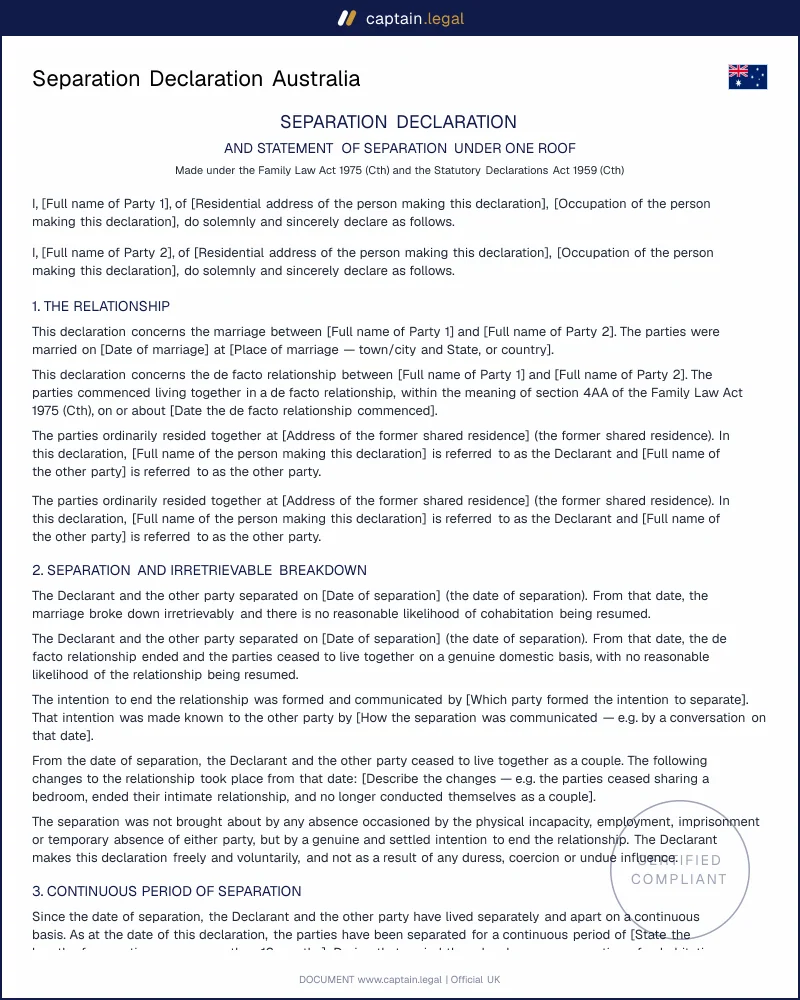
A separation declaration is a short but legally loaded statement that records the fact of separation, the date it happened, and the circumstances behind it, including the awkward but common situation where two people have separated yet still live under the one roof. Australians reach for this document in three very different rooms of the same house: the Federal Circuit and Family Court, a Centrelink service centre, and a bank refinance desk. Each audience wants the same core facts stated cleanly and truthfully, and each treats a vague or inconsistent declaration as a red flag. This template gives you a properly structured separation declaration and a supporting separated under one roof statement, drafted to the language the Family Law Act 1975 (Cth) actually uses, so the date and circumstances of your separation are recorded once and hold up wherever you need to produce them.

Used well, it closes an argument before it starts. Used carelessly, with a wrong date or a story that contradicts what you told another agency, it invites exactly the scrutiny you were trying to avoid.

Compliant

2026 Legislation

50,000+ clients

trust us

Affordable

From $4.90 / doc

Secure payment

Instant download

Separation Declaration Australia | s.90DA Family Law Act

Secure payment

Fill in the template

What is a separation declaration in Australia?

A separation declaration is a written statement, signed by one or both former partners, confirming that they have separated and setting out the separation date. It is not a court order and it does not by itself end a marriage or a de facto relationship. What it does is fix the fact and timing of separation in a form that courts, government agencies and financial institutions accept as evidence.

The term carries a precise technical meaning in one context. Under the Family Law Act 1975 (Cth), a separation declaration is the specific written declaration required by section 90DA before the property provisions of a married couple's binding financial agreement can take effect, with the equivalent for de facto couples sitting in section 90UF and the superannuation-splitting version in section 90XP. In everyday practice the phrase is used more broadly for any written record of separation you might attach to a divorce application, a Centrelink review, or a lender's file. This template covers both uses: the strict statutory declaration that switches on a financial agreement, and the general-purpose statement of separation that proves your relationship status to a third party. The separated under one roof statement is the companion document for the situation Australian families increasingly face, where money, a mortgage or the children mean nobody has moved out yet.

2

When do you need this document?

The most frequent trigger is a Centrelink assessment. When a former couple keeps sharing an address, Services Australia needs to decide whether to pay each person as a single or as a partnered claimant, and a clean written declaration of the separation date and the changed living arrangements is what supports the single rate. The next common scenario is a divorce application that relies on twelve months of separation lived under the one roof, where the Court expects the parties to explain, in a signed statement, how the relationship changed even though the address did not. A binding financial agreement creates a third, stricter need: without a compliant declaration under section 90DA or section 90UF, the property clauses simply do not come into force.

Banks and lenders form a quieter fourth audience. When you refinance to take one name off a joint mortgage, or release a partner from a loan, the lender often wants documentary confirmation that the relationship has ended and when. A short edge case worth flagging: some people try to backdate a separation to capture a more favourable Centrelink or property outcome, then find the date contradicted by a lease, a joint holiday booking, or a social media post. Use one consistent separation date across every form and conversation, because inconsistency is the single fastest way to trigger a review. A second edge case involves family violence, where separation under one roof may be unsafe; in those situations the practical arrangements in a parenting plan under section 63C often matter more urgently than the paperwork of a declaration.

3

Key clauses included in our template

  • The statement of separation and separation date is the heart of the document. It records that the parties have separated, fixes the exact date the relationship broke down, and confirms, in the words section 90DA expects, that there is no reasonable likelihood of cohabitation resuming. This single sentence is what a court, a lender or Services Australia reads first.
  • The relationship characterisation clause identifies whether the parties were married or in a de facto relationship, which determines whether section 90DA, section 90UF or section 90XP applies and changes the precise language the declaration must carry.
  • The separated under one roof particulars describe the changed living arrangements in concrete terms: separate sleeping arrangements, the division of finances and domestic tasks, the ending of a shared social life, and who was told and when. These are the facts Services Australia and the Court weigh, so the template prompts you for the specifics rather than leaving you to guess.
  • The third-party corroboration section provides space for a supporting statement from a friend, family member or professional who can confirm the separation, mirroring the affidavit evidence the Federal Circuit and Family Court routinely asks for in under-one-roof divorces.
  • The declaration and execution block sets out the signing formalities, including the option for one or both parties to sign, and is drafted so the declaration can stand alone or be included within a financial agreement as section 90DA permits.
4

Regional considerations

The Family Law Act 1975 (Cth) is Commonwealth legislation and applies uniformly across every state and territory, so the core separation declaration wording does not change whether you are in Sydney or Perth. What varies is the surrounding machinery.

New South Wales and Victoria generate the largest volume of under-one-roof divorce applications, and the Federal Circuit and Family Court registries in those states are well used to requesting a corroborating affidavit before granting a divorce where separation was lived at a shared address. Preparing that supporting statement at the same time as the declaration saves a later request.

Queensland families often encounter the declaration through property settlement rather than divorce, given the state's high rate of de facto relationships; here the section 90UF de facto pathway, rather than the section 90DA married pathway, is the one to check. Related financial documentation such as a limited child support agreement under the Child Support Act 1989 frequently accompanies the separation record.

Western Australia is the important exception to watch. For de facto couples, family law property matters in that state are dealt with under the Family Court Act 1997 (WA) rather than the Commonwealth Act, so a de facto separation declaration prepared in WA should be checked against the state legislation. Married couples in WA remain under the Commonwealth Family Law Act 1975. Across all states, a broader separation agreement under the Family Law Act 1975 can carry the practical terms while the declaration handles the bare fact and date of separation.

5

How to fill out this separation declaration

You begin by confirming whether you were married or in a de facto relationship, because that choice sets which sections of the Family Law Act 1975 the declaration relies on and adjusts the wording accordingly. From there you enter the separation date, and the form asks you to be precise rather than approximate, since this date anchors everything a court, Centrelink or a bank will later assess. If you have been living under the one roof, the template opens the additional particulars section and prompts you through the specific facts that support a genuine separation: sleeping arrangements, finances, domestic responsibilities, and how the separation was communicated. You then indicate whether one or both former partners will sign, and whether the declaration will stand alone or sit inside a financial agreement. The document assembles into a clean, signable statement, and you can add a corroborating third-party statement where the Court or Services Australia is likely to want one. Once complete, you download it in Word and PDF, edit any detail that needs adjusting, and print it for signature. If your matter also involves a formal financial split, you would prepare the binding financial agreement in parallel so the declaration can trigger its property terms.

6

Common mistakes to avoid

The mistake that causes the most damage is an inconsistent separation date. People give one date to Centrelink, a slightly different one on a divorce application, and a third in conversation with a lender, and every discrepancy invites a review that a single agreed date would have avoided. Closely related is treating separation as a change of address rather than a change of relationship. Because section 49 allows separation while living together, the declaration must describe how the relationship actually ended, and a statement that says nothing beyond "we separated" gives the Court and Services Australia nothing to assess. A third recurring error is continuing to present publicly as a couple, sharing a bank account, attending events together, posting jointly, while claiming to be separated under one roof; the paperwork cannot outrun conduct that contradicts it.

On the financial side, the most expensive slip is assuming a binding financial agreement works the moment it is signed. It does not: without a compliant declaration under section 90DA or section 90UF, the property provisions have no force, and couples sometimes discover this only when they try to rely on the agreement. Never backdate a separation to improve an outcome, because a false declaration to Services Australia can lead to penalties, and a false statement to the Court carries far heavier consequences. Finally, people forget that lenders are not bound by a private agreement to take one name off a loan; the declaration supports the conversation, but refinancing and release still follow the bank's own process.

Key takeaways

What it does

It records separation, not a relationship end

A separation declaration is evidence of when you separated and the circumstances. It is not a court order, and it does not by itself end a marriage or de facto relationship. Its value is practical: it fixes the separation date in a form that the Federal Circuit and Family Court, Centrelink and lenders tend to accept, so you are not re-arguing the basics each time.

Family Law Act

Section 90DA can switch on your BFA

If you have a binding financial agreement, section 90DA of the Family Law Act 1975 (Cth) matters. The property parts of a married couple’s agreement have no force until a separation declaration is made. The declaration must state you have separated and, at the time of declaring, there is no reasonable likelihood of cohabitation resuming. That wording is what gives the agreement legal effect.

Under one roof

Separation is about conduct, not address

Under sections 48 and 49, separation is a question of fact. You can be separated in law while still living together, including where you keep sharing a home for money, a mortgage or the children. Section 49(2) spells this out. A separated under one roof statement supports the declaration by describing how you communicated the separation and then lived consistently with the relationship being over.

Frequently Asked Questions

A separation declaration is a statement of fact rather than a binding contract, so it does not create obligations the way an agreement does. Its legal weight lies in what it proves. Under section 90DA of the Family Law Act 1975 (Cth), a compliant declaration is a precondition to the property provisions of a married couple's binding financial agreement taking effect, and without it those clauses have no force. For divorce and Centrelink purposes it operates as evidence of the fact and date of separation. Because it can be relied on by a court or Services Australia, the statements in it must be true; a false declaration carries real consequences, which is why the template is drafted to record only accurate, verifiable facts.

Yes, and it is increasingly common. Australian family law treats separation as a change in the relationship, not the address. Under section 48, as affected by section 49, a couple can be separated even though they continue to live in the same residence, provided the relationship has broken down, at least one person has formed and communicated the intention to separate, and the parties then act consistently with that. What matters is the substance: separate sleeping arrangements, divided finances, the end of a shared social life, and telling family or friends. The clearer you can describe those changes in your declaration, the easier it is to show a genuine separation under the one roof.

The separation declaration and the supporting separated under one roof statement download in both Word and PDF. The Word version lets you adjust any detail, insert additional particulars, or tailor the corroborating statement to your circumstances before finalising. The PDF gives you a clean, print-ready copy for signature and for lodging with the Court, Services Australia or a lender. Most people edit in Word, confirm the separation date and the living-arrangement particulars are accurate, then print the PDF for signing. Having both formats means you can negotiate wording where needed and still produce a tidy final document for whichever audience asks for it.

If you receive a Centrelink payment and still live with your former partner, Services Australia needs to decide whether to pay you as a single person or as a member of a couple. A clear declaration of your separation date and changed living arrangements supports assessment at the single rate, which is generally higher. Where you remain under the one roof, you will usually also complete the official Relationship Details, Separated Under One Roof form, and your declaration should match what you tell Services Australia in every particular. Consistency is everything here. A date or circumstance that conflicts with your Centrelink form is the fastest route to a review, a payment suspension, or a debt.

Not necessarily. The Family Law Act 1975 allows a separation declaration to be made by one spouse or by both, which reflects the reality that separation often happens through the action of a single person. A declaration signed by one former partner is valid, and section 49 confirms that a couple can be held to have separated even where the cohabitation was ended by the conduct of only one of them. That said, a jointly signed declaration is harder to dispute and is often preferred where both parties agree on the date. The template accommodates either approach, so you can proceed even if your former partner will not sign.

You must be separated for a continuous period of at least twelve months before you can apply for a divorce, and this period can include time separated under the one roof. The requirement comes from section 48 of the Family Law Act 1975 (Cth), which asks the Court to be satisfied that the marriage has broken down irretrievably and that there is no reasonable likelihood of reconciliation. Where the whole or part of that twelve months was lived at the same address, the Court will generally expect a corroborating affidavit from someone who can confirm the separation. Preparing your declaration and the supporting statement early means the evidence is ready when you file.

No, and that is an important distinction. A separation declaration records the fact and date of separation; it is not the document that divides assets or sets out care of the children. Property division is handled through a binding financial agreement or consent orders, and day-to-day care is recorded in a parenting plan or parenting orders. The declaration frequently sits alongside these, and under section 90DA it is what actually switches on the property terms of a financial agreement. If you need to settle finances or arrangements for the children, you would pair the declaration with the relevant family and separation documents for Australia rather than expecting one statement to do everything.

4.8/5

14 verified reviews · 50 000+ downloads

Separation Declaration Australia | s.90DA Family Law Act
  • Immediate access to the document
  • PDF + Word download
  • Compliant with 2026 legislation
  • Reviewed by lawyers
Fill in the template
Secure payment
Updated on July 22, 2026

You might also like

Binding Financial Agreement Australia
Consent Orders Application Pack AU