Create my document
Login

Choose country

AustraliaAustraliaChoose country
Business

Supply Agreement Australia | ACL & PPSA Compliant

Supply agreement drafted to the Competition and Consumer Act 2010, state Sale of Goods Acts and PPSA retention of title rules. Lawyer-grade Word & PDF.
4.9/511 reviews50 000+ downloadsInstant download
Share

A sale of goods or supply agreement is the contract that sits underneath almost every business-to-business trade in Australia. It sets the price, the delivery arrangements, the point at which risk passes from supplier to buyer, and the warranties each side gives. Whether you manufacture components, wholesale stock, or supply equipment on account, a written supply agreement is what turns a purchase order into an enforceable commercial relationship. It works alongside the Australian Consumer Law, the state Sale of Goods Acts, and the Personal Property Securities Act 2009 (Cth), and a well drafted one keeps you protected when a buyer stops paying or a shipment goes wrong.

Most suppliers only discover the gaps in their terms of trade at the worst possible moment, usually when a customer enters administration owing them tens of thousands of dollars in unpaid stock. This page walks through what the agreement does, the law that governs it in Australia, and the clauses that separate a document that holds up from one that leaves you exposed.

Compliant

2026 Legislation

50,000+ clients

trust us

Affordable

From $4.90 / doc

Secure payment

Instant download

Supply Agreement Australia | ACL & PPSA Compliant

Secure payment

Fill in the template

What is a sale of goods or supply agreement?

A sale of goods agreement is a contract for the transfer of ownership in tangible goods from a seller to a buyer for a price. A supply agreement is the broader cousin: it governs an ongoing relationship where goods (and sometimes related services) are delivered repeatedly over time under agreed terms of trade, rather than a single one-off sale. In practice Australian businesses use the terms loosely, but the distinction matters when you draft. A one-off sale needs a clean description, price, and delivery term. A continuing supply relationship needs credit terms, ordering mechanics, and a framework that survives dozens of individual deliveries.

The document differs from a services agreement, which deals with work performed rather than goods transferred, and from a simple invoice, which records a transaction but rarely sets out the terms that decide a dispute. It also differs from an independent contractor agreement built for genuine contracting relationships, where the value is labour and deliverables rather than physical stock. A supply agreement answers the questions an invoice never does: when does title pass, who carries the risk in transit, what happens if the goods are defective, and how are disputes resolved. Suppliers who trade on account without one are effectively extending unsecured credit on a handshake, and that position collapses the moment the buyer's solvency does.

2

When do you need this document?

The clearest trigger is selling goods on credit rather than cash on delivery. The moment you hand over stock before you are paid, you are an unsecured creditor unless your terms of trade say otherwise, and a written supply agreement with a registered retention of title clause is what changes that. Wholesalers, distributors, and manufacturers who invoice on 30-day terms are the most exposed group, and they are also the ones most likely to be trading on a verbal understanding or a set of terms printed on the back of an invoice that no one signed.

The second common scenario is an ongoing supply relationship with a repeat customer. Once orders become regular, the parties need a master agreement that governs every future delivery, so the price mechanism, lead times, minimum order quantities, and payment terms are settled once rather than renegotiated each time. This is also the point where founders formalising their trading structure often revisit their company constitution drafted to the Corporations Act 2001 and their broader governance documents, because supply obligations sit better on a properly constituted company than on a sole trader.

A third situation is supplying goods with a real defect or safety risk, where the description, fitness for purpose, and warranty terms decide who bears the cost of a return or recall. Suppliers of equipment, components, and industrial goods need warranty and liability clauses that reflect the actual risk profile of the product rather than boilerplate. A fourth, easily missed case is selling internationally or importing for resale, where the contract needs to fix the delivery term, the currency, and the point of risk transfer with far more care than a domestic sale. The edge case worth flagging is the master supply agreement where the headline order sits above the ACL threshold but individual drawdowns fall below it, which can quietly pull the guarantees back into play on the smaller purchases.

3

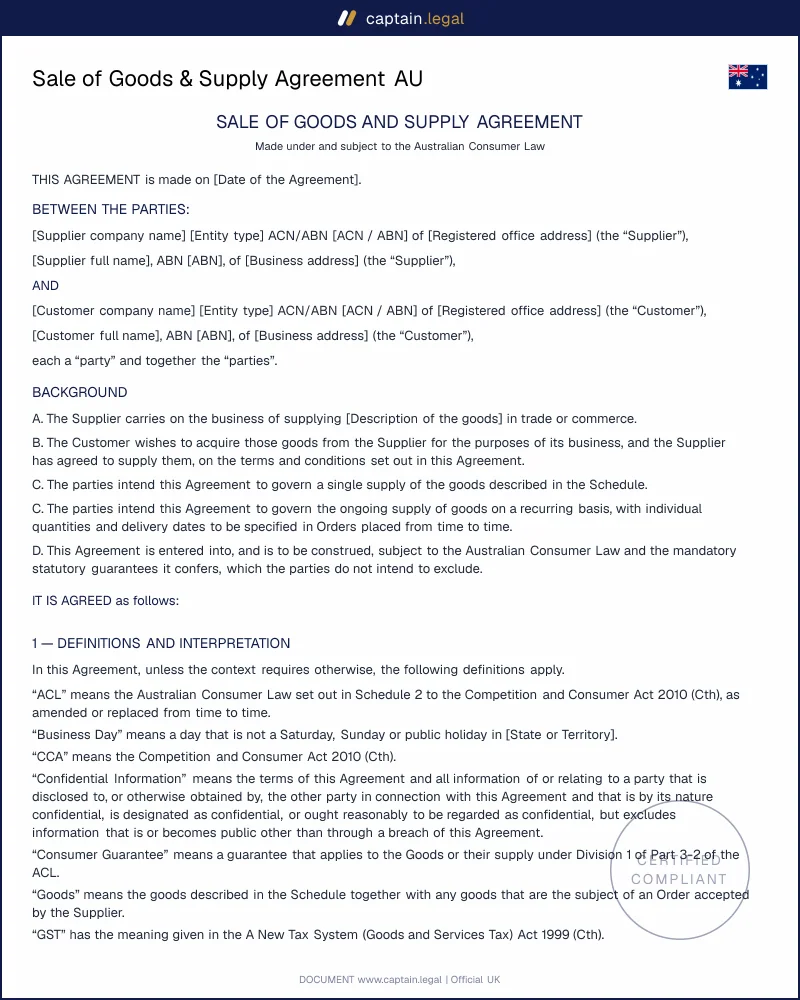
Key clauses included in our template

  • The description and specification of the goods fixes exactly what is being supplied, by reference to model numbers, grades, or an attached schedule. Vague descriptions are the single most common source of supply disputes, because a buyer who claims the goods do not match can rely on the implied condition as to description under the state Sale of Goods Act. A precise specification closes that argument off.

  • The price and payment terms set the amount, whether it is inclusive or exclusive of GST, the invoicing cycle, and the due date. This clause also carries the late payment interest rate and the point at which supply can be suspended for non-payment, which are the two levers that actually move a slow-paying customer.

  • The passing of risk and title clause is drafted to separate the two deliberately. Risk in the goods usually passes to the buyer on delivery, so the buyer must insure from that point, while title is retained by the supplier until payment is received in full. This is the commercial heart of the document and the reason the retention of title wording has to be precise.

  • The retention of title and PPSR clause preserves your ownership until you are paid and puts the buyer on notice that you will register a security interest. The clause only bites against other creditors if you actually register it on the Personal Property Securities Register, so the drafting is written to support a purchase money security interest registration.

  • The consumer guarantees and limitation of liability clause is written to sit lawfully alongside the ACL. It limits liability to the extent the law permits, caps consequential loss, and expressly preserves the non-excludable guarantees rather than pretending to remove them, which keeps the whole agreement compliant with section 64.

  • The delivery, acceptance, and returns clause sets lead times, the inspection window, and what counts as valid rejection, so a buyer cannot sit on defective goods for months and then claim a refund.

4

State-specific considerations

New South Wales applies the Sale of Goods Act 1923 (NSW), one of the oldest codifications in the country. Its default rules on when property passes turn on whether the goods are specific or unascertained, and on the parties' intention, which the contract can and should override expressly. NSW suppliers should pay particular attention to the interaction between the state Act and the Personal Property Securities Act 2009 (Cth), because a retention of title clause that relies only on the state statute without PPSR registration will usually fail against a liquidator. The state's Fair Trading office handles consumer-facing complaints, but B2B supply disputes above the ACL threshold generally proceed as ordinary contract claims in the Local or District Court.

Victoria operates under the Goods Act 1958 (Vic), which combines the sale of goods rules with the state's goods and consumer provisions. Victorian suppliers dealing in higher-value plant and equipment should note that the passing of risk default can leave them carrying loss in transit unless the contract fixes risk transfer on delivery. The clause allocating risk needs to be explicit, because relying on the statutory presumption is exactly where suppliers get caught when a shipment is damaged before the buyer takes possession.

Queensland uses the Sale of Goods Act 1896 (Qld), and section 22 of that Act expressly allows a seller to reserve the right of disposal until conditions are met, which underpins retention of title arrangements. Queensland has a large volume of primary production and equipment supply, so PPSR registration of purchase money security interests is especially common here. Suppliers who register within the statutory time limit gain the "super priority" that a purchase money security interest confers, which is often the difference between recovering stock and joining the queue of unsecured creditors.

Western Australia applies the Sale of Goods Act 1895 (WA), the oldest of the state Acts, and its resources and mining supply chains generate a high proportion of the country's large-value goods contracts. WA suppliers to mining and construction clients frequently deal with buyers whose standard purchase terms try to shift risk and reverse warranties, so a supplier's own supply agreement is what gives them a starting position to negotiate from rather than accepting the buyer's terms by default.

5

How to fill out this supply agreement

You start by identifying the parties, using the full legal names and ACNs of the supplying and buying companies rather than trading names, because a notice or claim served on the wrong entity is a notice served on no one. From there the form asks whether this is a one-off sale or an ongoing supply relationship, and it adjusts the ordering and credit terms accordingly. You then set the description of the goods, either inline or by attaching a specification schedule for anything technical, and you fix the price, the GST treatment, and the payment cycle.

The template then walks you through the commercial levers that matter most: the delivery term, the point at which risk passes, the retention of title position, and the late payment interest rate. You choose your governing state, which aligns the agreement with the relevant Sale of Goods Act, and you complete the retention of title and limitation of liability clauses to match your actual risk. Once the details are in, you download the finished agreement in Word and PDF, ready to sign and, where retention of title applies, to support a PPSR registration. Businesses building out a full set of trading documents often pair this with an employment contract compliant with the Fair Work Act 2009 and the other core agreements in the Captain.Legal Australian business document library.

6

Common mistakes to avoid

The most expensive mistake is keeping a retention of title clause in the contract while never registering it on the PPSR. Before 2012 ownership alone protected a supplier, but under the Personal Property Securities Act 2009 (Cth) an unregistered security interest usually vests in the buyer's company on insolvency, meaning the supplier loses both the goods and the money. Suppliers also routinely fail to separate risk from title, leaving themselves liable for goods that are sitting in the buyer's warehouse, or carrying insurance on stock the buyer should be covering. A close third is drafting a blanket exclusion of all warranties, which is void to the extent it purports to remove the ACL consumer guarantees and now carries penalty exposure under the unfair contract terms regime.

The other recurring errors are quieter but just as damaging. Vague goods descriptions invite disputes about whether what arrived matched what was ordered, and a missing specification schedule turns a clear breach into a contest of recollection. Many suppliers also forget to set a late payment interest rate and a suspension right, which leaves them with no practical remedy short of litigation when an invoice ages. Finally, businesses that grow past a handful of customers often keep relying on terms printed on the back of an invoice that no buyer ever signed, and unsigned terms of trade are the weakest possible foundation for a claim. A properly executed supply agreement sits far better alongside a shareholders agreement built to the Corporations Act 2001 as part of a coherent set of company documents.

Key takeaways

PURPOSE

Turn purchase orders into enforceable terms

A supply agreement sits under day-to-day B2B trading and spells out the basics an invoice often misses: price, delivery arrangements, when risk passes in transit, and what warranties apply. It is the document that makes an ongoing supply relationship workable across repeated orders, especially where goods are supplied on account. Without it, you are often relying on default rules and informal understandings when a dispute arises.

LEGAL RULES

Default Sale of Goods rules apply

State and territory Sale of Goods legislation (for example Sale of Goods Act 1923 (NSW), Goods Act 1958 (Vic), Sale of Goods Act 1896 (Qld)) sets default positions on title, description, quality and when property and risk pass. Those rules apply unless your contract changes them. A written agreement lets you set clear payment and risk terms instead of inheriting the statutory defaults by silence.

ACL

You cannot contract out of guarantees

The Australian Consumer Law (Schedule 2 to the Competition and Consumer Act 2010 (Cth)) brings non-excludable consumer guarantees into many supply deals. Section 64 makes any term that tries to exclude, restrict or modify those guarantees void. This can catch B2B sales, not just retail: a business buyer is a “consumer” where the goods are priced at or below $100,000, or are ordinarily acquired for personal or domestic use regardless of price.

Frequently Asked Questions

Yes. Once both parties sign a supply agreement that identifies the goods, the price, and the essential terms, it forms a binding contract enforceable under Australian contract law and the relevant state Sale of Goods Act. The template is drafted to work alongside the Competition and Consumer Act 2010 (Cth), so its limitation and warranty clauses are structured to remain valid rather than being struck down under section 64. What makes it enforceable is proper execution by authorised signatories and accurate party details, including company names and ACNs. An agreement left unsigned, or signed by someone without authority to bind the company, is where enforceability problems usually start, so completing the signing block correctly matters as much as the clauses themselves.

No, and attempting to is a mistake that now carries real consequences. Under section 64 of the Australian Consumer Law, any term that tries to exclude, restrict, or modify a consumer guarantee is void. Where your buyer acquires goods priced at or below $100,000, or goods ordinarily bought for personal use, the guarantees apply automatically even in a business-to-business sale. The template does not pretend to remove these guarantees. Instead it limits liability to the maximum extent the law allows and preserves the non-excludable guarantees expressly, which keeps the agreement compliant while still protecting you from unlimited consequential loss.

Retention of title keeps ownership of the goods with you until the buyer pays in full, but ownership alone is no longer enough. Under the Personal Property Securities Act 2009 (Cth), your retention of title clause is a security interest, and to bind other creditors you must register it on the Personal Property Securities Register. Register it correctly and within the time limit and you gain a purchase money security interest, which grants "super priority" over other secured creditors for those goods. Skip the registration and your clause, however well drafted, usually vests in the buyer's company on liquidation. The agreement supports registration, but you must complete the PPSR step yourself.

That depends on what your contract says, which is exactly why fixing it in writing matters. The state Sale of Goods Acts set a default position, but it can leave a supplier carrying loss for goods already in the buyer's hands. The template separates the two deliberately: risk usually passes on delivery, so the buyer must insure the goods from that moment, while title is retained until payment. Setting risk to pass on delivery means a shipment damaged in the buyer's warehouse is the buyer's problem, not yours. Relying on the statutory default instead is where suppliers frequently find themselves liable for goods they no longer control.

The agreement downloads in both Microsoft Word and PDF. The Word version is fully editable, so you can adjust the goods description, payment terms, delivery arrangements, and retention of title wording to match your business before you finalise it. The PDF is a clean, ready-to-sign version suitable for execution and for keeping on file. Having the editable Word file matters for a supply agreement in particular, because your specification schedule and credit terms will differ from one customer to the next, and you will often produce several versions of the same base document for different trading relationships.

Both approaches work, and the template supports each. For a genuine one-off sale, a single completed agreement covering that transaction is enough. For repeat customers, the smarter structure is a master supply agreement that governs every future order, with individual purchase orders drawing down against it. That way you settle the price mechanism, credit terms, and retention of title once, and each delivery inherits them automatically. Watch the ACL threshold here: where the master agreement sits above $100,000 but individual orders fall below it, the consumer guarantees can still reach the smaller purchases, so the compliant warranty drafting stays important across the whole relationship.

Keep the signed agreement for at least the duration of the trading relationship plus the limitation period for contract claims in your state, which is generally six years from the date a cause of action arises. Retention of title and PPSR registrations should be maintained and reviewed for as long as you continue supplying that customer on credit, because a lapsed or incorrectly described registration can leave you unsecured without your realising it. Many suppliers set a calendar reminder to review their active PPSR registrations annually, since an out-of-date register entry offers little protection when a buyer's administrator comes to test it.

4.9/5

11 verified reviews · 50 000+ downloads

Supply Agreement Australia | ACL & PPSA Compliant
  • Immediate access to the document
  • PDF + Word download
  • Compliant with 2026 legislation
  • Reviewed by lawyers
Fill in the template
Secure payment
Updated on July 22, 2026

You might also like

Privacy Policy Template Australia
Company Constitution Australia