A Notice of Intention to Leave is the written notice a tenant serves on a landlord or agent to formally end a residential tenancy and set the date on which vacant possession will be given. In Australia there is no single national form, because each state and territory runs its own Residential Tenancies Act, and the minimum notice period a tenant must give changes depending on the jurisdiction, the type of agreement (fixed term or periodic), and the ground relied on. Get the notice period right and the exit is clean. Get it wrong, and you can stay liable for rent, lose part of your bond, or face a compensation claim at the tribunal. This template gives you a tenancy termination notice that carries the correct statutory notice period, the right recipient details, and a defensible record of service.
Whether you are a renter ending a periodic lease in Perth, a tenant on a fixed term in Melbourne, or a co-tenant leaving a sharehouse in Brisbane, the mechanics are the same: put it in writing, count the days correctly, and serve it so you can prove it later.
Compliant
2026 Legislation
50,000+ clients
trust us
Affordable
From $4.90 / doc
Secure payment
Instant download
Notice of Intention to Leave | Residential Tenancies Act
Secure payment
What is a notice of intention to leave?
A notice of intention to leave is a tenant-initiated written notice that terminates a residential tenancy agreement on a stated date. It is the tenant's counterpart to the landlord's notice to vacate, and the two should not be confused. A notice to vacate flows from the rental provider to the renter and usually requires a legal ground. A notice of intention to leave flows the other way and, in most jurisdictions, needs no ground at all when the tenancy is periodic or when the fixed term is ending. The tenant simply exercises a right the statute already grants.
The terminology shifts across the map. Queensland calls it a Notice of intention to leave (Form 13), Victoria uses a Notice of intention to vacate under the Residential Tenancies Act 1997, New South Wales refers to a termination notice given by the tenant, and Western Australia issues a Form 22 notice of termination from tenant to lessor. Despite the different labels, each does the same job: it fixes the end date, protects the tenant from open-ended rent liability, and starts the clock on the bond refund and final inspection. A properly drafted notice also does something quieter but valuable. It creates a paper trail that a tribunal will trust when a landlord later claims they never received word, or argues the tenant "just walked out." If you are moving straight from one rental into another, pair this notice with a fresh residential tenancy agreement built on the prescribed standard terms so both ends of the move sit on solid ground.
Legal framework
Residential tenancies in Australia are governed at the state and territory level, and the notice a tenant must give is set by the local Act, not by any national rule. In New South Wales the governing statute is the Residential Tenancies Act 2010. A tenant ending a periodic agreement must serve a termination notice specifying a date not earlier than 21 days after the notice is given, while a tenant ending at the conclusion of a fixed term needs a minimum of 14 days, served on or before the last day of the term. In Victoria the Residential Tenancies Act 1997 sets the standard tenant notice at 28 days under section 91Z, applying to both periodic agreements and the end of a fixed term, with a shorter 14-day window available under section 91ZB in defined circumstances such as certain provider breaches.
Queensland runs on the Residential Tenancies and Rooming Accommodation Act 2008, where the tenant lodges the prescribed Form 13 and gives at least 14 days notice to end a periodic agreement without a breach, or a shorter period where the property manager has breached the agreement. Western Australia applies the Residential Tenancies Act 1987, under which a tenant ending a periodic tenancy gives not less than 21 days written notice under section 68, using the Form 22. The remaining jurisdictions follow the same pattern with their own numbers: South Australia's Residential Tenancies Act 1995, Tasmania's Residential Tenancy Act 1997, the ACT's Residential Tenancies Act 1997, and the Northern Territory's Residential Tenancies Act 1999 each prescribe their own minimum periods and forms.
Two rules cut across every jurisdiction. First, the notice must be in writing, signed by the tenant, identify the premises, and state the termination date. An oral notice or a text message that omits the address or the date is not a valid notice in most states, and a tribunal can disregard it. Second, service must be done by a method the Act recognises, and the person who served it may have to prove it. For the authoritative position on notice periods and grounds in your state, the NSW Fair Trading guidance on ending a residential tenancy is a reliable starting point, and each state consumer agency publishes an equivalent.
When do you need this document?
The most common trigger is a periodic (month-to-month) tenancy that has rolled on past its fixed term, where the tenant simply wants out. No ground is required. The tenant serves the notice, counts the statutory days, and vacates on the stated date. The second frequent scenario is the end of a fixed term, where a tenant who does not want to renew serves notice timed to expire on or after the last day of the lease. Serve it too late and the agreement quietly converts to a periodic tenancy, which resets the clock and can cost you an extra cycle of rent.
Reduced-notice situations sit at the more delicate end. A tenant facing a landlord who has breached the agreement, or premises that have become unfit to live in, can often shorten the notice period dramatically. Victoria allows as little as 2 days where the premises are destroyed or rendered unsafe, and most states carry an equivalent frustration or uninhabitability pathway. These shortened periods are conditional and evidence-hungry, so a tenant relying on them should keep photos, correspondence, and repair requests. Co-tenants leaving a sharehouse form another edge case: one departing tenant usually cannot end the whole agreement, only their own interest, and the mechanics differ sharply between states. Tenants escaping family or domestic violence have dedicated fast-track provisions in every jurisdiction, typically requiring supporting documentation rather than the standard notice period. If your reason for leaving is a rent increase you consider unfair, review the timing rules on a rent increase notice under the Residential Tenancies Acts before you commit to a termination date.
Key clauses included in our template
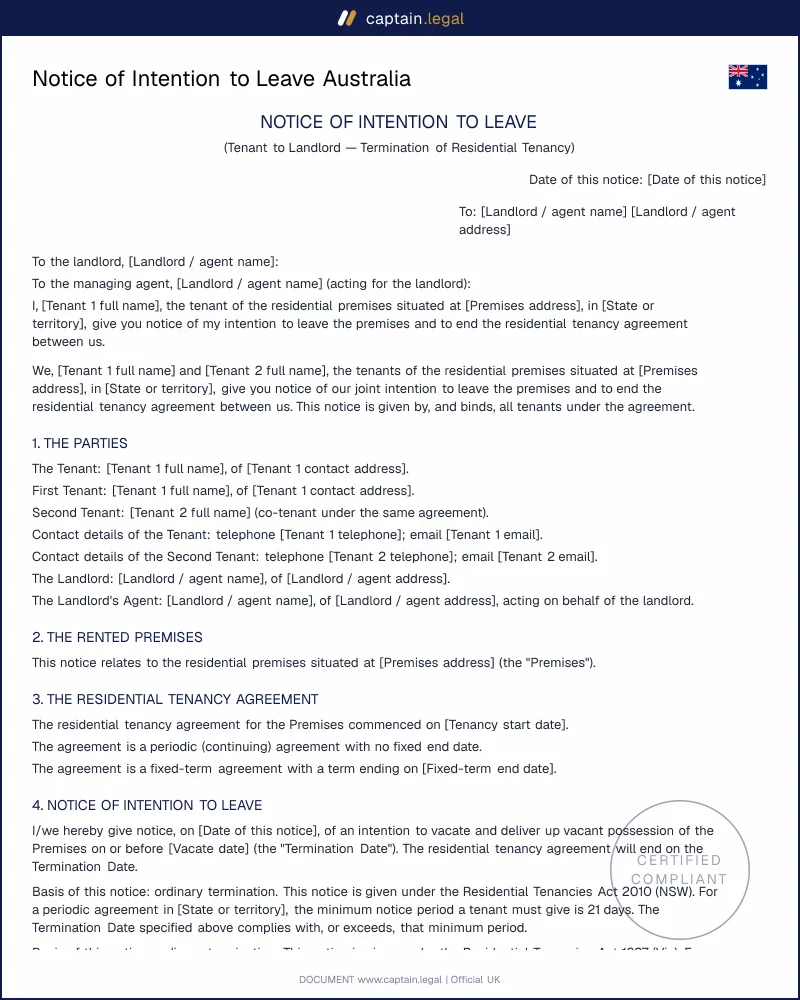
- The tenant and landlord identification block names every tenant on the agreement and the landlord or managing agent as the correct recipient. A notice served on an agent who no longer manages the property, or one that omits a co-tenant, invites a later argument that the notice was defective. The template prompts you to enter the exact names on the lease.
- The premises description states the full rental address, including unit or flat number, so there is no ambiguity about which tenancy is ending. Tribunals have set aside notices that described the property loosely, and this field removes that risk.
- The statement of the ground and Act reference identifies whether you are ending a periodic agreement, ending at the fixed term, or relying on a reduced-notice ground, and cites the section of your state's Residential Tenancies Act. Vague wording is replaced with the statutory basis your tribunal expects to see.
- The termination date is the operative clause, and the template helps you back-calculate it from the day of service so the minimum notice period is satisfied. A date that falls even one day short can void the whole notice.
- The method and date of service records how the notice was delivered, whether by hand, post, or email where the Act permits it. This is the clause that wins the "I never received it" dispute, because it fixes both the method and the day the clock started.
- The tenant signature and date completes the formal requirements. An unsigned notice is not a notice, and the date of signing anchors the timeline.
State and territory considerations
New South Wales applies the Residential Tenancies Act 2010. A tenant ending a periodic agreement gives a minimum of 21 days under section 97, and the termination date need not align with the rent cycle. Ending at the conclusion of a fixed term takes 14 days, served on or before the last day of the term, with the date set for the last day or later. NSW also recognises several 14-day early-exit grounds without a break fee, including where the tenant was not told the property was for sale before signing. Recent reforms have tightened landlord grounds and rent-increase frequency, but the tenant's own notice periods remain as set out above.
Victoria runs on the Residential Tenancies Act 1997, where section 91Z fixes the standard tenant notice at 28 days for both periodic agreements and the end of a fixed term. The document is a notice of intention to vacate, and the reduced periods in section 91ZB can bring the figure down to 14 days in defined circumstances. Where premises are destroyed or become unsafe, notice can fall to 2 days. Victoria's push toward stronger renter protections means agents scrutinise the form closely, so the address, date, and signature must be exact.
Queensland applies the Residential Tenancies and Rooming Accommodation Act 2008 and uses the prescribed Form 13, Notice of intention to leave. A tenant ending a periodic agreement without a breach gives at least 14 days, and the tenancy ends on the later of the agreement end date or the notice end date. Shorter periods apply where the manager or owner has breached, and a distinct pathway exists where the premises fail the prescribed minimum housing standards that have applied to all tenancies since 1 September 2024. Using the RTA's own Form 13 wording keeps the notice within scope.
Western Australia applies the Residential Tenancies Act 1987, under which a tenant ends a periodic tenancy with not less than 21 days written notice under section 68, using Form 22. The notice must be signed, identify the premises, and specify the day possession is delivered up, and it need not coincide with the end of a rent period. Where premises are destroyed or rendered uninhabitable through no fault of the tenant, section 69 allows 2 days. WA's 2024 reforms changed rent and pet rules but left the core tenant notice period intact. The remaining jurisdictions, South Australia, Tasmania, the ACT, and the Northern Territory, each set their own minimums and forms under their respective Acts, so always confirm the local figure before you fix your date.
How to fill out this notice of intention to leave
You start by selecting the state or territory where the property is located, because that single choice drives the statutory notice period, the correct terminology, and the section references that appear on the finished notice. From there you enter the rental address in full, then the names of every tenant on the agreement and the landlord or managing agent who will receive it. The template then asks whether your tenancy is periodic or fixed term, and whether you are relying on a standard exit or a reduced-notice ground, and it adjusts the minimum period accordingly. You choose your intended move-out date, and the tool checks it against the day of service so you do not accidentally set a date that falls short of the legal minimum. You then record how you will serve the notice, whether by hand, by post, or by email where your state permits electronic service. Finally you download the completed notice in Word if you want to make further edits, or in PDF for a clean, signable version. Keep a copy for yourself, and note the exact date and method of service, because that record is what protects you if the timing is ever questioned. If you are also documenting the condition of the property on your way out, prepare a tenancy condition report to protect your bond at handover alongside this notice.
Common mistakes to avoid
The single most frequent error is miscounting the notice period. Tenants read "21 days" and treat the day they hand over the notice as day one, or they forget that some states require the notice to reach the recipient before the count begins, not merely to be posted. A notice that is even one day short can be treated as no notice at all, and you may have to serve a fresh one and wait out the full period again. The second common failure is serving the wrong person. A notice handed to a landlord who has since appointed an agent, or an agent who no longer manages the property, can be defective, so confirm the current recipient before you serve. Tenants also routinely rely on a text message or a casual email that leaves out the address, the termination date, or their signature, and then discover at the tribunal that it was never a valid notice.
Two more traps catch experienced renters. The first is timing a fixed-term exit badly, so the notice expires after the term instead of on or before its last day, which lets the agreement roll into a periodic tenancy and drags out the liability. The second is failing to keep proof of service. When a landlord claims they never received the notice, the burden often falls on the tenant to show it was served correctly, and a dated record of the method used is usually the deciding evidence. Serve early, serve properly, and keep the receipt.
Frequently Asked Questions
23 verified reviews · 50 000+ downloads
- Immediate access to the document
- PDF + Word download
- Compliant with 2026 legislation
- Reviewed by lawyers
You might also like