Create my document
Login

Choose country

AustraliaAustraliaChoose country
Family & Divorce

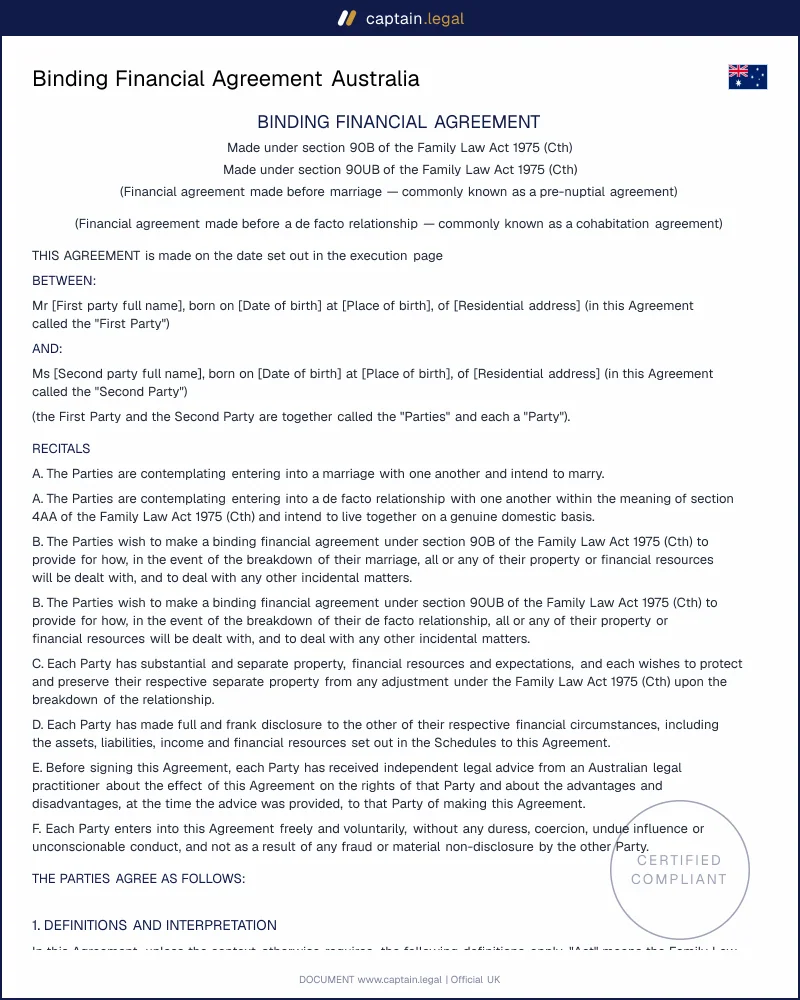
Binding Financial Agreement | Family Law Act 1975 s.90B

Binding financial agreement template under Part VIIIA of the Family Law Act 1975. Meets s.90G independent legal advice rules. Word and PDF download.
4.7/519 reviews50 000+ downloadsInstant download
Share

A binding financial agreement is the closest thing Australian law offers to a private property settlement negotiated on your own terms. Signed under Part VIIIA or Part VIIIAB of the Family Law Act 1975 (Cth), it lets couples decide in advance how assets, superannuation and financial resources will be divided if the relationship ends, keeping the outcome out of the hands of a judge. This page covers the pre-nuptial and pre-cohabitation versions, made under section 90B for couples contemplating marriage and section 90UB for those about to enter a de facto relationship. Both are built around one non-negotiable feature: each party must receive independent legal advice before signing, or the agreement is worth very little when tested.

Most people reach for one of these documents to protect something specific. A business built before the relationship, an inheritance, a family trust, children from an earlier marriage, or simply the wish to avoid a costly fight years down the track. The template here is drafted to Australian standards and covers the disclosure, execution and advice steps that decide whether the agreement holds.

Compliant

2026 Legislation

50,000+ clients

trust us

Affordable

From $4.90 / doc

Secure payment

Instant download

Binding Financial Agreement | Family Law Act 1975 s.90B

Secure payment

Fill in the template

What is a binding financial agreement?

A binding financial agreement, commonly shortened to BFA, is a written contract between two people that sets out how their property, superannuation and financial resources are to be dealt with if their marriage or de facto relationship breaks down. It is authorised by the Family Law Act 1975 (Cth), and when it satisfies the strict statutory requirements it ousts the court's usual power to make property adjustment orders. In plain terms, a valid BFA means neither partner can later ask the Federal Circuit and Family Court of Australia to redistribute the assets it covers.

The label people use most often is pre-nup, but that is only one variety. A section 90B agreement is made in contemplation of marriage, a section 90C agreement during the marriage, and a section 90D agreement after divorce. The de facto equivalents sit in Part VIIIAB: section 90UB before the relationship starts, section 90UC during it, and section 90UD after separation. This page deals with the two "before" versions, the 90B pre-nuptial and the 90UB pre-cohabitation agreement, which are the ones used to lock in expectations at the start rather than clean up after a split.

A BFA is different from consent orders, which are terms the court itself approves and turns into enforceable orders. A financial agreement is a private contract that never goes before a judge for approval. That privacy is part of its appeal, and also part of its risk: nobody checks the fairness of the deal at signing, so the safeguards built into the drafting and advice process are all that stand between you and a document that can be set aside.

2

When do you need this document?

The clearest case is the person entering marriage with assets that predate the relationship. Someone who owns a home outright, holds shares in a family company, or expects an inheritance usually wants those assets quarantined before the wedding, and a section 90B agreement is the instrument that does it. The same logic drives the pre-cohabitation version. Couples moving in together without marrying often assume the law leaves them alone, but de facto partners acquire property claims after two years of cohabitation, so a 90UB agreement is how you set the boundaries before that clock starts.

Second marriages and blended families are the other common trigger. A parent who wants to preserve capital for children from a first relationship cannot rely on goodwill alone, and a BFA is the mechanism that ring-fences those assets so they pass as intended rather than being drawn into a later property pool. Business owners sit in a similar position. If you run a company with partners or investors, a financial agreement protects the enterprise from becoming a bargaining chip in a separation, which is often a condition your co-owners or shareholders quietly expect. You may find our Australian shareholders agreement template useful where business interests need parallel protection.

An edge case worth flagging is the migrating couple. Because a 90UB agreement requires ordinary residence in a participating jurisdiction, a couple planning to settle in Western Australia cannot make an effective de facto financial agreement under the federal Act, since WA runs its own de facto property regime. Get advice on jurisdiction before you draft, not after. Another is the couple who sign years before marrying and then let the document gather dust while their finances transform. A pre-nup drawn against a modest asset base can look very different once a business grows or an inheritance lands, and stale agreements are prime candidates for a set-aside application.

3

Key clauses included in our template

  • The identification of the parties and relationship status opens the agreement and fixes which part of the Act applies. It records whether the couple is contemplating marriage under section 90B or a de facto relationship under section 90UB, because the wrong recital can push the document into the wrong statutory box and undermine it from the first page.
  • The full and frank disclosure schedule annexes each party's assets, liabilities, superannuation and financial resources. Non-disclosure of a material asset is one of the express grounds a court can rely on to set an agreement aside, so the schedule is drafted to force a complete picture rather than a convenient summary.
  • The separate property provisions define which assets stay quarantined and confirm that property acquired in substitution for a pre-relationship asset keeps its protected character. This is the engine of a pre-nup: without it, an inheritance sold and reinvested could quietly lose its protection.
  • The division mechanism on breakdown sets out exactly how the pool is split if the relationship ends, whether by percentage, by a fixed payment, or by each party retaining what they brought and dividing only what was jointly acquired.
  • The superannuation clause deals with splitting or flagging entitlements, drafted so it operates under the superannuation provisions of the Act rather than being left as a loose intention that cannot bind a fund.
  • The statements of independent legal advice are annexed as separate certificates signed by each party's lawyer. Under section 90G and section 90UJ these are not optional paperwork; they are the condition on which the whole agreement's enforceability rests.
4

Regional considerations

New South Wales couples make and enforce financial agreements under the federal Family Law Act 1975 (Cth), so a 90B or 90UB agreement operates the same way in Sydney as it does elsewhere on the east coast. What varies in practice is the pool of practitioners and the volume of appellate authority coming out of the Federal Circuit and Family Court of Australia registries in NSW, which sets the tone for how carefully advice certificates are scrutinised. Parties here should pay particular attention to disclosure, since NSW set-aside applications frequently turn on a hidden asset or an undervalued business interest.

Victoria operates under the same federal framework, and Melbourne registries apply the section 90G and section 90UJ requirements without local variation. The practical wrinkle in Victoria tends to be timing around de facto relationships, because couples who cohabit before making a 90UB agreement can find the contemplated relationship has already begun, which affects whether the agreement bites. Signing before cohabitation starts is the safer path.

Queensland follows the federal regime as well, and the Family Law Act 1975 (Cth) governs both married and de facto agreements made in Brisbane, the Gold Coast and regional centres. Queensland's large population of de facto couples makes the section 90UB pre-cohabitation agreement especially common, and the two-year threshold for de facto property claims is the number local advisers most often cite when explaining why an early agreement is worth the effort.

Western Australia is the genuine exception. Family law property matters for de facto couples in WA are dealt with under state legislation rather than Part VIIIAB, because WA never referred its de facto powers to the Commonwealth. A section 90UB agreement made by a couple ordinarily resident in WA will not be effective under the federal Act. Married couples in WA can still use section 90B agreements, but de facto partners need advice grounded in the WA regime, which is why jurisdiction is the first thing to confirm before drafting.

5

How to fill out this binding financial agreement

You start by confirming which relationship category applies, since the template branches at the top between the section 90B marriage path and the section 90UB de facto path. From there you enter the parties' details and work through the disclosure schedule, listing every asset, liability and superannuation interest, because a gap here is the single most common reason agreements are later challenged. The form then walks you through the separate property provisions, prompting you to identify what each party wants quarantined and how substituted assets should be treated.

Next you set the division mechanism, choosing between a clean percentage split, a fixed sum, or a retain-what-you-brought structure, and the template adjusts the wording to match. Once the substance is complete, you produce the document in Word and PDF so it can be edited and negotiated before signing. The final and non-negotiable step happens off the platform: each party takes the draft to their own independent lawyer, receives advice on its effect, and has that lawyer sign the statement of advice that gets annexed to the agreement. Only when both parties have signed and exchanged those statements does the agreement become binding. If you also need to record living or property arrangements around the separation itself, our Australian real estate document templates cover tenancy and property paperwork in the same locale.

6

Common mistakes to avoid

The mistake that sinks more agreements than any other is treating independent legal advice as a formality. Some couples try to use one lawyer between them, sign before the advice is given, or rush the certificates on the day of signing. Each of these hands the other party a ready-made argument to set the agreement aside under section 90K or section 90UM, and the appellate court has shown little sympathy for shortcuts. The related error is incomplete disclosure. Leaving a company interest, a trust, or a superannuation balance off the schedule looks harmless at signing, but it is one of the express statutory grounds for tearing the whole agreement up years later.

People also misjudge what a BFA can and cannot do about third parties. An agreement to "take one name off the mortgage" binds the couple but not the bank, and the lender's refinancing and release processes run entirely separately, a point that catches out couples who assume their private contract can direct a financial institution. Others sign a pre-nup and then let it fossilise while their finances transform, which turns a once-fair agreement into a set-aside risk. Review the agreement whenever a major asset enters the picture, whether that is a business, a property, or a child. If you are also formalising business protections, our Australian company constitution template addresses the corporate side that a personal agreement cannot reach.

Key takeaways

EFFECT

A valid BFA can keep court out

A binding financial agreement (BFA) under the Family Law Act 1975 can displace the Federal Circuit and Family Court of Australia’s usual power to make property adjustment orders for the assets it covers. That means you and your partner can set the rules now for property, superannuation and financial resources, rather than leaving the outcome to a judge if the relationship later ends.

ELIGIBILITY

Use the right section for your relationship

The “before” agreements are different depending on whether you are contemplating marriage (s 90B, Part VIIIA) or planning to start a de facto relationship (s 90UB, Part VIIIAB). The de facto pathway has extra hurdles: under s 90UA the parties must be ordinarily resident in a participating jurisdiction (which excludes Western Australia), and a s 90UB agreement only operates if the contemplated de facto relationship actually begins.

VALIDITY

Independent legal advice is non-negotiable

A BFA lives or dies on the execution and advice steps. Under s 90G (marriage) and s 90UJ (de facto), it must be in writing and signed by both parties, and each person must receive independent legal advice from an Australian legal practitioner about the agreement’s effect on their rights, plus the advantages and disadvantages. A signed advice statement must be exchanged; skip this and the agreement may be set aside when tested.

Frequently Asked Questions

Yes, and that is precisely the point of it. A financial agreement made under section 90B or section 90UB of the Family Law Act 1975 (Cth) is a private contract that never needs court approval, unlike consent orders. When it meets the requirements in section 90G or section 90UJ, in writing, signed by both parties, with independent legal advice given and certified before signing, it displaces the court's power to make property orders over the assets it covers. The trade-off is that no judge checks fairness at signing, so the agreement can still be challenged and set aside if disclosure was incomplete or advice was defective. You can browse the full range through our Australian legal document catalogue.

Yes, without exception. Each party must receive independent legal advice from their own Australian legal practitioner before signing, and that lawyer must certify the advice in a statement annexed to the agreement. You cannot share one lawyer, and the requirement cannot be waived even if both of you would prefer to save on advice. The Full Court of the Federal Circuit and Family Court of Australia has repeatedly enforced agreements against parties who signed and then argued their advice was inadequate. Separate, genuine, documented advice is the safeguard that keeps the agreement standing when it is tested.

A section 90B agreement is made by a couple contemplating marriage, and a section 90UB agreement is made by a couple contemplating a de facto relationship, including same-sex partners. They sit in different parts of the Act, Part VIIIA and Part VIIIAB, and the de facto version carries extra conditions. Under section 90UA the parties must be ordinarily resident in a participating jurisdiction, which excludes Western Australia, and the 90UB agreement only becomes effective if the contemplated de facto relationship actually begins. Choosing the correct section for your situation is the first drafting decision the template asks you to make.

The template is delivered in both Word and PDF. The Word version is the working document you edit as the two of you negotiate the terms, adjust the disclosure schedule, and settle on the division mechanism. Once the substance is agreed, the PDF gives you a clean, fixed version to print and sign. Keep in mind that signing is not the final step: each party must take the draft to their own lawyer for independent advice, and the signed statements of advice are annexed to the agreement before it becomes binding.

For a pre-nuptial agreement, sign well before the wedding, not the night before. A section 90B agreement signed under time pressure days out from the ceremony invites an argument that one party was under duress, which is a recognised basis for a set-aside application. Allowing several weeks gives each party room to obtain genuine independent advice and to disclose fully without rushing. For a section 90UB pre-cohabitation agreement, the timing point is different but just as important: sign before you start living together, because once the de facto relationship has begun the "in contemplation" foundation of the agreement is harder to establish.

Yes. A court can set aside a financial agreement under section 90K for marriage agreements or section 90UM for de facto agreements. The grounds include fraud, failure to disclose a material asset, unconscionable conduct, and circumstances that make the agreement impracticable to carry out, such as the birth of a child that was not provided for. Defective independent legal advice is the ground raised most often. This is why complete disclosure and proper separate advice are not bureaucratic hurdles but the very things that protect the agreement from challenge years later.

It can, and a well-drafted one usually should. Superannuation can be split or flagged within a section 90B or section 90UB agreement, provided the clause is drafted to operate under the superannuation splitting provisions of the Family Law Act 1975 (Cth) rather than being left as a vague intention. Because super is frequently one of the largest assets a couple holds, leaving it out of the agreement can defeat the purpose of quarantining wealth. The template includes a dedicated superannuation clause so this asset is dealt with rather than overlooked.

4.7/5

19 verified reviews · 50 000+ downloads

Binding Financial Agreement | Family Law Act 1975 s.90B
  • Immediate access to the document
  • PDF + Word download
  • Compliant with 2026 legislation
  • Reviewed by lawyers
Fill in the template
Secure payment
Updated on July 18, 2026

You might also like

Separation Declaration Australia
Consent Orders Application Pack AU