Create my document
Login

Choose country

AustraliaAustraliaChoose country
Personal

Codicil Template Australia | Succession Act Compliant

Codicil drafted to Succession Act 2006 and Wills Act 1997 formalities: two-witness execution, attestation clause, valid in every state. Word and PDF.
4.7/521 reviews50 000+ downloadsInstant download
Share

A codicil is a short supplementary document that changes an existing will without forcing you to rewrite the whole thing. It sits alongside your original will and modifies one or two provisions, typically a change of executor, the addition or removal of a beneficiary, or an adjustment to a specific gift. In Australia the codicil carries the same legal weight as the will it amends, which means it must be signed and witnessed with identical formality. Get that part wrong and the amendment simply fails, leaving the original will to operate as if nothing had changed. This template gives you a clean, properly structured codicil with a compliant attestation clause and witness block ready for execution in your state or territory.

Compliant

2026 Legislation

50,000+ clients

trust us

Affordable

From $4.90 / doc

Secure payment

Instant download

Codicil Template Australia | Succession Act Compliant

Secure payment

Fill in the template

What is a codicil to a will?

A codicil is a testamentary document that adds to, alters, or revokes specific clauses in a will already in existence. The word comes from the Latin codicillus, meaning a small writing, and that captures its purpose well: it is meant for narrow, contained changes, not wholesale revision. Under Australian succession law the definition of "will" expressly includes a codicil. In New South Wales, for example, section 3 of the Succession Act 2006 (NSW) defines a will to include a codicil and any other testamentary disposition, so the will and every codicil are read together as a single testamentary instrument.

The distinction people miss is between a codicil and a fresh will. A new will revokes all previous wills automatically and produces one self-contained document, which is cleaner when several changes stack up. A codicil leaves the original will intact and layers a change on top. That is efficient for a single amendment, but it introduces a risk: the codicil can become physically separated from the will, or the two can end up contradicting each other if the drafting is loose. A well-drafted codicil always identifies the original will by its date, states clearly which clauses are revoked or varied, and confirms that the rest of the will stands unchanged. For anything beyond two or three simple changes, most practitioners will steer you toward a replacement will instead. If your circumstances have shifted substantially, our Australian wills and estate planning templates let you produce a complete new will rather than patching an old one.

2

When do you need a codicil?

The most common trigger is a change of executor. The person you named years ago has died, moved overseas, fallen out with the family, or simply no longer wants the job, and you need to appoint someone else without disturbing the rest of your estate plan. A codicil handles that in a single clause. Almost as frequent is the arrival or departure of a beneficiary: a new grandchild you want to include, a marriage or divorce that reshapes who you intend to provide for, or a falling-out that leads you to remove someone. Each of these is a discrete change that a codicil accommodates cleanly.

Adjusting a specific gift is another classic case. You may have left a particular property, a sum of money, or a personal item to someone, and the asset has since been sold, the amount now feels wrong, or you want to redirect it. A codicil lets you revoke that single bequest and substitute a new one while the residuary provisions stay exactly as drafted. People also use codicils to update an executor's or trustee's powers, to correct a misspelled name, or to reflect a change of address that affects identification.

There are edge cases worth flagging. If you have remarried, be careful: in every Australian state marriage revokes an earlier will unless it was made in contemplation of that marriage, so a codicil to a revoked will amends nothing. The same caution applies where capacity is in doubt. A codicil signed late in life, under family pressure, is exactly the kind of document that draws a contest, so timing, independent witnesses, and a clear paper trail matter. If your estate involves a business, a trust, or superannuation, remember that a binding death benefit nomination sits outside the will entirely, and a codicil cannot touch it. Our power of attorney and personal authority templates address the separate question of who manages your affairs while you are alive.

3

Key clauses included in our template

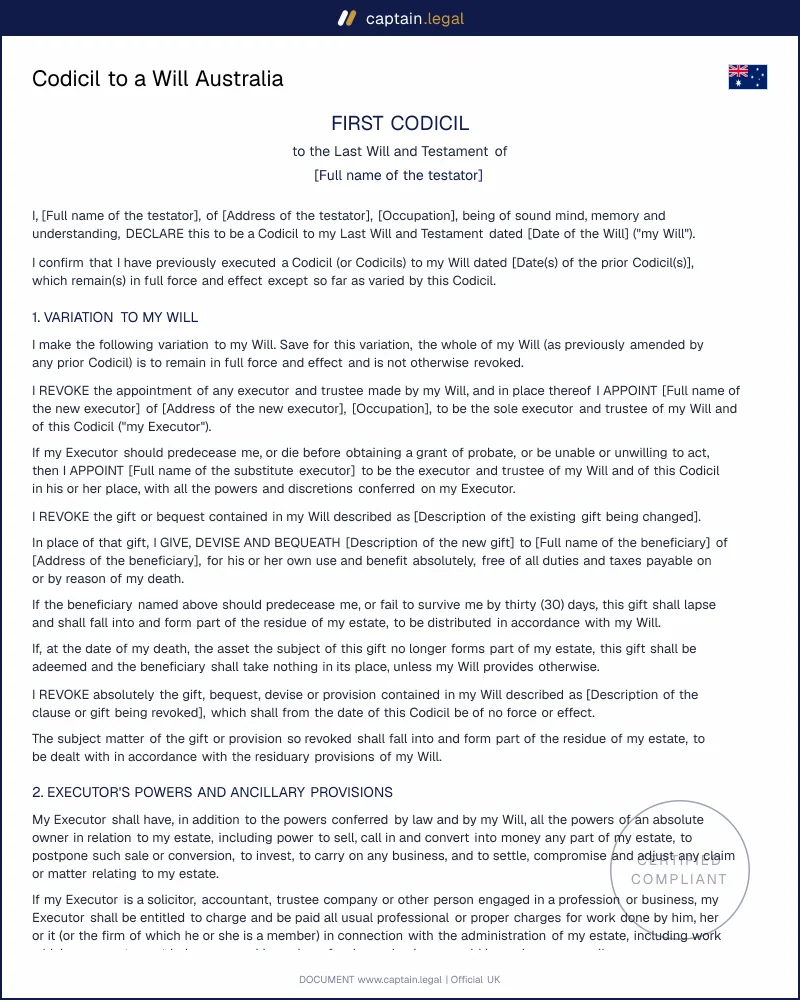
  • The identification of the original will opens the codicil by naming you as testator and referencing your existing will by its exact date of execution. This is what binds the two documents together as one testamentary instrument, and a codicil that fails to identify its parent will accurately can be read as ambiguous or ineffective.
  • The statement of confirmation expressly declares that, except for the changes set out below, you confirm and republish your original will in all other respects. This single clause prevents the common misreading that a codicil somehow displaces the whole will, and it fixes the will's operative date to the date of the codicil.
  • The operative amendment clauses are drafted to revoke, add, or vary the specific provisions you are changing, using clear cross-references to the clause numbers in the original will. Vague language such as "I change my executor" is replaced with a precise revocation of the named clause and a clean substitution.
  • The execution and attestation clause records that you signed the codicil in the presence of two witnesses who were present together, and that they signed in your presence. This is the clause that carries the Succession Act formalities, and its absence is the single most frequent reason a codicil is questioned in probate.
  • The witness details block captures each witness's full name, address, and occupation beneath their signature, which the probate registry relies on if an affidavit of due execution is later required to prove the document.
4

State and territory considerations

New South Wales operates under the Succession Act 2006 (NSW), which at section 6 sets out the standard execution requirements and at section 8 provides the court's dispensing power for informal documents. The Act's definition of "will" in section 3 expressly includes a codicil, so your codicil and will are construed as one. A beneficiary who acts as a witness will generally lose their gift under the interested-witness rule, so choose two independent adults.

Victoria applies the Wills Act 1997 (Vic). Execution is governed by section 7, and section 9 gives the Supreme Court its dispensing power over documents not executed in the required manner. Victoria stands apart on one point: under section 11 a gift to a witnessing beneficiary is not automatically void, unlike most other states. Victoria also permits a remote execution procedure under section 8A, requiring a special witness and completion on the same day within the state, which can be useful where signatories cannot be physically together.

Queensland relies on the Succession Act 1981 (Qld), which harmonises with the other states on the two-witness rule and treats a codicil as part of the will. As in New South Wales, a beneficiary-witness in Queensland forfeits the gift, so the safest course is always two disinterested witnesses who watch you sign and then sign themselves in your presence.

South Australia now sits under the Succession Act 2023 (SA), in force since 1 January 2025 and replacing the former Wills Act 1936 (SA). Its section 16 confirms that a completed will cannot be altered except by a document executed as a will, which is precisely why a codicil is required rather than handwritten changes. Do not assume an amendment made by striking through text will hold; South Australia, like every other jurisdiction, treats unwitnessed alterations as ineffective.

5

How to fill out this codicil

You start by identifying yourself as the testator and entering the exact date of the original will you are amending, which the template uses to link the two documents. From there you choose the type of change you are making, whether that is appointing a new executor, adding or removing a beneficiary, or revoking and replacing a specific gift, and the form adjusts the operative clause to match. You then enter the details of the change in plain terms, and the template drafts the revocation and substitution language for you, complete with cross-references back to the will.

Once the substance is set, the form builds the confirmation clause that republishes the rest of your will unchanged, then generates the attestation and witness block sized for two witnesses. It reminds you of the signing sequence that your state requires: you sign first, in front of both witnesses at the same time, and they then sign in front of you. You download the finished codicil in editable Word format for any last adjustments and as a print-ready PDF for signing. The document is written to be read together with your existing will, and if your changes turn out to be more extensive than a codicil comfortably allows, the full range of personal and estate documents includes a complete will you can use instead.

6

Common mistakes to avoid

The mistake that ruins more codicils than any other is defective witnessing. People sign the codicil alone and post it to a friend to sign later, or they let a beneficiary witness it, or only one witness is present. Any of these leaves the codicil vulnerable, and the fix is an expensive application to the Supreme Court under the dispensing power rather than a quick amendment. The second frequent error is failing to identify the original will properly, or drafting the amendment so loosely that it contradicts a clause elsewhere in the will, which forces the executor to guess your intention and can trigger a family dispute. If you have separate arrangements for who manages your affairs during life, keep those current too through our enduring power of attorney and guardianship documents, because a codicil deals only with your estate after death.

A quieter mistake is stacking too many codicils onto one will. A first codicil is fine; a third or fourth layered on top becomes a puzzle the executor has to reassemble, and each new codicil is a fresh chance for an inconsistency. Once you reach that point, a new will is cleaner and safer. People also forget that marriage or divorce can revoke or affect a will, so a codicil signed after a relationship change may be amending a document that no longer operates. And superannuation and life insurance often sit outside the will through binding nominations, so a codicil cannot redirect them no matter how carefully it is drafted. When a business is involved, coordinate your estate documents with your company and shareholder agreement templates so ownership succession lines up with your will.

Key takeaways

Purpose

Use a codicil for small changes

A codicil is a short document that sits with your existing will and changes only specific parts, like swapping an executor, adding or removing a beneficiary, or tweaking a particular gift. It does not replace the will; it modifies it. If you are making more than two or three changes, a fresh will is usually cleaner because it avoids multiple layers of documents that can conflict.

Execution

Sign and witness it like a will

A codicil has the same legal weight as the will it amends, so it must follow the same signing formalities. It needs to be in writing, signed by the testator, and that signature must be made or acknowledged in front of two witnesses who are present at the same time, and who then sign in the testator’s presence. If you get this wrong, the amendment can fail.

Risk

Keep it consistent and properly attached

A codicil should clearly identify the original will (including its date), say exactly which clauses are revoked or varied, and confirm the rest of the will stays unchanged. Loose drafting can create contradictions, and a codicil that gets separated from the will can cause confusion after death. Also, do not use beneficiaries as witnesses; in most states they lose the gift.

Frequently Asked Questions

Yes, provided it is executed correctly. A codicil has exactly the same legal force as the will it amends, because Australian succession legislation defines "will" to include a codicil. To be binding it must be in writing, signed by you, and witnessed by two independent adults who are present at the same time and who then sign in your presence, in line with provisions such as section 6 of the Succession Act 2006 (NSW) or section 7 of the Wills Act 1997 (Vic). If those formalities are met, the codicil and the will operate together as one testamentary instrument. If they are not met, the codicil is at risk of failing, and the court would have to be asked to save it under its dispensing power.

You can. Nothing in Australian law requires a codicil to be prepared by a solicitor, and a properly drafted template that follows the statutory formalities is legally valid. What matters is not who drafts it but whether it is executed correctly and whether the changes are expressed clearly enough to read consistently with the original will. The two areas where self-prepared documents fail are witnessing and ambiguity. Using a template with a compliant attestation clause and clear amendment wording addresses both, though genuinely complex estates involving trusts, businesses, or blended families are usually better served by professional advice.

Two. The rule is uniform across every Australian state and territory: your signature on the codicil must be made or acknowledged in front of two witnesses who are present at the same time, and both must then sign in your presence. The witnesses should be adults with mental capacity, and they must not be beneficiaries under the will or the codicil. In most states a beneficiary who witnesses forfeits their gift, with Victoria the limited exception under section 11 of the Wills Act 1997 (Vic). Choosing two entirely independent witnesses avoids the problem everywhere.

The codicil is available as an editable Word document and as a print-ready PDF. The Word file lets you make final adjustments to names, dates, or wording before you print, which is useful if your circumstances change slightly between drafting and signing. The PDF gives you a clean, correctly formatted version for execution. Australian succession law requires a codicil to be signed on paper in wet ink in front of witnesses, so you print the final document and sign the physical copy. Keep the signed codicil stored with your original will, since the two must be read together.

Very likely, yes. In every Australian jurisdiction, marriage revokes an existing will unless the will was made in contemplation of that marriage. If your will is revoked, any codicil amending it amends nothing, because there is no valid will left to change. After marrying you should review your estate plan and, in most cases, make a fresh will rather than a codicil. Divorce also affects a will in most states, typically revoking gifts to and appointments of a former spouse, so a relationship change is one of the strongest signals that your estate documents need revisiting.

A codicil amends specific clauses of an existing will and leaves the rest intact, while a new will revokes all previous wills and starts fresh. A codicil is efficient for a single, contained change such as swapping an executor. A new will is the better choice once you have several changes, because it produces one clean self-contained document with no risk of a codicil becoming separated or contradicting the original. As a rule of thumb, one or two simple amendments suit a codicil; anything more and a replacement will is safer and easier for your executor to administer.

4.7/5

21 verified reviews · 50 000+ downloads

Codicil Template Australia | Succession Act Compliant
  • Immediate access to the document
  • PDF + Word download
  • Compliant with 2026 legislation
  • Reviewed by lawyers
Fill in the template
Secure payment
Updated on July 20, 2026

You might also like

Last Will and Testament Australia
Advance Care Directive Australia