Create my document
Login

Choose country

AustraliaAustraliaChoose country
Family & Divorce

Parenting Plan Australia | s.63C Family Law Act

Section 63C compliant parenting plan reflecting the 6 May 2024 reforms. Time, parental responsibility and communication clauses. Word and PDF, ready to sign.
4.7/524 reviews50 000+ downloadsInstant download
Share

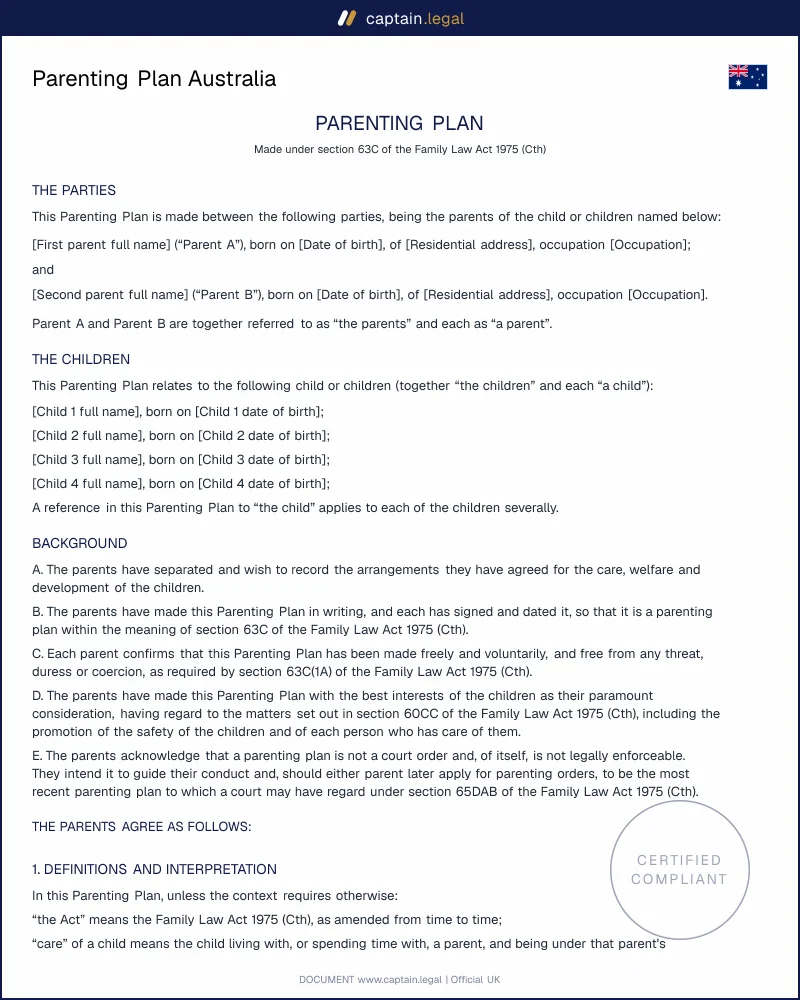
A parenting plan is a written, signed and dated agreement between separated parents that records who the children live with, how much time they spend with each parent, how decisions get made, and how the two households will communicate. Under section 63C of the Family Law Act 1975 (Cth), it is the recognised vehicle for parents to set out day-to-day arrangements without going to court, and it is almost always the sensible first step before any application for consent orders. This template is built for Australian families who have reached agreement, or are close to it, and want a document that reflects the reformed parenting framework that commenced on 6 May 2024, not a generic form pulled from an overseas site.

Separation rarely divides neatly along a calendar. Handovers, school pickups, Christmas, and the question of who gets the final say on a change of school all need to be written down while goodwill still exists. A parenting plan does exactly that, in language the Family Law Act recognises.

Compliant

2026 Legislation

50,000+ clients

trust us

Affordable

From $4.90 / doc

Secure payment

Instant download

Parenting Plan Australia | s.63C Family Law Act

Secure payment

Fill in the template

What is a parenting plan under Australian family law?

A parenting plan is defined in section 63C of the Family Law Act 1975 (Cth) as a written agreement, made free from threat, duress or coercion, that is signed and dated by the parents and deals with any aspect of the care, welfare or development of a child. It can cover who a child lives with, the time a child spends with each parent and with other significant people such as grandparents, how parental responsibility for major long-term issues is allocated, the communication a child has with each parent, and the process the parents will use to resolve disagreements or change the plan later. It can name almost anyone with an interest in the child's care, including a grandparent or other relative, not just the two parents.

The distinction people most often get wrong is the one between a parenting plan and parenting orders. A parenting plan is not legally enforceable in the way a court order is. If one parent stops following it, the other cannot ask the police or the court to enforce the plan itself. What a plan does carry is real legal weight of a different kind: a court will have regard to the most recent parenting plan when later making orders, and under section 64D a parenting order can be made subject to a subsequent plan. So it is far more than a private note. Families who want enforceability convert the agreed terms into consent orders, and a well-drafted parenting plan is the natural draft they file. If you are also sorting out property and finances, our separation agreement templates for Australian couples sit alongside this document in the same category.

2

When do you need this document?

The clearest trigger is a recent separation where both parents are still communicating and want to lock in a workable routine before memories and moods start to drift. Writing down the school-week pattern, the weekend rotation and the changeover point while you still agree is what stops the slow slide into a fortnightly argument. The second common scenario is the lead-up to consent orders: parents who intend to formalise their arrangement almost always draft a plan first, because it forces the detail out into the open and becomes the working document their lawyers or the court can adopt. The third is change. A plan written when the children were toddlers rarely survives the move to high school, a parent's relocation for work, a new partner joining a household, or a shift to weekend rosters. Updating the plan is cheaper and calmer than litigating a dispute that a stale document helped create.

There are also edge cases where the plan does heavy lifting. Where a grandparent or other relative provides significant care, section 63C lets the plan name them and record the time the child spends with them, which matters when a school or a doctor asks who is authorised. And where separation happens under one roof, or where one parent travels frequently, a plan that spells out communication methods and changeover logistics prevents the ambiguity that otherwise festers. Parents who are also employed and juggling shift work often pair this with our employment contract templates for Australian workplaces when negotiating a roster that fits the care schedule. If there is any history of family violence, do not treat a parenting plan as a substitute for legal advice, because safety considerations may make court orders the safer path.

3

Key clauses included in our template

  • The parties and children schedule records both parents' full names and contact details, the date of separation, and a repeatable list of each child with date of birth and current school. Getting the children correctly identified sounds trivial until a plan naming only "the children" collides with a blended family, so each child is listed explicitly.
  • The living and time arrangements clause sets out who the child lives with and the pattern of time spent with each parent, whether that is shared care, care primarily with one parent, or a split arrangement across siblings. It is drafted to reflect the post-2024 position that there is no presumed equal split, so you describe the arrangement that actually fits your family rather than defaulting to a fixed formula.
  • The allocation of parental responsibility clause addresses major long-term issues as defined in section 4(1), meaning education, health, religion, culture, name and significant changes to living arrangements. It lets you decide, issue by issue, whether decisions are made jointly or by one parent, and records the consultation process the parents will follow.
  • The holidays and special occasions clause covers the most disputed territory: Christmas, Easter, school holidays, birthdays, and cultural or religious observances. Vague wording here is where plans fall apart, so the template prompts specific alternating arrangements rather than an aspirational "we'll work it out".
  • The communication and changeover clause sets how the child communicates with the non-resident parent, how the parents communicate with each other, the changeover location and named collector, and a no-disparagement understanding. It also flags interstate notification and international travel, including passport arrangements under the Australian Passports Act 2005.
4

State and territory considerations

Parenting under the Family Law Act 1975 (Cth) is Commonwealth law and applies uniformly across the country, so the core framework does not change between jurisdictions. Where the states and territories matter is in the surrounding services, the courts you deal with, and the practical mechanics of changeover and safety.

New South Wales parents deal with the largest registry of the Federal Circuit and Family Court of Australia, and Sydney's family dispute resolution services carry significant waitlists, which is worth factoring into your section 60I timing. Where family violence is a concern, a NSW Apprehended Domestic Violence Order made under state law sits alongside the federal parenting framework, and your plan's changeover arrangements should be drafted so they do not put either parent in breach of an existing order.

Victoria operates a well-developed network of Family Relationship Centres and the Victorian Family Violence Intervention Order regime under the Family Violence Protection Act 2008 (Vic). Melbourne parents frequently use supervised or neutral-location changeovers arranged through community contact services, and naming that service in the plan removes a recurring flashpoint. Victoria's cultural diversity also makes the section 60CC focus on cultural needs a live drafting consideration rather than a formality.

Queensland covers vast distances, and relocation between regional centres and the south-east corner is a common source of dispute. A Brisbane or Townsville plan should be explicit about travel arrangements, who bears the cost and logistics of long-distance changeover, and how school-holiday flights are booked. Queensland's Domestic Violence Order framework under the Domestic and Family Violence Protection Act 2012 (Qld) again interacts with changeover clauses and should be checked before finalising.

Western Australia is the outlier every Australian parent should know about. Family law for children of unmarried and de facto parents is governed not by the Commonwealth Act but by the Family Court Act 1997 (WA), administered by the separate Family Court of Western Australia. The concepts are closely aligned and WA adopted parallel best-interests reforms, but the section numbers and the court differ, so a Perth parent should confirm the WA-specific pathway before assuming the federal provisions apply directly.

5

How to fill out this parenting plan

You begin by entering both parents' details and the date of separation, then adding each child in turn with their date of birth and current school, which the form repeats as a clean schedule. From there you describe the living and time arrangements in plain language, choosing the pattern that reflects your family rather than a preset split, and the template guides you toward the level of specificity that prevents later argument. You then work through parental responsibility issue by issue, deciding for education, health, religion and the other major long-term issues whether the decision is joint or sits with one parent, and recording how you will consult. The holidays section walks you through Christmas, Easter, school breaks and birthdays so nothing is left to a future disagreement, and the communication section captures changeover location, the named collector and how the child keeps contact with each parent. The final step is the part people skip at their peril: both parents must sign and date the plan for it to meet the section 63C definition. If you intend to seek enforceability, you carry the finished plan across into our consent order and family law document templates, and if you are drafting a will to reflect your new circumstances, our personal legal document templates for Australians cover that alongside powers of attorney.

6

Common mistakes to avoid

The most damaging mistake is treating a parenting plan as though it were a court order and assuming it can be enforced the same way. It cannot, and a parent who relies on that assumption discovers the gap at the worst possible moment. If enforceability matters, the plan needs to become consent orders, and the plan should be drafted from the outset with that conversion in mind. The second frequent error is writing the plan around an assumed equal-time default that the law abandoned on 6 May 2024. Since the repeal of the presumption of equal shared parental responsibility, a plan that reads like a mechanical 50/50 split, without reference to the child's actual needs, sits awkwardly against the reformed section 60CC framework and is more likely to unravel.

Vagueness is the quiet killer. A holiday clause that says the parents "will share Christmas fairly" guarantees a fight every December, whereas a clause that alternates specific years removes it. Parents also routinely forget that a plan cannot bind third parties: a school, a bank, or Centrelink is not obliged to follow a private agreement, so anything requiring institutional action needs its own process. Finally, never draft or sign a plan under pressure, because section 63C requires the agreement to be made free from threat, duress or coercion, and a plan produced in a coercive dynamic is both legally fragile and, where family violence is present, potentially unsafe.

Key takeaways

s 63C

A parenting plan must be signed and dated

Under s 63C of the Family Law Act 1975 (Cth), a parenting plan is a written agreement made free from threat, duress or coercion, and it must be signed and dated. It can cover living arrangements, time with each parent and other significant people, decision-making for major long-term issues, communication, and how you will resolve disputes or vary the plan later.

Enforceability

Not a court order, but still matters

A parenting plan is not enforceable like parenting orders, so you cannot rely on police or the court to enforce the plan itself if it is breached. That said, it carries legal weight: a court must have regard to the most recent parenting plan when making later orders, and under s 64D a parenting order can be made subject to a subsequent plan.

6 May 2024

No default 50/50 after the reforms

The parenting law changes that commenced on 6 May 2024 removed the old presumption of equal shared parental responsibility (formerly s 61DA). Do not draft your plan around an assumed equal time split. The focus is what works for your child, with the child’s best interests paramount under s 60CA and the reformed s 60CC factors, led by safety.

Frequently Asked Questions

A parenting plan is a legally recognised document under section 63C of the Family Law Act 1975 (Cth), but it is not legally enforceable in the way a court order is. If one parent stops following it, you cannot ask a court to enforce the plan itself. What it does carry is significant legal weight: a court must have regard to your most recent parenting plan when later deciding parenting orders, and under section 64D an existing order can be varied by a subsequent plan. Parents who want the arrangement to be enforceable convert the agreed terms into consent orders filed with the Federal Circuit and Family Court of Australia, using the parenting plan as the working draft.

A parenting plan is a signed private agreement between parents, flexible and easy to change by a further written agreement. Consent orders are the same kind of arrangement approved and made by a court, which makes them enforceable and gives them the force of any other court order. In practice most families draft a parenting plan first because it forces the detail out, then apply for consent orders if they want enforceability. The trade-off is flexibility versus enforceability: a plan you can update over coffee, an order you change only by returning to court. Many parents keep a plan for low-stakes logistics and reserve orders for the arrangements they most need protected.

You do not need family dispute resolution to make a parenting plan itself, since a plan is simply a written agreement you and the other parent sign. Family dispute resolution becomes relevant if agreement breaks down and you want to apply to court. Under section 60I of the Family Law Act 1975 (Cth), most parenting applications require a certificate from an accredited practitioner showing a genuine effort to resolve the dispute, unless an exception such as family violence or urgency applies. In reality, a parenting plan is very often the productive result of a family dispute resolution session, so the two work together rather than in sequence.

Yes. One of the practical strengths of a parenting plan is that it can be varied or revoked by a further written agreement, as section 63D contemplates. Both parents simply agree the new terms, sign and date them, and the revised plan becomes the current one. This flexibility is why plans suit changing circumstances: a new school, a relocation, a shift roster, or a child growing into different needs. The point to remember is that the most recent signed plan is the one a court will look to, so keep the paperwork current rather than relying on an informal understanding that quietly departed from the written version months ago.

The template downloads in both Word and PDF formats. The Word version is the one most parents work from, because a parenting plan is meant to be tailored to your family and edited as you negotiate the time arrangements, holidays and communication clauses. Once both parents are satisfied, you finalise it, print it, and both sign and date it, which is what section 63C requires for a valid plan. The PDF version is useful for a clean, signed copy to keep and to share with anyone who needs sight of the arrangements, such as a school or a family dispute resolution practitioner. You can edit the Word file as many times as you need before signing.

There is no fixed answer, and that is deliberate. Since the Family Law Amendment Act 2023 (Cth) repealed the presumption of equal shared parental responsibility on 6 May 2024, the law does not start from an assumed equal split. The time each parent spends with the child is whatever the parents agree serves the child's best interests under the six factors in section 60CC, with the child's safety as the leading consideration. That might be a near-equal week-about roster, a fortnightly weekend pattern, or care primarily with one parent, depending on the children's ages, schooling, and each household's circumstances. The plan should describe the arrangement your family actually needs, not a formula.

School holidays are the single most disputed area, so the plan should be specific rather than aspirational. Set out how the major periods are divided: Christmas and the summer break, Easter, and each term break, ideally on an alternating-year basis so the pattern is automatic and never needs renegotiating. Address birthdays, both the child's and each parent's, and any cultural or religious observances that matter to your family, which connects to the section 60CC focus on the child's cultural needs. Include how and when holiday plans are confirmed and how any interstate or overseas travel is handled, including passports under the Australian Passports Act 2005. Precision here removes the recurring December argument that vague wording guarantees.

4.7/5

24 verified reviews · 50 000+ downloads

Parenting Plan Australia | s.63C Family Law Act
  • Immediate access to the document
  • PDF + Word download
  • Compliant with 2026 legislation
  • Reviewed by lawyers
Fill in the template
Secure payment
Updated on July 18, 2026

You might also like

Post-Nuptial Financial Agreement
Limited Child Support Agreement