Create my document
Login

Choose country

AustraliaAustraliaChoose country
Employment

Flexible Work Arrangement Agreement | s.65 Fair Work Act

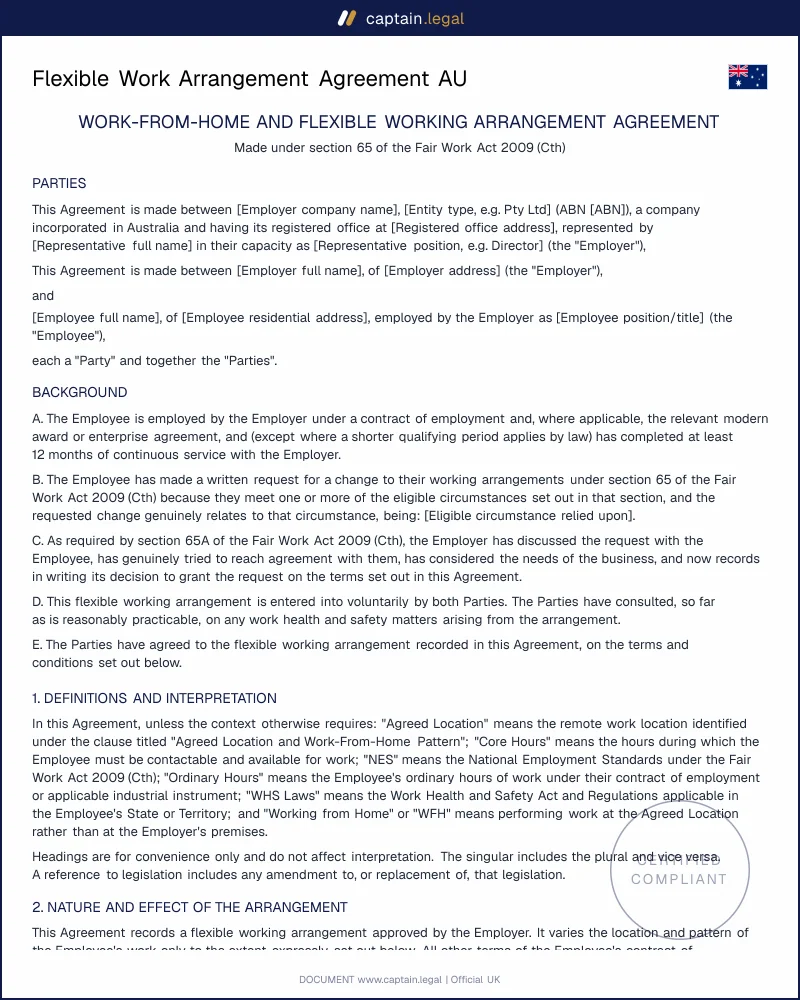
Flexible work arrangement agreement built to s.65 Fair Work Act 2009: 21-day response, reasonable business grounds, WHS duties. Word and PDF.
4.8/518 reviews50 000+ downloadsInstant download
Share

A Work-From-Home and Flexible Work Arrangement Agreement records the terms on which an employee works remotely or on a modified schedule, and it is the natural output of a valid flexible working request made under section 65 of the Fair Work Act 2009 (Cth). It is used by employers responding to a formal request, by HR teams standardising hybrid work across a team, and by employees who want their arrangement written down rather than left as a verbal "we'll see how it goes". A good agreement fixes the working hours, the days on site versus at home, availability windows, data security expectations, and who supplies and insures the equipment.

The document sits at the intersection of two obligations most workplaces underestimate: the Fair Work process for requesting and granting flexibility, and the work health and safety duty that follows the employee into their spare room. This template handles both, in plain English, ready to sign.

Compliant

2026 Legislation

50,000+ clients

trust us

Affordable

From $4.90 / doc

Secure payment

Instant download

Flexible Work Arrangement Agreement | s.65 Fair Work Act

Secure payment

Fill in the template

What is a work-from-home and flexible work arrangement agreement?

A flexible work arrangement agreement is a written variation to an employee's ordinary terms that changes where, when, or how they work without ending the underlying employment relationship. In Australian practice it usually documents one of three things: a remote or hybrid working pattern, a change to start and finish times, or a shift in the pattern of hours such as compressed weeks or reduced days. The base contract stays on foot; the agreement simply overlays the agreed variation and records the conditions attached to it.

It helps to separate two ideas that often get merged. A section 65 request is the statutory mechanism an eligible employee uses to ask for change, and it carries specific rights and timeframes. The arrangement agreement is the document that captures the outcome once the employer says yes, whether the trigger was a formal request or an ordinary business decision to offer hybrid work. Not every flexible arrangement flows from a section 65 request, and an employer who offers remote work voluntarily still needs it in writing to control safety, hours, and equipment. This is different from an Individual Flexibility Arrangement under a modern award, which varies award terms and has its own better-off-overall test. If your goal is to lock down a remote or hybrid pattern and the duties attached to it, the arrangement agreement is the correct instrument, and it pairs naturally with a properly drafted Australian employment contract built to the Fair Work Act.

2

When do you need this document?

The most common trigger is a formal section 65 request landing in a manager's inbox, usually from a returning parent who wants school-run hours or two days at home. Once that request is valid, the employer is on a 21-day clock and needs the arrangement documented cleanly if it says yes. The second scenario is proactive: a business rolling out hybrid work across a team wants every person on the same written terms rather than a patchwork of email promises. Standardising the arrangement here prevents the drift where one employee "always works Fridays at home" because nobody wrote down that it was a trial.

A third situation is the mid-employment variation, moving someone from full office attendance to a split week, or compressing five days into four. Document the change or you will argue about it later, because payroll, availability, and performance expectations all shift with the pattern. Flexibility tied to family or domestic violence is a distinct and sensitive category added in 2023, and it deserves a discreet, respectful arrangement rather than an ad hoc conversation. One edge case worth flagging: an employee under 12 months' service, or whose reason falls outside the listed circumstances, cannot compel a section 65 outcome, as the Commission confirmed in Quirke v BSR Australia where an unsupported anxiety claim failed the eligibility test. That does not stop an employer offering flexibility voluntarily, and the agreement works equally well for those discretionary arrangements. Businesses reviewing broader terms often pair this with their suite of Australian employment templates to keep the whole file consistent.

3

Key clauses included in our template

  • The arrangement type and pattern clause states plainly whether the arrangement is remote, hybrid, or a change to hours, and sets the specific days, locations, and start and finish times. Vagueness here is where disputes breed, so the clause pins the pattern down and flags whether it is a trial or ongoing.
  • The availability and core hours clause defines when the employee must be contactable and responsive, which matters most for remote roles where "online" is not the same as "at a desk". It also addresses the right to disconnect now in the Fair Work Act, so contact expectations stay lawful outside agreed hours.
  • The work health and safety clause records the employee's home workspace self-assessment and the shared duty to keep it safe, because the WHS legislation treats the home as a workplace. It obliges the employee to report hazards and injuries as they would on site, closing a gap that catches many employers off guard.
  • The equipment, expenses and security clause sets out who supplies laptops and furniture, who insures them, and how confidential data and customer information must be handled off site. It ties into the business's obligations under the Privacy Act 1988, and links naturally to a standalone confidentiality and non-disclosure agreement for Australian businesses where sensitive material is involved.
  • The review, variation and termination clause explains how either party revisits the arrangement, what notice applies, and the circumstances in which work reverts to the default location. This keeps a trial genuinely reversible without threatening the underlying employment.
4

Regional considerations

While the Fair Work Act operates nationally, the work health and safety obligations attached to a home office are set by state and territory statutes, and this is where the agreement must flex. In New South Wales, Queensland, and most other jurisdictions the harmonised Work Health and Safety Act 2011 applies, imposing a primary duty of care that follows the worker into the home; the model laws make the employer responsible for a safe system of work even when they cannot physically inspect the room. Victoria sits outside the harmonised scheme under its Occupational Health and Safety Act 2004, so a Victorian employer relies on self-assessment checklists and reporting duties rather than the model WHS wording, though the substance of the duty is comparable.

Workers compensation is the sharper edge. An injury sustained while genuinely performing work at home is generally compensable, and the relevant scheme differs by state, icare in New South Wales, WorkSafe in Victoria, WorkCover in Queensland, so the agreement should require prompt injury reporting regardless of location. Do not assume a home injury sits outside the scheme, because the test is whether the worker was engaged in employment, not where the desk happened to be. Long service leave, payroll tax thresholds, and public holiday entitlements are also set at state level and continue to accrue on the substantive contract, unaffected by the flexible pattern. Employers who engage staff across multiple states should keep each arrangement mapped to the employee's usual place of work, and align the file with the applicable state-aware employment documents on Captain.Legal rather than assuming one template covers every jurisdiction identically.

5

How to fill out this flexible work arrangement agreement

You start by identifying the employer and the employee and confirming the underlying contract that the arrangement varies, so the agreement clearly overlays rather than replaces it. From there you select the arrangement type, remote, hybrid, or a change to hours, and the form adjusts the clauses to suit, prompting you for the specific days on site, the days at home, and the agreed start and finish times. Next you set the availability window and confirm whether the arrangement is a defined trial or ongoing, which controls how the review clause reads.

The form then walks you through the safety and equipment questions, capturing the home workspace self-assessment, who supplies and insures the equipment, and how confidential data is protected off site. You record whether the arrangement responds to a section 65 request or is offered voluntarily, since that affects the review and refusal wording. Finally you generate the document in editable Word and print-ready PDF, ready for both parties to sign and date. The whole path is designed so a manager responding to a request inside the 21-day window can produce a compliant agreement without drafting from scratch.

6

Common mistakes to avoid

The error that costs employers most is treating a valid section 65 request casually, missing the 21-day response window or refusing without first discussing the request and genuinely trying to reach agreement. Since June 2023 that failure is no longer a paperwork slip, it exposes the business to a Fair Work Commission dispute and a possible order to grant the very arrangement it refused, exactly what happened in Chandler v Westpac. A close second is refusing on grounds that sound like reasons but are not evidence, a manager's general discomfort with remote work will not satisfy the reasonable business grounds test, which the Commission scrutinises against the actual operational impact.

On the drafting side, the most frequent trap is silence on work health and safety. Employers assume the home is the employee's problem, but the WHS duty follows the work, and an unassessed home office is a live liability. Leaving equipment, insurance, and data security undefined causes the next round of disputes, especially when a laptop is damaged or confidential files leak from an unsecured home network. Two further mistakes recur: writing an arrangement with no review or reversion mechanism, which turns a trial into a permanent entitlement by default, and confusing this agreement with an Individual Flexibility Arrangement under an award, which serves a different purpose and carries its own better-off-overall test. Getting the instrument right from the start avoids all of it.

Key takeaways

FAIR WORK

Section 65 triggers a strict process

A flexible work request under s.65 of the Fair Work Act 2009 (Cth) is not a casual chat. Eligibility matters: generally 12 months continuous service for permanent employees, or 12 months regular and systematic work for eligible casuals, plus a qualifying circumstance (for example, caring responsibilities, disability, age 55+, pregnancy, or family and domestic violence). The agreement is the written record of the outcome.

21 DAYS

You must respond in writing fast

Since the 6 June 2023 changes, the employer must respond in writing within 21 days. Before refusing, the employer has to discuss the request and genuinely try to reach agreement, then any refusal must be on reasonable business grounds and explain those grounds. Leaving it as “we’ll see how it goes” creates compliance and dispute risk.

WHS + CONTROL

Remote work still needs clear rules

Working from home does not switch off workplace duties. The arrangement should spell out hours, on-site versus at-home days, availability windows, data security expectations, and who provides and insures equipment. This helps manage work health and safety obligations that follow the employee into their home workspace, and it prevents scope creep where flexible work turns into always-on availability.

Frequently Asked Questions

Yes. Once both parties sign, the agreement is a binding variation to the employee's terms and is enforceable like any other contractual variation, provided it does not undercut the National Employment Standards or an applicable modern award. It does not override the Fair Work Act 2009 (Cth); it operates alongside it. Where the arrangement responds to a section 65 request, the agreement also evidences that the employer met its statutory obligation to respond and reach agreement. The template is drafted to sit consistently with the underlying employment contract, so the two documents work together rather than contradicting each other. Signing and dating both copies is what makes the variation stick.

An employer must give a written response within 21 days of receiving a valid request under section 65. Within that window the employer must either grant the request, grant it with agreed modifications, or refuse it on reasonable business grounds, and a refusal is only lawful if the employer first discussed the request with the employee and genuinely tried to reach agreement. A refusal must state the grounds and set out any alternative arrangement the employer is willing to offer. Missing the 21-day deadline is itself a breach and can send the matter to the Fair Work Commission, so the response should be prepared promptly and documented carefully.

Eligibility under section 65 requires two things at once. First, a permanent employee needs at least 12 months of continuous service immediately before the request, while a regular casual qualifies after 12 months of systematic engagement with a reasonable expectation of continuing work. Second, the employee must fall within a listed circumstance: being a parent or carer of a school-age or younger child, a carer under the Carer Recognition Act 2010, a person with disability, aged 55 or over, pregnant, or experiencing family or domestic violence. An employee who meets neither limb cannot compel a statutory outcome, though an employer remains free to offer flexibility voluntarily and document it with this same agreement.

Yes. The agreement generates in both editable Word and print-ready PDF formats. The Word version lets you adjust the pattern, availability window, and equipment terms to fit the specific role before signing, while the PDF gives you a clean, locked copy for the employee file. Most employers keep the signed PDF on record and retain the Word version for the next time the arrangement is reviewed or varied. Having both means you can tailor quickly and still produce a professional signed document without reformatting.

No, the duty stays the same, and that surprises many employers. Under the harmonised Work Health and Safety Act 2011, and Victoria's Occupational Health and Safety Act 2004, the employee's home becomes a workplace once work is performed there, so the employer's primary duty of care follows the worker in. The practical answer is a home workspace self-assessment plus clear reporting duties for hazards and injuries, both built into this agreement. An injury sustained while genuinely working at home is generally compensable under the relevant state workers compensation scheme, so treating the home office as outside the system is a costly assumption.

The Fair Work Act sets out what counts, and general reluctance is not on the list. Legitimate grounds include arrangements that would be too costly, that cannot be accommodated without impractical changes to other employees' work, that would produce a significant loss of efficiency or productivity, or that would significantly harm customer service. The employer must be able to point to evidence, not assumptions, and the Fair Work Commission will test the stated grounds against the real operational impact. A refusal that reads as a manager's preference rather than a business necessity is the pattern that loses at arbitration, so the grounds must be specific and genuinely held.

Yes, and a well-drafted agreement plans for exactly that. The review and variation clause lets either party revisit the arrangement, sets the notice that applies, and defines when work reverts to the default location or hours. Running an arrangement as a defined trial is a sensible approach, because it keeps the change genuinely reversible without threatening the underlying employment. If circumstances shift, the parties vary the agreement in writing rather than reverting by silence, which is where entitlement disputes usually start. Building the review mechanism in from day one is what keeps flexibility flexible for both sides.

4.8/5

18 verified reviews · 50 000+ downloads

Flexible Work Arrangement Agreement | s.65 Fair Work Act
  • Immediate access to the document
  • PDF + Word download
  • Compliant with 2026 legislation
  • Reviewed by lawyers
Fill in the template
Secure payment
Updated on July 22, 2026

You might also like

Casual Employment Contract Australia
Employment Contract Australia