Create my document
Login

Choose country

AustraliaAustraliaChoose country
Employment

Employee Offer Letter Australia | s.125 Fair Work Act

Offer letter and onboarding pack built to s.125 Fair Work Act 2009, with compliant Fair Work Information Statement acknowledgement of receipt.
4.8/517 reviews50 000+ downloadsInstant download
Share

An offer letter is the document that turns "we'd love to have you" into a binding written commitment, setting out the role, the pay, and the conditions the candidate is accepting before their first day. In Australia, a well-drafted employee offer letter does more than confirm a start date. It locks in the terms you actually agreed, records whether a modern award applies, and pairs with the onboarding paperwork every employer is legally required to hand over. This page covers the offer letter and onboarding pack sold on Captain.Legal, including the acknowledgement of receipt for the Fair Work Information Statement, so your new hire starts on paper that holds up if anything is ever disputed.

Compliant

2026 Legislation

50,000+ clients

trust us

Affordable

From $4.90 / doc

Secure payment

Instant download

Employee Offer Letter Australia | s.125 Fair Work Act

Secure payment

Fill in the template

What is an employee offer letter and onboarding pack?

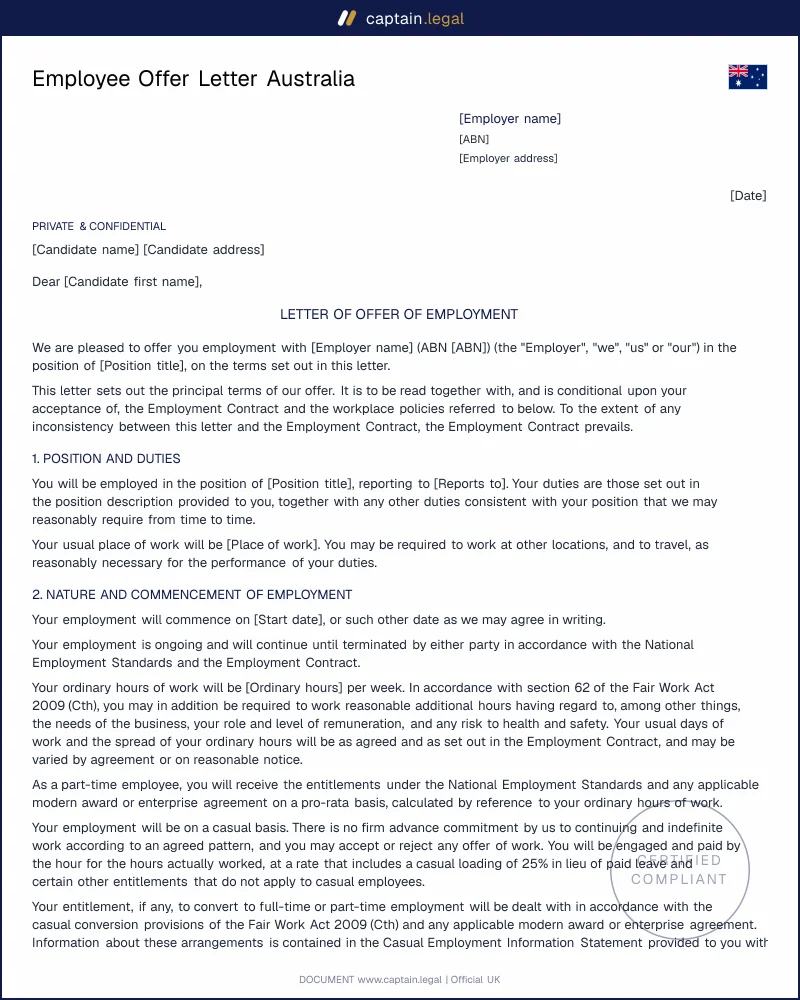
An employee offer letter is a written offer of employment that a candidate accepts by signing or replying in the affirmative. It names the position, the reporting line, the classification, the remuneration, the hours, the start date, and any conditions the offer depends on, such as satisfactory reference checks, evidence of right to work, or a qualification. Once accepted, it forms the core of the employment contract, or sits alongside a fuller contract that the letter cross-refers to.

The onboarding pack is everything the letter needs to travel with. In Australia the most important item is the Fair Work Information Statement (FWIS), which every employer must give to a new employee, and the signed acknowledgement that confirms the employee received it. People conflate the offer letter with the employment contract, and while the two overlap, they are not identical. A letter can be a short, standalone offer with the detailed terms attached separately, or it can be the contract itself when the letter contains all the essential terms. What matters is that the terms are captured in writing before the first shift, because verbal offers and informal emails are where most later arguments begin. If you also need the underlying agreement, our Australian employment contract template covers the full set of clauses the National Employment Standards expect.

2

When do you need this document?

The obvious moment is a straightforward permanent hire, where you want the terms confirmed and the FWIS handed over before day one rather than sorted out later. A great candidate with a competing offer usually wants something in writing quickly, and a clean offer letter lets you move at that speed without giving up precision on pay, hours, and award coverage. The onboarding pack rides along so induction is done properly the first time instead of chased up weeks into the job.

It also covers the conditional offer, which is more common than people assume. If the role depends on a Working with Children Check, a police check, a licence, or confirmation of right to work, the letter should make the offer contingent on those checks and say what happens if they do not clear. Spelling that out protects you if you need to withdraw before the person starts. Fixed-term and casual engagements are another trigger, because each brings its own information statement on top of the FWIS, and the acknowledgement pack keeps all of them in one signed record. A quieter edge case worth flagging is the rehire: because section 125 only requires the FWIS once in any twelve months, re-engaging a former employee within that window does not reset the obligation, though giving a fresh copy anyway is harmless and often sensible. Where the offer sits inside a broader confidentiality-sensitive role, you may also want to attach terms from our confidentiality and NDA template for Australian businesses.

3

Key clauses included in our template

  • The position and reporting details name the role title, the manager or reporting line, and the primary location or work arrangement. This anchors the duties and gives you a reference point if you later need to adjust the role, because a vague "general duties" offer invites arguments about what the job actually was.
  • The classification and award coverage states whether a modern award or enterprise agreement applies and, if so, the classification level, or records clearly why the role is award-free. This is the single most protective clause in the pack, since underpayment claims almost always trace back to a letter that mentioned a salary and nothing about the instrument setting the floor.
  • The remuneration and hours set out the base pay, the pay cycle, ordinary hours, and how additional hours or overtime are treated. Where a salary is intended to absorb award entitlements, the wording flags the set-off so the arrangement is transparent rather than assumed.
  • The conditions of the offer list any checks the offer depends on, such as right to work, references, or a licence, and state that the offer may be withdrawn if a condition is not met before commencement. This is what lets you rescind cleanly when a check comes back badly.
  • The probation and notice terms record the probation period and the notice each side must give, aligned to the NES minimums so the clause is enforceable rather than aspirational.
  • The Fair Work Information Statement acknowledgement confirms in writing that the employee received the current FWIS, and where relevant the CEIS or FTCIS, on or before the day they started. Keep the signed copy on file, because it is your evidence of compliance with section 125.
4

State and territory considerations

Employment in Australia runs largely on the national system, so the Fair Work Act 2009 and the NES apply across every state and territory for national-system employers, which is the overwhelming majority of private-sector businesses. That national coverage is why the offer letter and FWIS obligation look the same whether you hire in New South Wales, Victoria, or Queensland. The differences that matter sit outside the Act, in the checks and secondary obligations your onboarding pack should reference.

Work health and safety is the clearest example, since the model WHS laws are enacted separately in most jurisdictions while Victoria runs its own Occupational Health and Safety Act 2004. A thorough onboarding pack points the new employee to your safety induction regardless of where they sit. Working with Children Checks are also state-based, with different names and processes in each jurisdiction, so a conditional offer for a role involving children needs to reference the correct local check rather than a generic one. Long service leave is another genuinely local entitlement, governed by each state's own statute with its own qualifying periods, and while it rarely bites at the offer stage it is worth being accurate about in the terms you attach. For the small number of non-national-system employees, usually in specific public-sector or unincorporated contexts, state industrial systems can apply instead, and those roles need tailored advice before you rely on a standard offer. If you are also setting up the business behind these hires, our company constitution template under s.136 of the Corporations Act sits in the same workflow.

5

How to fill out this offer letter and onboarding pack

You start by choosing whether the letter is a standalone offer with a separate contract to follow, or a self-contained offer that carries all the essential terms itself. From there the form asks for the employer and employee details, the position title, and the reporting line, then moves to the substance: classification and award coverage, base pay and pay cycle, ordinary hours, start date, and probation. When you reach the conditions section you tick the checks the offer depends on, and the wording adjusts so the offer is expressed as conditional on those items clearing.

The onboarding side is guided so nothing is missed. You confirm the employment type, and the pack surfaces the right information statements, the FWIS for everyone, the CEIS for casuals, and the FTCIS for fixed-term roles, with an acknowledgement of receipt tailored to match. Once the fields are complete you download in editable Word to make any final adjustments, then export a clean PDF to send for signature. The acknowledgement page is designed to be signed and kept, which is what turns your compliance with section 125 from a claim into a record. If you later need to end the relationship, the same care applies to our termination letter pack built to s.119 of the Fair Work Act.

6

Common mistakes to avoid

The most expensive mistake is treating the offer letter as a formality and leaving award coverage out of it. An offer that quotes a salary and says nothing about the applicable modern award is the classic starting point for an underpayment claim, because the employee's actual entitlements are set by the instrument you never named, not by the round number you did. The fix is dull but decisive: state the award and level, or state plainly and correctly that the role is award-free, and deal with how a salary absorbs entitlements rather than hoping the figure covers everything.

The second cluster of errors is procedural. Employers forget that the Fair Work Information Statement must go out on or before day one under section 125, then scramble to backfill it weeks later, and casual and fixed-term hires slip through without their extra statements entirely. Making an offer unconditional when it should have hinged on a right-to-work or licence check is another trap, because it leaves you exposed if you then have to withdraw. People also let the offer expire into ambiguity by never setting a deadline for acceptance, or accept a verbal "yes" and start the person before anything is signed. Each of these is avoidable with a letter that states conditions, sets an acceptance date, and travels with the acknowledgement pack already attached.

Key takeaways

Offer terms

Get the deal in writing early

An employee offer letter turns a verbal “yes” into a binding written commitment once the candidate accepts. It should capture the essentials before the first shift: role, reporting line, classification, pay, hours, start date, and any conditions (for example right to work evidence or reference checks). Informal emails and verbal promises are where disputes usually start, so pin the agreed terms down clearly.

FWIS duty

Give the FWIS on time

Under s.125 of the Fair Work Act 2009 (Cth), you must provide each new employee with the current Fair Work Information Statement before they start, or as soon as practicable afterwards. You generally only need to give it once in any 12 months to the same employee, but the timing still matters. Keep a signed acknowledgement of receipt in the onboarding pack.

Minimums

NES and awards override your letter

Your offer letter cannot undercut the National Employment Standards or any applicable modern award or enterprise agreement. If the letter promises less than NES minimums (such as annual leave or notice), it is unenforceable to that extent. Where an award applies, its classification levels, minimum rates, allowances and penalty rates can fill gaps above your wording, so identify the award and level rather than relying on a bare salary figure.

Frequently Asked Questions

Once the employee accepts a written offer that contains the essential terms, it forms a binding contract of employment, so the letter is legally effective as soon as it is signed or accepted in writing. The template is drafted to sit within the Fair Work Act 2009 and the National Employment Standards, meaning its terms add to rather than undercut the statutory minimums. The acknowledgement page is not a contract in itself; it is evidence that you met your section 125 obligation to provide the Fair Work Information Statement. For a role that needs a fuller agreement, the letter can cross-refer to a separate employment contract carrying the detailed clauses.

Yes. Under section 125 of the Fair Work Act 2009, an employer must give each new employee the current Fair Work Information Statement before they start, or as soon as practicable afterwards, and this applies regardless of whether they are full-time, part-time, or casual. The one limit is that you need not provide it more than once in any twelve-month period to the same employee. Casual hires must also receive the Casual Employment Information Statement, and fixed-term hires the Fixed Term Contract Information Statement. Missing the FWIS is a breach of the NES that can attract penalties, so the signed acknowledgement in this pack is your proof of compliance.

You receive the offer letter and onboarding pack in editable Microsoft Word so you can adjust names, pay, hours, and conditions to fit the specific hire, and as a print-ready PDF for a clean copy to send for signature. Most employers keep the Word version for future roles and file the signed PDF, including the FWIS acknowledgement page, in the employee's record. Both formats download immediately after you complete the form.

There is no fixed statutory deadline for the offer letter itself, but the practical answer is as early as possible, ideally once you have decided and before the candidate accepts anything verbally. The hard deadline attaches to the Fair Work Information Statement, which section 125 requires on or before the first day of employment. A sensible sequence is to send the conditional offer, let the checks clear, confirm acceptance in writing, then hand over the FWIS and acknowledgement on or before commencement so every obligation is met in one clean run.

You can, but how cleanly depends on how the letter was written. If the offer was expressed as conditional on checks such as right to work, references, or a licence, and a condition does not clear, you can withdraw on that basis without much difficulty. If the offer was unconditional and the candidate has accepted, withdrawing becomes a potential breach of contract, and if they have already resigned from another job in reliance on it, the exposure grows. This is exactly why the template lets you make the offer conditional and set out what happens if a condition is not satisfied before the start date.

Yes, and this is where employers most often fall short. Every new employee gets the Fair Work Information Statement, but a casual must also receive the Casual Employment Information Statement, which explains casual conversion and the pathway to permanent employment, and a fixed-term employee must receive the Fixed Term Contract Information Statement. The onboarding pack surfaces the right combination based on the employment type you select, and the acknowledgement is worded to cover whichever statements apply, so you are not left proving you handed over one document while forgetting another.

The Act does not strictly require a signed acknowledgement, but keeping one is the sensible way to prove you complied with section 125. If the Fair Work Ombudsman ever queries whether the Fair Work Information Statement was provided, a signed and dated acknowledgement settles the question immediately, whereas an unrecorded "we emailed it at some point" is far weaker. The pack includes an acknowledgement page designed to be signed on or before the first day and filed with the rest of the employee's onboarding paperwork.

4.8/5

17 verified reviews · 50 000+ downloads

Employee Offer Letter Australia | s.125 Fair Work Act
  • Immediate access to the document
  • PDF + Word download
  • Compliant with 2026 legislation
  • Reviewed by lawyers
Fill in the template
Secure payment
Updated on July 22, 2026

You might also like

Fixed-Term Employment Contract AU
Termination Letter Template Australia