Create my document
Login

Choose country

AustraliaAustraliaChoose country
Real Estate

Lease Renewal Agreement | Residential Tenancies Acts

Continue a tenancy under the Residential Tenancies Act of your state. Respects the 12-month rent cap and notice rules. Compliant Word and PDF template.
4.8/528 reviews50 000+ downloadsInstant download
Share

A Residential Lease Renewal and Extension Agreement lets a landlord and tenant carry an existing tenancy forward without drafting a fresh contract from scratch. It records the new term, any adjustment to the rent, and confirms that every other clause in the original residential tenancy agreement stays on foot. For self-managing landlords and long-term renters across Australia, it is the cleanest way to keep a working arrangement going when a fixed term is about to expire.

The document sits between two poles. A renewal starts a new fixed term with the same parties over the same premises, while an extension simply pushes out the end date of the current agreement. Both are governed by the Residential Tenancies legislation of the relevant state or territory, and both must respect the statutory limits on how often and by how much rent can move. Getting the paperwork right at renewal saves you from the far messier alternative of a disputed periodic tenancy or a tribunal hearing.

Compliant

2026 Legislation

50,000+ clients

trust us

Affordable

From $4.90 / doc

Secure payment

Instant download

Lease Renewal Agreement | Residential Tenancies Acts

Secure payment

Fill in the template

What is a residential lease renewal and extension agreement?

A residential lease renewal and extension agreement is a short written instrument that continues an existing tenancy on agreed terms. It names the same landlord and tenant, identifies the same rented premises, and sets a new expiry date. Where the parties want to change the rent, adjust who is responsible for a utility, or add a clause about pets or a garden, those variations are recorded in the same document. Everything left unaddressed rolls over unchanged from the original lease.

It helps to separate three things that often get confused. A renewal creates a brand new fixed-term agreement, which means the parties effectively sign a fresh contract for a further six or twelve months. An extension keeps the existing agreement alive and only alters the termination date. A periodic tenancy is what you fall into by default if nobody signs anything before the fixed term ends, continuing week to week or month to month until one side gives notice. If you do nothing, the law in every Australian jurisdiction converts an expiring fixed term into a periodic tenancy on the same terms, which is rarely what a landlord wants when the plan is a defined new period. A written renewal removes that ambiguity and locks both parties into a clear commitment, which is exactly why our template is drafted to record the new term and the rent in the same breath.

2

When do you need this document?

The most common trigger is a fixed term approaching its end date where both sides are happy to continue. Rather than let the tenancy slide into a periodic arrangement, the landlord offers a new fixed term and the tenant accepts, often with a modest rent adjustment reflecting the market. This is the bread-and-butter use, and it is precisely the moment when a written renewal earns its keep. You can explore the wider set of Australian residential tenancy and property templates that surround this document when a full new lease is the better fit.

The second scenario is a short extension for practical reasons. A tenant needs another eight weeks while their new home settles, or a landlord wants to hold a reliable tenant over a slow leasing period before listing the property for sale. Here an extension of the existing agreement is cleaner than a full renewal, because nothing changes except the end date. A third situation involves varying a term at the same time as continuing the tenancy, adding a pet clause after a policy change, or shifting responsibility for a garden or a utility account.

Two edge cases deserve flagging. Where a tenancy began before a state's recent reforms took effect, a pre-reform rent increase clause written into the original lease may still apply until that agreement ends, which changes what you can lawfully do at renewal. And where the property is being marketed for sale, several states now recognise a sale-related ground for ending a tenancy, so a landlord who signs a fresh twelve-month renewal may lock themselves out of vacant possession. Think about the exit before you commit to the new term.

3

Key clauses included in our template

  • The identification of the parties and premises repeats the exact names and address from the original lease, so the renewal reads as a continuation rather than a separate contract. A renewal that misnames a co-tenant or omits one who remains in possession creates a gap the tribunal will not fill for you.
  • The reference to the original agreement cites the date and, where relevant, the registration or lodgement details of the tenancy being continued. This is what ties the two documents together and confirms that every unamended clause survives.
  • The new term states whether this is a renewal creating a fresh fixed term or an extension of the existing end date, and sets the precise start and finish dates. Ambiguity here is what pushes disputes into a tribunal, so the clause is written to leave no doubt about which mechanism applies.
  • The rent and any adjustment records the continuing amount or the new figure, along with the effective date, drafted to sit inside the statutory 12-month frequency limit. Where an increase applies, the clause is framed to work alongside the separate written notice the relevant Act requires.
  • The variations to other terms capture anything the parties are changing, from a pet clause to a utility responsibility, while confirming that all remaining terms of the original lease stay in force unchanged.
  • The signatures and dating block requires every original party to sign, because a renewal signed by only one of two co-tenants binds nobody cleanly.
4

State-specific considerations

New South Wales governs renewals under the Residential Tenancies Act 2010 (NSW), and recent reforms across 2024 to 2026 reshaped the landscape. Rent can rise only once in any 12-month period, and renewing or switching from fixed term to periodic does not restart that clock. A landlord must give at least 60 days written notice of an increase, and a tenant who thinks the new figure is excessive can apply to NCAT within 30 days. NSW has also moved to remove no-grounds terminations, so the way a landlord frames the end of a renewed term now matters more than it once did. Landlords weighing a sale during the tenancy should read the Australian real estate and notice templates alongside the renewal.

Victoria operates under the Residential Tenancies Act 1997 (Vic), one of the more tightly drafted regimes in the country. Rent may increase only once every 12 months whether the lease is fixed or periodic, and the notice period for an increase rose to 90 days from November 2025, up from the previous 60. Consumer Affairs Victoria assesses whether an increase is excessive by reference to the Melbourne CPI and comparable local rents, and a tenant can escalate to VCAT. A Victorian renewal that adjusts rent must respect both the 12-month gap and the longer notice window, or the increase is vulnerable.

Queensland applies the Residential Tenancies and Rooming Accommodation Act 2008 (Qld), with the distinctive feature that the 12-month rent increase limit attaches to the property, not the tenancy. A landlord renewing with a new tenant inherits the previous increase date, so the clock cannot be reset by turning over occupants. At least two months written notice is required for any increase, and disputes go to QCAT. The 2025 regulation refreshed the standard tenancy forms, so a Queensland renewal should align with the current versions.

Western Australia sits under the Residential Tenancies Act 1987 (WA), reformed in 2024 to introduce the once-every-12-months limit that WA previously lacked. The 12-month period runs continuously across a renewed short fixed term, so renewing a six-month lease does not open the door to a second increase. A landlord must give 60 days written notice using the prescribed form, and Consumer Protection WA oversees compliance. Employers and business owners managing staff housing may also find the Australian employment agreement templates useful when a tenancy is tied to a role.

5

How to fill out this residential lease renewal and extension agreement

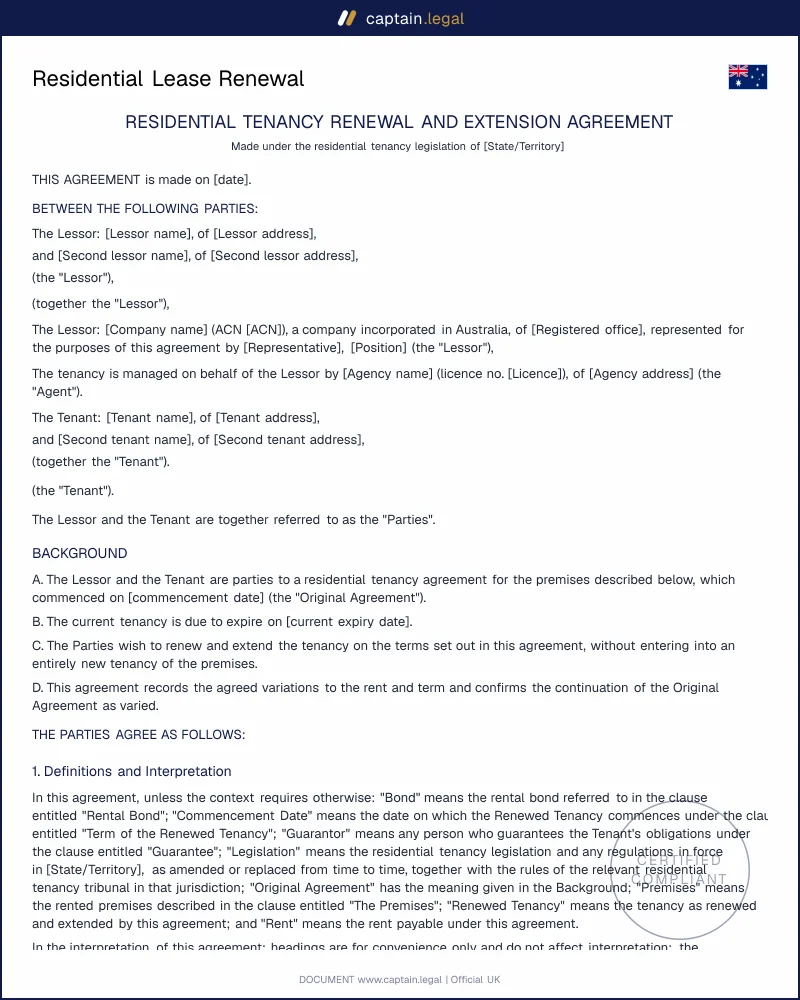
You start by selecting the state or territory where the property is located, because that choice drives the statutory references and the rent notice rules the document applies. From there you enter the details of the original tenancy, the parties' names exactly as they appear on the existing lease, the property address, and the date the current agreement was signed. The form then asks whether you are renewing into a new fixed term or extending the current end date, and it adjusts the operative wording to match your answer.

Next you set the new term dates and decide whether the rent is staying the same or changing. If you are adjusting the rent, the template prompts you to confirm the effective date and reminds you that a separate written notice is required under most state Acts, so the renewal and the notice work together rather than at cross purposes. You then record any other variations, a pet clause or a utility change for instance, before both parties sign and date. Once complete you download the finished agreement in Word and PDF, ready to sign. If your circumstances have shifted more substantially, our Australian personal and household legal documents cover the adjacent paperwork a move sometimes brings.

6

Common mistakes to avoid

The error we see most often is treating a renewal as a chance to raise rent whenever the landlord likes. It is not. The 12-month frequency cap applies across the whole tenancy relationship, and signing a fresh fixed term does not restart the clock, so a landlord who increased rent eight months ago cannot lawfully increase it again at renewal no matter what the new document says. A close second is skipping the separate written notice of increase, on the assumption that recording the higher figure in the renewal is enough. In most states it is not, and an increase served without the prescribed notice and notice period is open to challenge at the tribunal.

Another frequent slip is letting the fixed term lapse entirely before anyone signs, which drops the tenancy into a periodic arrangement and hands the tenant the shorter exit rights that come with it. Sign the renewal before the current term expires, not after. Landlords also forget to name every original party, so a renewal signed by one of two co-tenants leaves the agreement half-formed. Finally, some parties draft a renewal that quietly contradicts a mandatory term of the local Act, a shortened notice period for example, which the tribunal will simply strike out. When a full new contract is genuinely needed, the Australian business and commercial agreement templates show how a standalone document is structured.

Key takeaways

TERM TYPE

Renewal, extension, or falling periodic

A renewal signs up a new fixed term, while an extension only moves the current end date. If you do nothing before the fixed term expires, the tenancy generally rolls into a periodic tenancy on the same terms, which can create uncertainty about commitment and planning. Putting the continuation in writing avoids arguments later about what term applies.

WHAT CHANGES

Only vary what you write down

This agreement is meant to carry the existing residential tenancy agreement forward, while recording the new term and any agreed variations such as rent, utilities, pets or garden responsibilities. Anything not expressly changed is intended to stay on foot as written in the original lease. That makes accuracy key: if a clause matters, include it rather than relying on assumptions.

RENT LIMITS

Rent rises are capped yearly

Renewals and extensions must comply with the Residential Tenancies Act in the state or territory where the property is located. The big constraint at renewal is rent: across Australia, increases are limited to once every 12 months, and signing a new fixed term does not restart the clock. Notice rules also differ by state, so an increase without proper written notice can be challenged.

Frequently Asked Questions

Yes, provided it is in writing and signed by every party to the original tenancy. A renewal or extension is a variation of an existing residential tenancy agreement, and once signed it binds both landlord and tenant to the new term and any adjusted rent. Its enforceability rests on compliance with the Residential Tenancies Act of the relevant state, so the document must respect the statutory rent and notice rules rather than override them. A renewal signed by only one of several co-tenants is not cleanly binding, which is why the template requires each original party to sign before the new term begins.

It depends on your state. New South Wales and Western Australia require at least 60 days written notice, Queensland requires two calendar months, and Victoria requires 90 days following the November 2025 change. The notice is separate from the renewal document itself, so recording a higher rent in the agreement does not remove the obligation to serve a proper written notice. On top of the notice period, the increase must fall at least 12 months after the last one took effect, a limit that applies whether the tenancy is fixed or periodic.

No. Every Australian jurisdiction limits rent increases to once in any 12-month period, and this rule does not reset when a fixed term is renewed. If you renew a six-month lease, you cannot increase the rent again at the six-month renewal point because less than a year has passed since the last increase. In Queensland the 12-month limit is attached to the property rather than the tenant, so even a new tenant inherits the earlier increase date. The safest approach is to track the effective date of the last increase and count forward a full twelve months.

The tenancy does not end. In every state and territory an expiring fixed term automatically continues as a periodic tenancy on the same terms, running week to week or month to month until one party gives notice. That periodic arrangement usually carries shorter notice periods for ending the tenancy, which is often not what a landlord planning a defined new term wants. Signing a renewal before the current term expires avoids that default and keeps both parties committed to a clear fixed period.

Either works, and the right choice depends on how much is changing. A renewal or extension is quicker when the parties and premises stay the same and only the term and perhaps the rent are moving, because everything else rolls over from the original agreement. A full new lease makes sense when several terms are changing at once or when you want a clean standalone contract. Our template handles the renewal path, and the state selector adjusts the statutory wording so the continued tenancy stays compliant.

You can download the completed agreement in both Word and PDF. The Word file lets you make final adjustments before signing, which is useful if a party's details need a small correction, while the PDF is the clean version most people sign and store. Both are generated the moment you finish the form, so there is no waiting period between completing your answers and having a signature-ready document in hand.

Yes. A renewal is a natural point to vary terms the parties have agreed to change, whether that is permitting a pet, reallocating responsibility for a utility, or updating a garden maintenance clause. The template records these variations while confirming that every term you do not touch survives unchanged from the original lease. Any variation still has to sit within the mandatory terms of your state's Act, so a change that contradicts the statute will not hold even if both parties sign it.

4.8/5

28 verified reviews · 50 000+ downloads

Lease Renewal Agreement | Residential Tenancies Acts
  • Immediate access to the document
  • PDF + Word download
  • Compliant with 2026 legislation
  • Reviewed by lawyers
Fill in the template
Secure payment
Updated on July 21, 2026

You might also like

Rent Receipt Australia
Residential Tenancy Agreement Template